On this page
Chapter 7 of the rationalised NCERT Class 11 Mathematics book, Binomial Theorem, proves the theorem for positive integral indices only. Here are 28 of its key terms, most with a worked example. For solved questions, read our Binomial Theorem Class 11 guide.
General and middle terms are not in the current NCERT chapter (Reprint 2026-27), so they are left out. The CBSE 2026-27 Mathematics syllabus lists the theorem's statement and proof, Pascal's triangle and simple applications.
What do binomial, index and expansion mean?
Binomial: an algebraic expression with exactly two terms joined by + or −. Example: a + b, 2x + 3y and x − 2y are all binomials.
Index: the power to which the binomial is raised. Example: (a + b)⁷ has index 7.
Positive integral index: a positive integer 1, 2, 3, .... Counter-example: a power of 1/2 is a rational index, outside this chapter.
Expansion: a power of a binomial written as a sum of terms with no brackets. Example: (a + b)² = a² + 2ab + b².
Term: each separate product in an expansion. Example: 6a²b² is the third term of (a + b)⁴.
Coefficient of a term: the number multiplying the letters. Example: in 240x⁴y the coefficient is 240.
How does Pascal's triangle work?
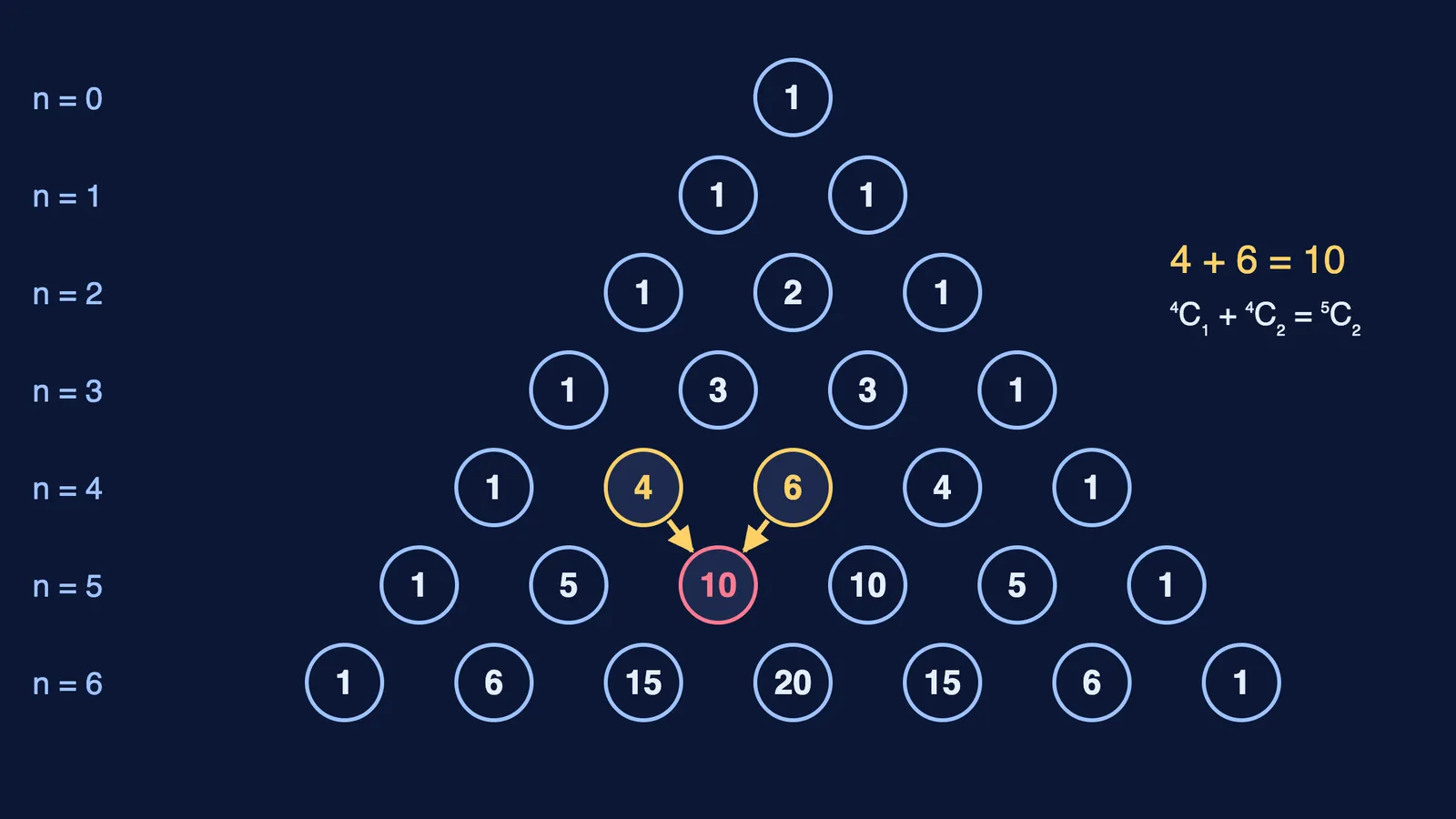
Pascal's triangle: a triangular array of the coefficients of (a + b)ⁿ, one row for each index, with 1 at the top and down both sides. Example: the row for index 4 is 1, 4, 6, 4, 1.
Row for index n: the n + 1 numbers that give the coefficients of (a + b)ⁿ. Example: the row 1, 5, 10, 10, 5, 1 gives (2x + 3y)⁵ = 32x⁵ + 240x⁴y + ... + 243y⁵.
Addition rule: each inner number is the sum of the two numbers just above it; in symbols ᵏCᵣ + ᵏCᵣ₋₁ = ᵏ⁺¹Cᵣ. Example: 4 + 6 = 10 in the row for index 5.
Meru Prastara: the triangular arrangement of these coefficients given by Pingla in his Chhanda shastra (200 B.C., per NCERT). NCERT calls Pascal's triangle similar to it.
What are binomial coefficients?
Factorial (n!): the product 1 × 2 × ... × n, with 0! = 1. Example: 5! = 120.
ⁿCᵣ: n!/(r!(n − r)!), defined for 0 ≤ r ≤ n where n is a non-negative integer. Example: ⁵C₂ = 10.
End values: ⁿC₀ = ⁿCₙ = 1, so every row starts and ends with 1.
Binomial coefficients: the numbers ⁿCᵣ that appear in the expansion of (a + b)ⁿ. Example: for index 7 they are 1, 7, 21, 35, 35, 21, 7, 1. Don't confuse with: the coefficient of a term. In (x + 2)⁶ the term ⁶C₂x⁴·2² has binomial coefficient 15 but coefficient 60.
Sigma notation: shorthand for the sum: (a + b)ⁿ = Σ ⁿCₖ aⁿ⁻ᵏ bᵏ, with k running from 0 to n.
What does the binomial theorem say?
Binomial theorem: for every positive integer n, (a + b)ⁿ = ⁿC₀aⁿ + ⁿC₁aⁿ⁻¹b + ⁿC₂aⁿ⁻²b² + ... + ⁿCₙbⁿ. Example: (x + 2)⁶ = x⁶ + 12x⁵ + 60x⁴ + ... + 64.
Number of terms: (a + b)ⁿ always has n + 1 terms. Example: (a + b)⁷ has 8 terms.
Falling and rising powers: the power of a falls by 1 from n to 0 while the power of b rises by 1 from 0 to n.
Sum of indices: in every term, the powers of a and b add up to n. Example: 10a³b² in (a + b)⁵.
Proof by mathematical induction: check P(1), then show P(k) true forces P(k + 1) true. NCERT's proof multiplies (a + b)ᵏ by (a + b) and uses the addition rule.
Which special cases and uses should you know?
Expansion of (x − y)ⁿ: put b = −y; signs alternate, ending with (−1)ⁿ ⁿCₙ yⁿ. Example: (x − 2y)⁵ = x⁵ − 10x⁴y + 40x³y² − ... − 32y⁵.
Expansion of (1 + x)ⁿ: put a = 1 and b = x to get ⁿC₀ + ⁿC₁x + ⁿC₂x² + ... + ⁿCₙxⁿ.
Sum of binomial coefficients: x = 1 in (1 + x)ⁿ gives ⁿC₀ + ⁿC₁ + ... + ⁿCₙ = 2ⁿ. Example: 1 + 4 + 6 + 4 + 1 = 16.
Alternating sum: x = 1 in (1 − x)ⁿ gives ⁿC₀ − ⁿC₁ + ⁿC₂ − ... + (−1)ⁿ ⁿCₙ = 0. Example: 1 − 4 + 6 − 4 + 1 = 0.
Evaluating a power by splitting: write the number as a sum or difference of easy numbers. Example: 98⁵ = (100 − 2)⁵ = 9039207968.
Comparing numbers: keep the first terms; the rest are positive. Example: (1.01)¹⁰⁰⁰⁰⁰⁰ = 1 + 10000 + other positive terms, so it is larger than 10000.
Remainder and divisibility: writing a = bq + r shows that dividing a by b gives quotient q and remainder r. Example: 6ⁿ − 5n = 1 + 25k, so the remainder on dividing by 25 is 1.
Approximation by first terms: when the second number is small, the first few terms are close. Example: (0.99)⁵ = (1 − 0.01)⁵ ≈ 1 − 0.05 + 0.001 = 0.951, against an exact value of 0.95099...
How to learn these terms
Write rows 0 to 7 of Pascal's triangle from memory, then rewrite row 7 as ⁷C₀ to ⁷C₇.
Learn look-alike pairs together: binomial coefficient versus coefficient, sum 2ⁿ versus alternating sum 0.
Test every expansion: count n + 1 terms, check the powers add to n, and put the letters equal to 1. For (2x + 3y)⁵ the coefficients must add to 5⁵ = 3125.
Copy NCERT's induction proof by hand and circle where the addition rule is used.
Decide the split before expanding: 98 = 100 − 2, 0.99 = 1 − 0.01, 6 = 1 + 5.
If ⁿCᵣ itself feels shaky, revise our Permutations and Combinations Class 11 guide or the Fermi Concept Library, where every concept in mathematics has its own lesson and its place in the map. For JEE, our binomial theorem guide for JEE adds general and middle terms.