On this page
Every question stays inside the Atomic Structure unit of the official JEE (Advanced) 2026 syllabus, which includes wave function and probability density "plots only". Data come from NCERT Class 11 Chemistry Part I, Unit 2 (Reprint 2026-27): R = 109,677 cm⁻¹, rₙ = 52.9 n²/Z pm and Eₙ = −2.18 × 10⁻¹⁸ Z²/n² J, about −13.6 Z²/n² eV. For the chapter plan, read how to prepare atomic structure for JEE Advanced.
How should you use this practice set?
Cover the solutions. In a "one or more options correct" question, judge each option on its own. Our guide to JEE Advanced question types explains the formats.
Easy: can you read orbitals and configurations?
Q1 (easy, one or more options correct). Which statements are correct?
(A) In a hydrogen atom, an electron in 4f has the same energy as one in 4s. (B) A 3p orbital has two radial nodes. (C) For a 2s orbital, ψ² falls to zero at one finite distance from the nucleus. (D) The xy-plane is a nodal plane of the dxy orbital.
Answer: (A), (C). In hydrogen, energy depends only on n, so 4s = 4p = 4d = 4f. Radial nodes are n − l − 1, so 3p has one. The 2s ψ² curve drops to zero once. (D) fails: dxy's lobes lie in the xy-plane, between the axes; its two nodal planes are xz and yz. Trap: (D), because of the label.
Q2 (easy, numerical-value). How many electrons in a ground-state chromium atom (Z = 24) have n + l = 4?
Answer: 7. NCERT gives Cr as [Ar]3d⁵4s¹ (half-filled d subshell). Orbitals with n + l = 4 are 3p (3 + 1) and 4s (4 + 0): 6 + 1 = 7. Trap: plain Aufbau filling, 3d⁴4s², gives 8.
Q3 (easy, single-correct). In a hydrogen atom, how many orbitals have the same energy as a 4d orbital and at least two radial nodes?
(A) 4 (B) 9 (C) 16 (D) 1
Answer: (A). All 16 n = 4 orbitals of hydrogen share one energy. Radial nodes are n − l − 1: 4s has 3, 4p has 2, 4d has 1, 4f has 0. So 4s and three 4p orbitals qualify: 4. Trap: (B) counts radial nodes as n − l (adding 4d); (C) ignores the node condition; (D) assumes only s orbitals have radial nodes.
Medium: can you link spectra, uncertainty and configurations?
Q4 (medium, one or more options correct). A sample of He⁺ ions is excited to n = 4 and returns to the ground state. Using R = 109,677 cm⁻¹ with Z² scaling, which statements are correct?
(A) Six different emission lines are possible. (B) The longest-wavelength line lies in the visible region (400 to 750 nm). (C) The 3 → 2 line lies in the visible region. (D) The shortest wavelength emitted is 22.8 nm.
Answer: (A), (B). Levels 1 to 4 give 6 transitions. The longest is 4 → 3: 1/λ = 4R(1/9 − 1/16) = 7R/36, so λ = 469 nm (visible). (C) fails: Z² = 4 moves 3 → 2 from hydrogen's 656 nm to 164 nm (ultraviolet). The shortest line, 4 → 1, is 24.3 nm. Trap: (D) is the He⁺ series limit, a fall from infinity.
Q5 (medium, numerical-value). Suppose the electron in hydrogen's first Bohr orbit is located only to within the orbit's diameter, Δx = 2a₀. Using Δx · mΔv ≥ h/4π and Bohr's condition mvr = nh/2π, find the minimum Δv divided by the orbital speed v.
Answer: 0.25. Δv = h/(8πma₀), and Bohr gives v = h/(2πma₀) for n = 1, so the ratio is 1/4: the speed is too uncertain for a sharp orbit (see where the Bohr model breaks). Trap: 0.5 comes from taking Δx = a₀ or using h/2π.
Q6 (medium, list-match). Match each ion in List-I with its number of unpaired electrons in List-II.
List-I: (P) Mn²⁺ (Z = 25) (Q) Cu²⁺ (Z = 29) (R) Zn²⁺ (Z = 30) (S) V³⁺ (Z = 23)
List-II: (1) 0 (2) 1 (3) 2 (4) 3 (5) 5
(A) P→5, Q→4, R→1, S→3 (B) P→5, Q→2, R→1, S→3 (C) P→4, Q→4, R→3, S→1 (D) P→5, Q→2, R→3, S→1
Answer: (B). Remove 4s electrons first. Mn²⁺ is 3d⁵ (5 unpaired), Cu²⁺ 3d⁹ (1), Zn²⁺ 3d¹⁰ (0), V³⁺ 3d² (2, by Hund's rule). Trap: (C) removes 3d electrons first (Mn²⁺ as 3d³4s², V³⁺ as 4s²); (A) makes that slip for copper alone.
Hard: can you chain two ideas in one question?
Q7 (hard, single-correct). An electron in a hydrogen-like ion has total energy −6.04 eV and orbital angular momentum 3h/π. Taking Eₙ = −13.6 Z²/n² eV and rₙ = 52.9 n²/Z pm, its orbit radius is
(A) 238 pm (B) 79.4 pm (C) 1904 pm (D) 476 pm
Answer: (D). 3h/π = 6 × h/2π, so n = 6. Then 13.6 Z²/36 = 6.04 gives Z² = 16, Z = 4: the ion is Be³⁺. r = 52.9 × 36/4 = 476 pm. Trap: (A) uses energy alone (Z/n = 2/3 also fits He⁺ at n = 3) or reads 3h/π as n = 3. (B) uses n/Z; (C) forgets Z.
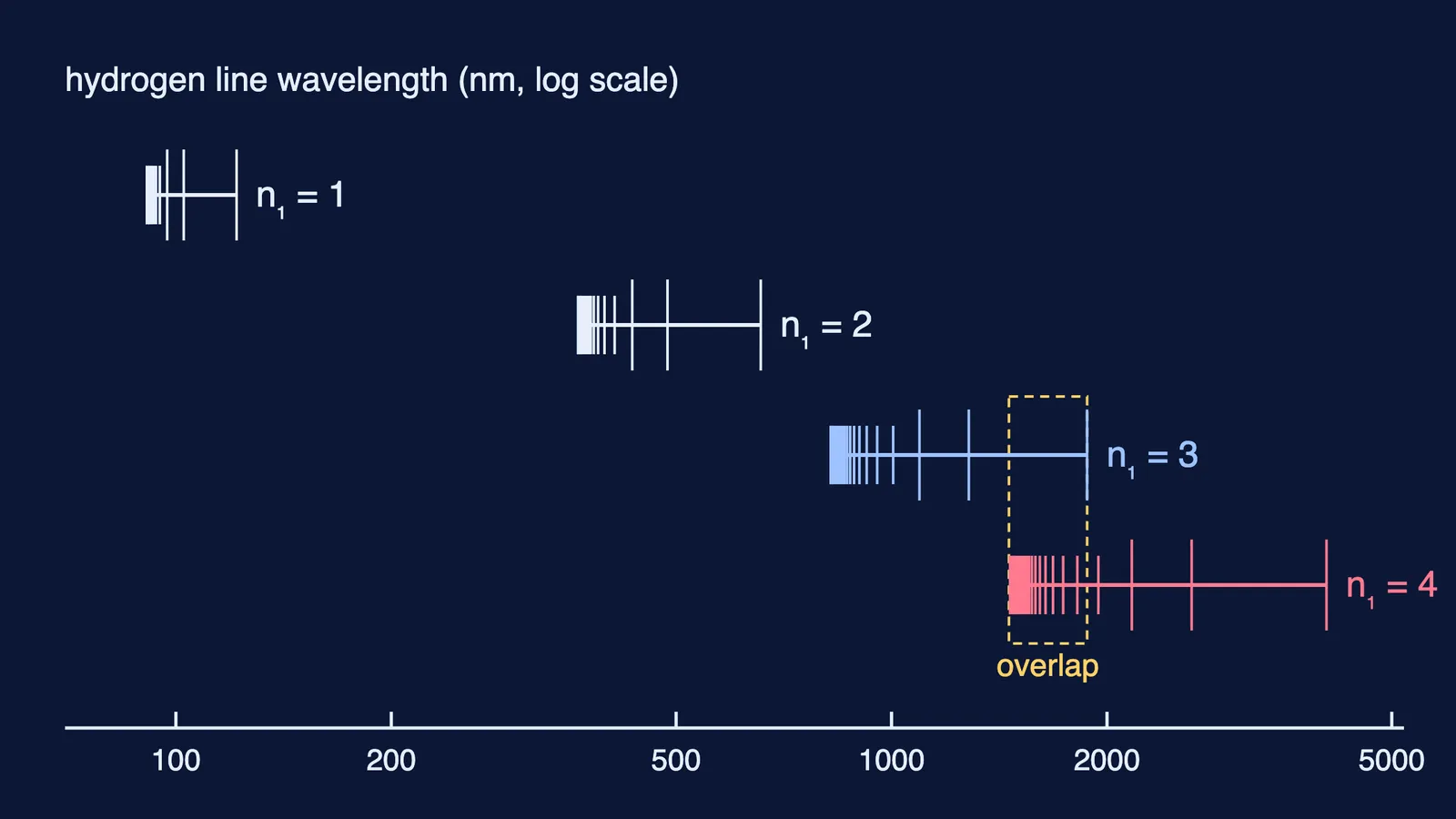
Q8 (hard, numerical-value). In hydrogen, call a series the set of lines that end on level n₁. What is the smallest n₁ whose series overlaps in wavelength with the series ending on n₁ + 1?
Answer: 3. A series runs from its limit, n₁²/R, to its longest line, n₁²(n₁ + 1)²/[(2n₁ + 1)R]. It overlaps the next series when its longest line exceeds the next limit, (n₁ + 1)²/R. That needs n₁² > 2n₁ + 1, so n₁ > 1 + √2 ≈ 2.41, and the first whole number is 3. The image at the top shows this overlap. Trap: 2 compares only the first lines of each series; Balmer ends at 656 nm, below Paschen's 820 nm limit.
What should you do after this set?
Orbital slips (Q1, Q3): write n − l − 1 and l first.
Configuration slips (Q2, Q6): write the neutral atom, with the Cr and Cu exceptions.
Bohr slips (Q4, Q5, Q7, Q8): write Z, n and the scaling before any number.
For concept gaps, the Fermi Concept Library covers every concept in physics, chemistry, biology, mathematics and computing, each with its own lesson.