On this page
One JEE Advanced atomic structure question can start with a spectral line and end with the electron's wavelength. Below: the official topics, two worked examples and a plan.
What does the JEE Advanced syllabus include in atomic structure?
The official JEE (Advanced) 2026 Syllabus says it is unchanged from 2025. Its Atomic Structure unit reads: "Bohr model, spectrum of hydrogen atom; Wave-particle duality, de Broglie hypothesis; Uncertainty principle; Qualitative quantum mechanical picture of hydrogen atom: Energies, quantum numbers, wave function and probability density (plots only), shapes of s, p and d orbitals; Aufbau principle; Pauli's exclusion principle and Hund's rule."
The 2027 syllabus is not published yet (as of 19 November 2026). The JEE (Advanced) 2027 website says the exam is on 23 May 2027 (Sunday), organised by IIT Delhi; eligibility includes a place in the top 2,50,000 of the JEE (Main) 2027 B.E./B.Tech. paper (eligibility criteria).
How is JEE Advanced atomic structure different from JEE Main?
Now read Unit 2 of the NTA's Syllabus for JEE (Main) - 2027. JEE Advanced names no topic that unit leaves out, but two differences matter:
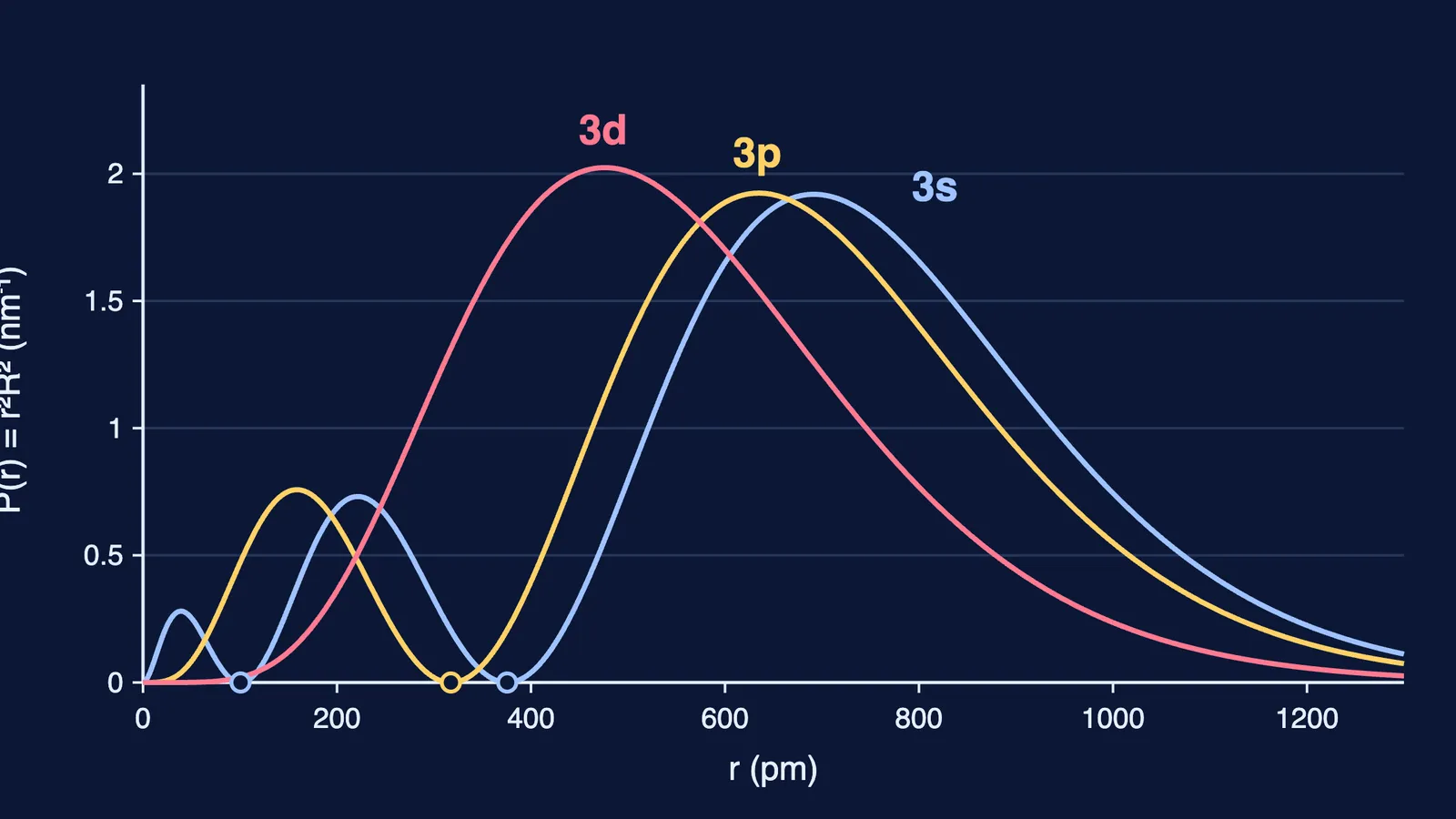
JEE Main names ψ and ψ² against r for 1s and 2s; JEE Advanced sets no orbital limit on its plots, so practise 3s, 3p and 3d.
The JEE Advanced Physics syllabus also lists "Bohr's theory of hydrogen-like atoms", so expect ions such as He⁺ and Li²⁺.
So the step up is depth and question style. Keep the basics from our Structure of Atom guide for JEE Main. JEE (Advanced) 2026 had two compulsory papers of three hours each, with marking details given in the paper's instructions at exam time (2026 Information Brochure), so do not rely on a fixed pattern. Our post on JEE Advanced question types explains multiple-correct and numerical-answer questions.
Worked example 1: how do the spectrum, Bohr radius and de Broglie wavelength connect?
A hydrogen-like ion emits a 142.5 nm photon when its electron falls from n = 5 to n = 3. Find Z, the n = 3 radius and the electron's de Broglie wavelength there. Use R_H = 109,677 cm⁻¹ and a₀ = 52.9 pm from NCERT Class 11 Chemistry, Unit 2.
1/λ = R_H Z² (1/9 − 1/25) = R_H Z² × 16/225.
1/λ = 70,175 cm⁻¹, so Z² = 70,175 × 225 / (16 × 109,677) = 9.00. Z = 3: the ion is Li²⁺.
Radius: r₃ = 52.9 × n²/Z = 52.9 × 9/3 = 158.7 pm.
Three wavelengths fit the orbit: 3λ = 2πr₃, so λ = 332 pm.
Check the limits. With Z = 1 the same jump gives 1282 nm, hydrogen's Paschen line. Speed goes as Z/n, so this electron matches hydrogen's ground-state speed, and h/(mv) also gives 332 pm.
Worked example 2: how do you read a probability plot?
A hydrogen orbital has two nodes in all and two peaks in its radial probability curve. Which statements are correct?
(A) Its energy is −1.51 eV.
(B) It has one planar angular node.
(C) Its radial probability is zero at r = 6a₀.
(D) In hydrogen it lies below 3d in energy.
Total nodes n − 1 = 2 give n = 3. Two peaks mean one radial node, so l = 1: a 3p orbital (gold curve in the image above). Using NCERT values, E = −2.18 × 10⁻¹⁸ J/9 = −2.42 × 10⁻¹⁹ J = −1.51 eV: (A) holds. Angular nodes = l = 1: (B) holds. The 3p radial function has a factor (6 − r/a₀), so its node is at 6a₀ = 317 pm: (C) holds. Hydrogen's energy depends only on n, so 3p and 3d are degenerate: (D) is false. Answer: A, B, C. The Aufbau order 3s < 3p < 3d holds only in many-electron atoms.
Finding nodes hard to picture? The Fermi Simulation Lab has interactive simulations for the ideas that are easier to see than to read.
How should you practise atomic structure for JEE Advanced?
Two weeks, an hour a day:
Days 1-3: Bohr model for hydrogen-like ions.
Days 4-6: spectral series and counting lines.
Days 7-8: de Broglie wavelength and the uncertainty principle.
Days 9-11: quantum numbers, nodes and reading probability plots.
Days 12-14: Aufbau, Pauli and Hund in mixed timed sets; log the failed step for each miss.
Try these original questions (h = 6.626 × 10⁻³⁴ J s and electron mass 9.109 × 10⁻³¹ kg, from the NCERT unit above; Δx·Δp ≥ h/4π):
An electron's speed is 3.00 × 10⁵ m s⁻¹ ± 0.50%. Find the minimum Δx and the de Broglie wavelength. Answer: Δx ≈ 38.6 nm, λ ≈ 2.42 nm.
How many electrons in a ground-state Mn atom (Z = 25) have m_l = 0? Answer: 13.
Excited He⁺ ions emit exactly three lines ending on n = 4. Find the highest level reached and the longest wavelength. Answer: n = 7; about 1013 nm.