On this page
Most slips in this chapter come from a true fact used as the wrong reason, or a radian read as a degree. These 10 original questions target both.
What do these questions cover?
Every item stays inside the CBSE 2026-27 Mathematics curriculum for Class XI, which lists general solutions of trigonometric equations among Class XI topics assessed only formatively, so none appear here.
Facts were checked against the NCERT chapter Trigonometric Functions (Reprint 2026-27); every number was checked by script. This is practice, not an exam paper. For theory and proofs, see our Trigonometric Functions Class 11 guide.
How do you answer assertion-reason questions?
Judge each statement alone first. If both are true, ask whether "A, because R" holds. See our assertion-reason strategy guide.
Keys for Q1 to Q6:
(A) Both A and R are true and R is the correct explanation of A.
(B) Both A and R are true but R is NOT the correct explanation of A.
(C) A is true but R is false.
(D) A is false but R is true.
Keys for Q7 to Q10:
(A) Both statements are correct.
(B) Both statements are incorrect.
(C) Statement I is correct, Statement II is incorrect.
(D) Statement I is incorrect, Statement II is correct.
Assertion-reason questions with answers
Q1 (easy). Assertion (A): In a circle of radius 8 cm, an arc of length 20 cm subtends an angle of 2.5 radian at the centre. Reason (R): If an arc of length l subtends θ radian at the centre of a circle of radius r, then l = rθ.
Answer: (A). R is NCERT's arc-length relation, and θ = l/r = 20/8 = 2.5 radian follows from it.
Trap: dividing r by l.
Q2 (easy). Assertion (A): sin 4 > 0. Reason (R): sin x is positive for 0 < x < π.
Answer: (D). R is true, but 4 radian (about 229°) lies between π and 3π/2, in the third quadrant, where sine is negative: sin 4 is about −0.76.
Trap: reading 4 as 4°.
Q3 (medium). Assertion (A): cos 1° > cos 1. Reason (R): 1 radian is a smaller angle than 1°.
Answer: (C). A is true: cos 1° is about 0.9998, while cos 1 is about 0.54. R is false: π radian = 180°, so 1 radian is about 57° 16′. Cosine decreases across the first quadrant, and 1° is the smaller angle.
Trap: thinking a radian is smaller than a degree.
Q4 (medium). Assertion (A): tan (π + x) = tan x for every x that is not an odd multiple of π/2. Reason (R): sin (2π + x) = sin x and cos (2π + x) = cos x.
Answer: (B). Both are true, but R only gives a repeat after 2π. A holds because sin (π + x) = −sin x and cos (π + x) = −cos x, so the two minus signs cancel in the ratio.
Trap: accepting any true periodicity fact as the reason.
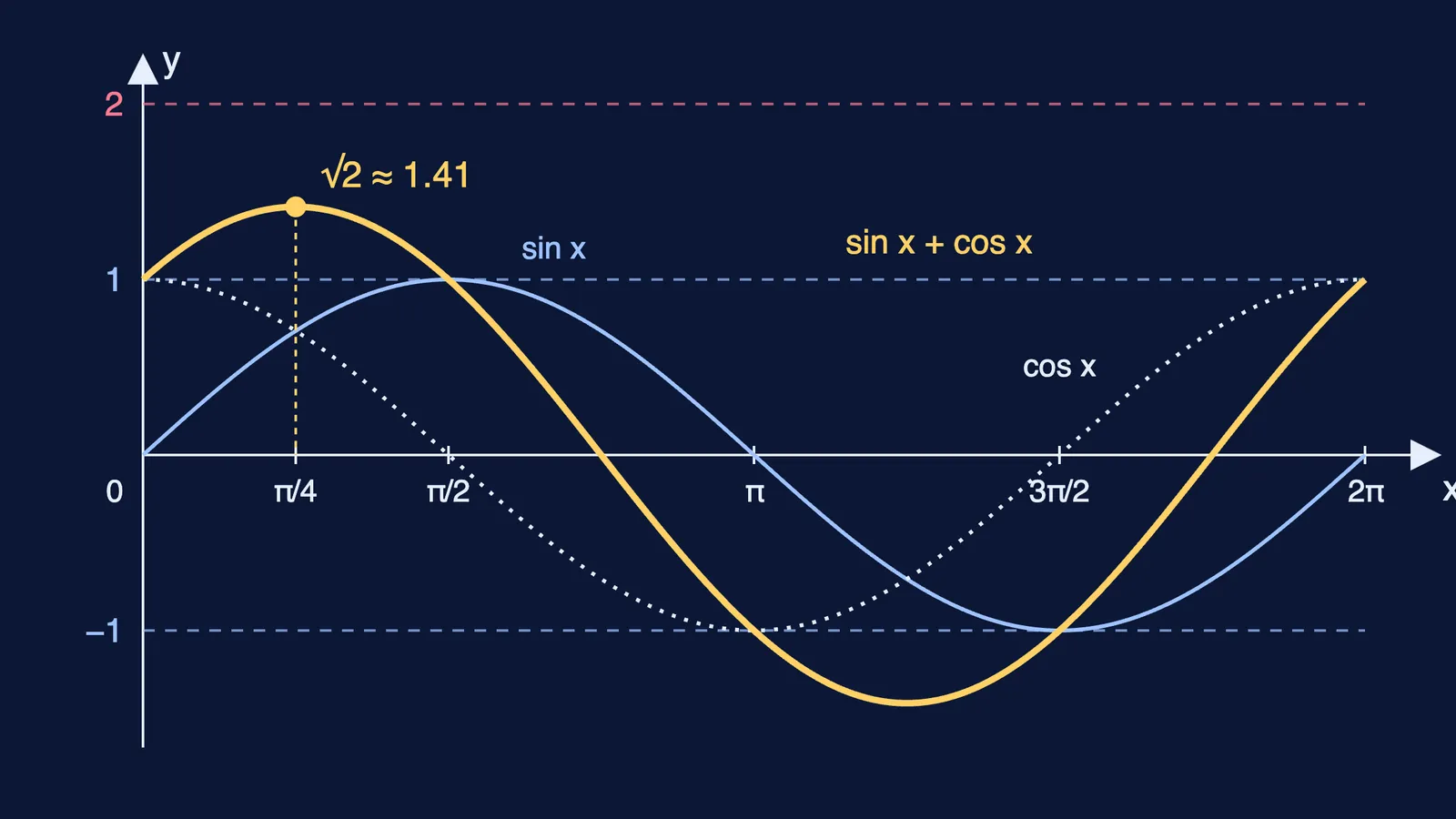
Q5 (hard). Assertion (A): The greatest value of sin x + cos x is 2. Reason (R): The greatest value of sin x is 1 and the greatest value of cos x is 1.
Answer: (D). R is true, but sin x = 1 at π/2, where cos x = 0. By the sin (x + y) formula, sin x + cos x = √2 sin (x + π/4), so the greatest value is √2, about 1.41, at x = π/4.
Trap: adding two maxima reached at different angles.
Q6 (hard). Assertion (A): If x − y = π/4, then (1 + tan x)(1 − tan y) = 2, wherever tan x and tan y are defined. Reason (R): tan (x − y) = (tan x − tan y)/(1 + tan x tan y) when none of x, y and x − y is an odd multiple of π/2.
Answer: (A). Since tan (π/4) = 1, R gives tan x − tan y = 1 + tan x tan y. So (1 + tan x)(1 − tan y) = 1 + (tan x − tan y) − tan x tan y = 1 + 1 = 2.
Trap: using the tan (x + y) denominator, 1 − tan x tan y.
Statement I and II questions with answers
Q7 (easy). Statement I: The domain of cot x is all real x except integer multiples of π. Statement II: The range of tan x is [−1, 1].
Answer: (C). cot x = cos x/sin x needs sin x ≠ 0, so I is correct. tan x takes every real value, so II is incorrect.
Trap: copying the range of sin x onto tan x.
Q8 (medium). Statement I: cos x increases as x increases from π/2 to π. Statement II: As x increases from π to 3π/2, tan x increases from 0 and takes arbitrarily large positive values.
Answer: (D). In the second quadrant cos x decreases from 0 to −1, so I is incorrect. II matches NCERT's table for the third quadrant.
Trap: thinking "moving towards −1" is increasing.
Q9 (medium). Statement I: If tan x = 2, then cos 2x = −3/5. Statement II: If sin x = 1/2, then sin 3x = 1.
Answer: (A). cos 2x = (1 − tan² x)/(1 + tan² x) = (1 − 4)/(1 + 4) = −3/5. sin 3x = 3 sin x − 4 sin³ x = 3/2 − 1/2 = 1, whichever angle has sin x = 1/2.
Trap: worrying about which x it is.
Q10 (hard). Statement I: cos 15° − sin 15° = 1/2. Statement II: sin 2x = 2 tan x/(1 − tan² x).
Answer: (B). cos 15° − sin 15° = √2 cos (15° + 45°) = √2 × 1/2 = 1/√2, about 0.707, so I is incorrect. II is incorrect: sin 2x = 2 tan x/(1 + tan² x); the given form is tan 2x.
Trap: swapping the two denominators.
How should you use this set?
Attempt all ten in 15 minutes.
Label each miss: wrong fact, wrong sign or wrong link.
Redo the misses two days later.
For more sign practice, see trigonometric ratios of allied angles in Class 11. If Q5 or Q6 tripped you, the Fermi Problem Library has worked problems with a step-by-step solver that explains the reasoning rather than printing an answer.