

On this page
These 10 original questions, six assertion-reason and four Statement I/II, run easy to hard. Every statement was checked against the NCERT Class 11 chapters on Thermodynamics and Kinetic Theory (Reprint 2026-27); both are in the NMC's updated NEET (UG)-2026 syllabus. New to the unit? Start with our guide on how to prepare Thermodynamics for NEET.
How do you answer assertion-reason and Statement I/II questions?
For assertion-reason items, run three checks in order:
Is the Assertion (A) true? Watch words like "all" and "complete".
Is the Reason (R) true? Check every factor, power and count.
If both are true, test "A, because R". Pick (A) only if R is the direct cause NCERT gives.
Assertion-reason key, used for Q1 to Q6:
(A) Both A and R are true and R is the correct explanation of A.
(B) Both A and R are true but R is NOT the correct explanation of A.
(C) A is true but R is false.
(D) A is false but R is true.
Statement pair key, used for Q7 to Q10:
(A) Both statements are correct.
(B) Both statements are incorrect.
(C) Statement I is correct, Statement II is incorrect.
(D) Statement I is incorrect, Statement II is correct.
Assertion-reason questions: can you find the real cause?
Q1 (easy). Assertion (A): When an ideal gas expands isothermally, all the heat it absorbs is used to do work on the surroundings. Reason (R): The internal energy of an ideal gas depends only on its temperature.
Answer: (A). R is the reason: with T fixed, ΔU = 0, so Q = W. Trap: thinking heat in must raise internal energy.
Q2 (easy). Assertion (A): At the same temperature, hydrogen molecules have a greater rms speed than oxygen molecules. Reason (R): At a given temperature, the average kinetic energy of a molecule is the same for every ideal gas.
Answer: (A). R explains A: equal average kinetic energy (3/2)k_BT with a smaller mass means a larger speed. Trap: ignoring mass.
Q3 (medium). Assertion (A): The mean free path of the molecules in a gas decreases when the number of molecules per unit volume increases. Reason (R): The mean free path is directly proportional to the diameter of the molecules.
Answer: (C). A is true: NCERT gives l = 1/(nπd²). R is false: l is inversely proportional to d², since bigger molecules collide more often. Trap: knowing d is in the formula but not where.
Q4 (medium). Assertion (A): A heat engine with no friction, working in a cycle, can convert all the heat it takes from a hot reservoir into work. Reason (R): No process is possible whose sole result is the absorption of heat from a reservoir and its complete conversion into work.
Answer: (D). A is false; R, the Kelvin-Planck statement, is true. Without friction an engine must still reject some heat to a colder body. Trap: treating friction as the only loss.
Q5 (medium). Assertion (A): An ideal gas cools when it expands adiabatically. Reason (R): For an ideal gas, Cp − Cv = R.
Answer: (B). Both are true, but the gas cools because Q = 0, so its work comes out of internal energy, lowering T. Trap: a correct formula from the same chapter looks like a reason.
Q6 (hard). Assertion (A): For a diatomic gas whose molecules behave as rigid rotators, γ = Cp/Cv = 7/5. Reason (R): Such a molecule has three translational and three rotational degrees of freedom.
Answer: (C). A is true: 5 degrees of freedom give Cv = (5/2)R, Cp = (7/2)R, γ = 7/5. R is false: NCERT counts only 2 rotational degrees of freedom; with 6 in all, γ would be 4/3. Trap: using the polyatomic count.
Statement I and Statement II questions: which half is wrong?
Q7 (easy). Statement I: Like temperature, heat is a state variable of a system. Statement II: In an isochoric process, part of the heat absorbed by a gas is used to do work.
Answer: (B). Heat and work are not state variables. At constant volume no work is done, so all the heat goes into internal energy. Trap: confusing heat with internal energy.
Q8 (medium). Statement I: Because a gas does net work in a cyclic process, its internal energy at the end of the cycle is lower than at the start. Statement II: In a cyclic process, the total heat absorbed by the system equals the work done by it.
Answer: (D). Statement I is incorrect: the system returns to its initial state, so ΔU = 0. Statement II follows from the first law. Trap: carrying over the adiabatic idea that work uses up internal energy.
Q9 (medium). Statement I: If the absolute temperature of an ideal gas is made four times, the rms speed of its molecules doubles. Statement II: If the pressure of an ideal gas is doubled at constant temperature, the rms speed of its molecules increases by a factor of √2.
Answer: (C). v_rms = √(3k_BT/m), so 4T gives 2v_rms. At fixed T, average kinetic energy does not depend on pressure. Trap: using √(3P/ρ) and forgetting ρ doubles too.
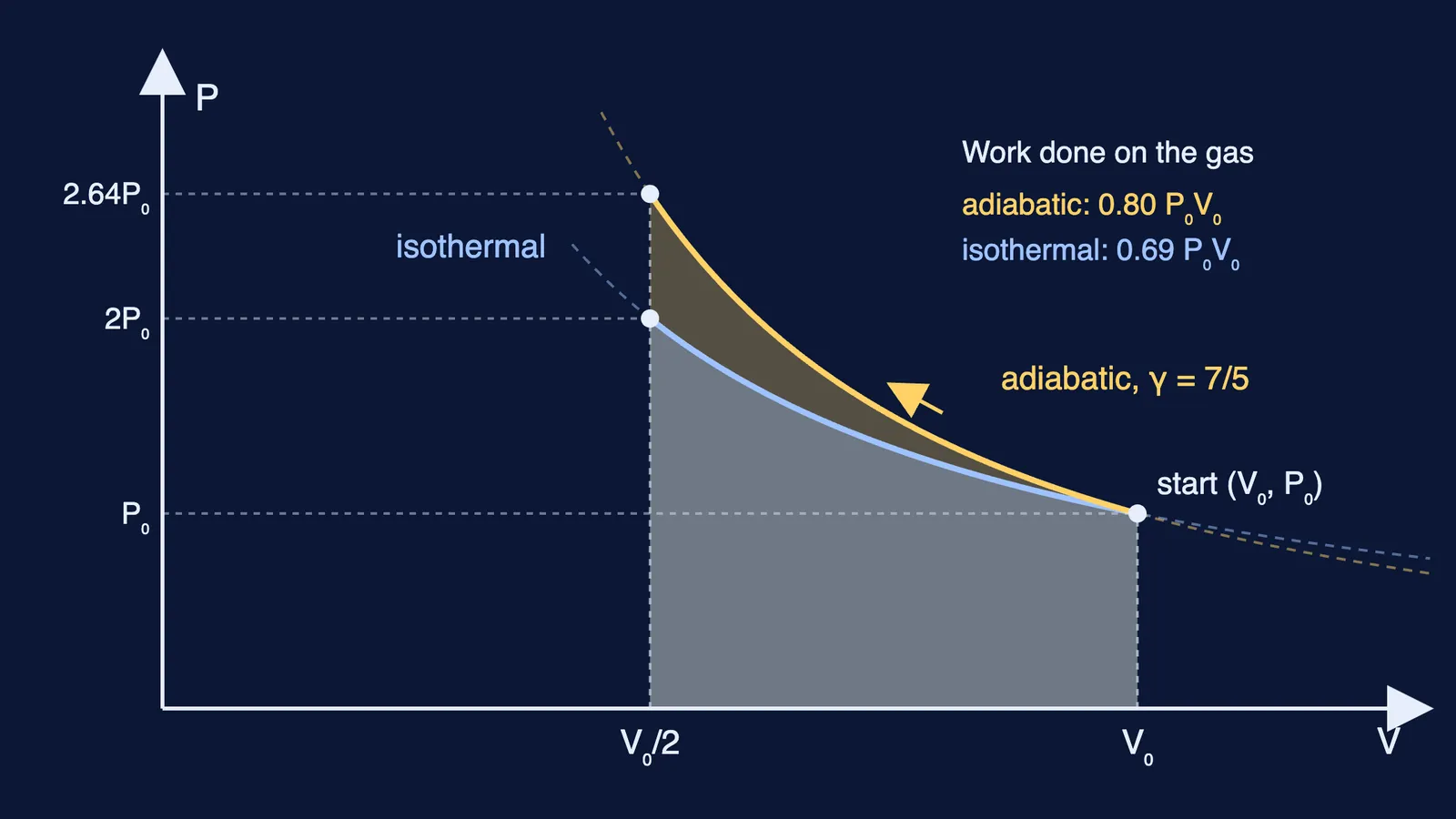
Q10 (hard). Statement I: When 2 mol of an ideal gas at 300 K expands isothermally and reversibly from 10 L to 20 L, it does about 3.46 kJ of work. Statement II: Starting from the same state, compressing an ideal gas reversibly to half its volume takes more work when done adiabatically than when done isothermally.
Answer: (A). W = μRT ln(V2/V1) = 2 × 8.314 × 300 × ln 2 ≈ 3,458 J. Adiabatic compression heats the gas, so pressure climbs faster and the area under the curve is larger: about 0.80 P₀V₀ against 0.69 P₀V₀ for γ = 7/5 (diagram above). Trap: using log base 10, which gives about 1.5 kJ.
How should you use this set?
Cover each answer, mark your key, then check.
For every miss, note which check failed: A, R or the link.
Redo missed items two days later.
For the second chapter, see how to prepare Kinetic Theory of Gases for NEET, and our assertion-reason question strategy for other subjects.
If P-V curves feel abstract, the Fermi Simulation Lab has interactive simulations for the ideas that are easier to see than to read.


