On this page
Most slips here come from carrying a shift or scale into the wrong measure, or picking a true fact as the reason. These 10 original questions target both.
What do these Statistics questions cover?
Treat these as practice. Every item stays inside the Statistics topic of the CBSE 2026-27 Class XI Mathematics curriculum, which lists range, mean deviation, variance and standard deviation, and was checked against Chapter 13 of NCERT Class 11 Mathematics, Reprint 2026-27. For formulas and worked examples, see our Statistics Class 11 Maths guide to mean deviation, variance and SD.
How do you answer assertion-reason questions?
Judge each statement alone. If both are true, ask whether "A, because R" holds, as our assertion-reason strategy guide explains.
Keys for Q1 to Q6:
(A) Both A and R are true and R is the correct explanation of A.
(B) Both A and R are true but R is NOT the correct explanation of A.
(C) A is true but R is false.
(D) A is false but R is true.
Keys for Q7 to Q10:
(A) Both statements are correct.
(B) Both statements are incorrect.
(C) Statement I is correct, Statement II is incorrect.
(D) Statement I is incorrect, Statement II is correct.
Assertion-reason questions on Statistics with answers
Q1 (easy). Assertion (A): The range of the data 14, 3, 22, 9, 17 is 19. Reason (R): Range = maximum value − minimum value.
Answer: (A). R gives 22 − 3 = 19 directly.
Trap: subtracting the first value from the last.
Q2 (easy). Assertion (A): For any data, the sum of the deviations of the observations from their mean is zero. Reason (R): The mean deviation about the mean of any data is zero.
Answer: (C). A is true, as NCERT states. R is false: mean deviation uses the absolute values of the deviations, so it is zero only when every observation equals the mean.
Trap: forgetting the modulus signs in M.D. = Σ|xᵢ − x̄| ÷ n.
Q3 (medium). Assertion (A): If heights are measured in centimetres, their variance is in square centimetres. Reason (R): Variance is the mean of the squares of the deviations from the mean.
Answer: (A). Squaring each deviation squares its unit; NCERT takes the positive square root to return to centimetres.
Trap: writing the variance in cm because the data are in cm.
Q4 (medium). Assertion (A): If 5 is added to every observation, the standard deviation also increases by 5. Reason (R): If 5 is added to every observation, the mean increases by 5.
Answer: (D). R is true. A is false: each xᵢ − x̄ is unchanged, so the standard deviation stays the same.
Trap: assuming every measure moves with the data.
Q5 (medium). Assertion (A): If every observation is multiplied by −2, the standard deviation is multiplied by 2. Reason (R): If every observation is multiplied by −2, the median is multiplied by −2.
Answer: (B). Both are true, but A holds because every deviation is multiplied by −2, so the variance is multiplied by (−2)² = 4 and its positive square root by 2. R is about the median, which plays no part in the standard deviation.
Trap: answering −2; a standard deviation is never negative.
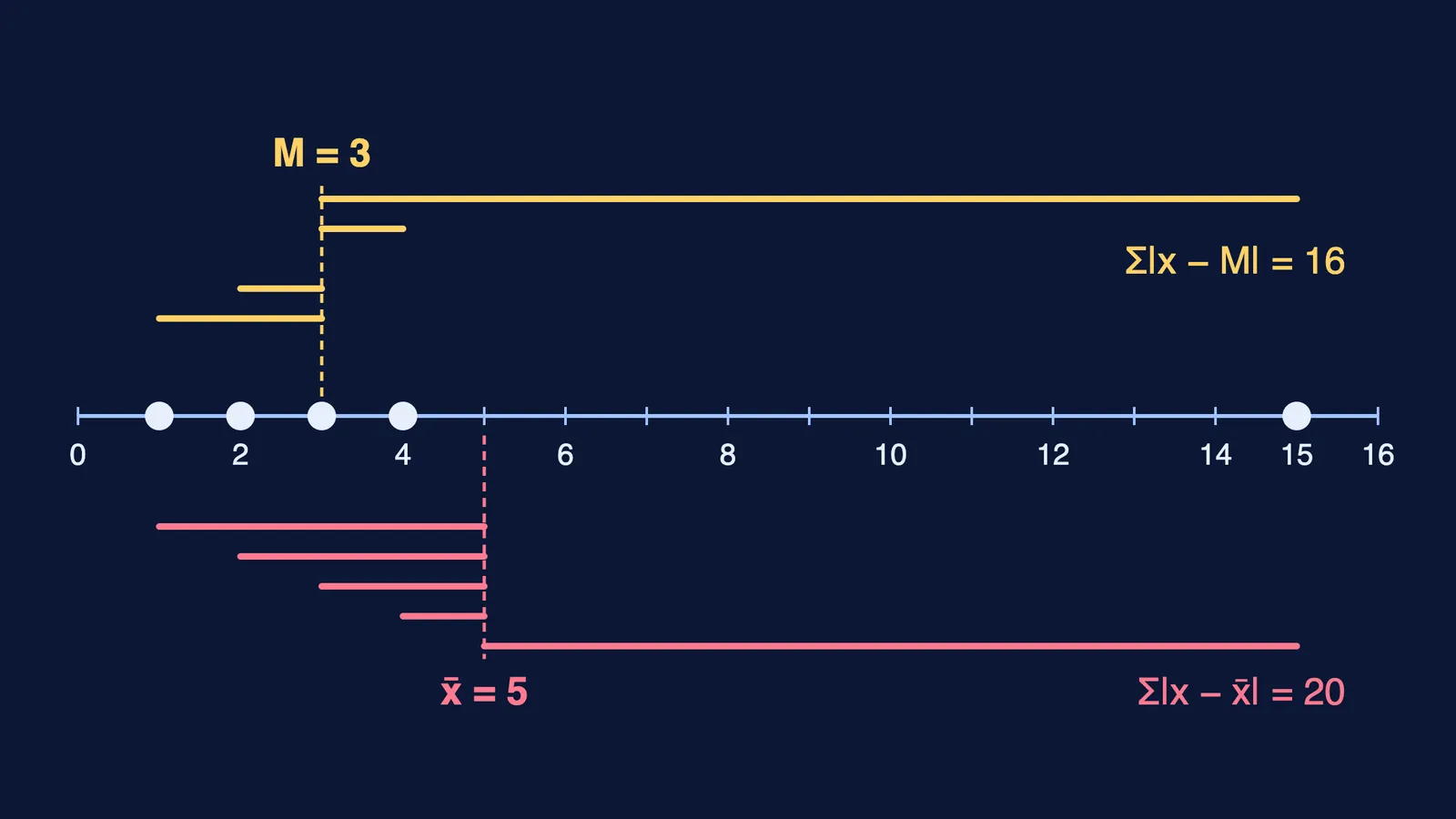
Q6 (hard). Assertion (A): For the data 1, 2, 3, 4, 15, the mean deviation about the median is smaller than the mean deviation about the mean. Reason (R): The sum of the absolute deviations of a set of observations is least when they are taken about the median.
Answer: (A). Median = 3 and mean = 5. Σ|xᵢ − 3| = 16 and Σ|xᵢ − 5| = 20, so M.D.(M) = 3.2 and M.D.(x̄) = 4, as the chart above shows. R is exactly why.
Trap: assuming the mean always gives the smallest deviation.
Statement I and II questions on Statistics with answers
Q7 (easy). Statement I: The range uses only the largest and the smallest observations. Statement II: Two data sets with the same mean must have the same standard deviation.
Answer: (C). I is correct. II is incorrect: 5, 5 and 0, 10 both have mean 5, but standard deviations 0 and 5.
Trap: reading equal averages as equal spread.
Q8 (medium). Statement I: The standard deviation of 1, 2, 3, 4, 5 is 2. Statement II: The variance of 10, 20, 30, 40, 50 is 200.
Answer: (D). I is incorrect: the mean is 3, Σ(xᵢ − 3)² = 10, so the variance is 10 ÷ 5 = 2 and the standard deviation is √2. II is correct: multiplying by 10 multiplies the variance by 10² = 100.
Trap: stopping at the variance and calling it the standard deviation.
Q9 (hard). Classes 0–10, 10–20, 20–30 and 30–40 have frequencies 2, 3, 3 and 2. With A = 25 and h = 10, the step deviations are −2, −1, 0 and 1, so ȳ = −0.5 and the variance of y is 1.05. Statement I: The mean is 25 − 0.5 = 24.5. Statement II: The variance of the data is 10 × 1.05 = 10.5.
Answer: (B). Both are incorrect. NCERT's shortcut gives x̄ = A + hȳ = 25 − 5 = 20 and σₓ² = h²σᵧ² = 100 × 1.05 = 105.
Trap: dropping h from the mean, or using h instead of h².
Q10 (hard). Statement I: A set of 4 observations with Σ(xᵢ − x̄)² = 100 is more spread out than a set of 25 observations with Σ(xᵢ − x̄)² = 400. Statement II: If the variance of a data set is 0, all its observations are equal.
Answer: (A). I is correct: the variances are 100 ÷ 4 = 25 and 400 ÷ 25 = 16; as NCERT shows, a bare sum of squares is not a proper measure of dispersion. II is correct: a sum of squares is zero only when every xᵢ − x̄ is zero.
Trap: comparing sums of squares instead of variances.
How should you use this set?
Attempt all ten in 15 minutes.
Label each miss: wrong fact, wrong arithmetic, or wrong link between A and R.
Redo the misses two days later, then try harder sums in our worked problems on mean, variance and standard deviation.
If a variance keeps going wrong, the Fermi Problem Library has worked problems with a step-by-step solver that explains the reasoning rather than printing an answer.