

On this page
Assertion-reason items on semiconductors punish half-remembered facts: which dopant is trivalent, which way the depletion layer moves, why reverse current barely changes. The 10 original questions below stay inside the NCERT Class 12 Physics chapter on semiconductor electronics and the electronic devices unit of the NMC syllabus for NEET (UG)-2026. That unit also lists LEDs, photodiodes, solar cells, Zener diodes and logic gates, but the current NCERT chapter has no sections on them, so this set skips them.
How do you answer assertion-reason questions?
Judge each statement alone, then ask whether R is the direct cause of A as the textbook gives it. Our step-by-step strategy for assertion-reason questions covers the method in detail.
Use these keys for questions 1 to 6:
(A) Both A and R are true and R is the correct explanation of A.
(B) Both A and R are true but R is NOT the correct explanation of A.
(C) A is true but R is false.
(D) A is false but R is true.
Use these keys for questions 7 to 10:
(A) Both statements are correct.
(B) Both statements are incorrect.
(C) Statement I is correct, Statement II is incorrect.
(D) Statement I is incorrect, Statement II is correct.
Assertion-reason questions on semiconductors
Q1 (easy). Assertion (A): In a pure silicon crystal at room temperature, the number of free electrons equals the number of holes. Reason (R): Each covalent bond broken by thermal energy releases one free electron and leaves behind one vacancy.
Answer: (A). Both true, and R is why A holds: every thermally freed electron leaves its own hole, so ne = nh = ni.
Trap: treating holes as independent particles that can outnumber electrons.
Q2 (easy). Assertion (A): Silicon doped with a small amount of boron is a p-type semiconductor. Reason (R): Boron is a pentavalent impurity that donates an extra electron.
Answer: (C). A is true. R is false: boron is trivalent and creates a hole; pentavalent donors such as phosphorus make n-type material.
Trap: mixing up group 13 and group 15 dopants.
Q3 (medium). Assertion (A): A piece of n-type silicon carries no net charge. Reason (R): In n-type silicon, electrons are the majority carriers.
Answer: (B). Both true, but R does not explain A. Neutrality holds because each donor that gives up an electron becomes a fixed positive ion.
Trap: reading "more electrons" as "negatively charged".
Q4 (medium). Assertion (A): Below breakdown, the reverse current of a p-n junction diode stays almost the same when the reverse voltage is doubled. Reason (R): The reverse current is limited by the number of minority carriers near the junction, not by the applied voltage.
Answer: (A). Both true, and R is the textbook cause: even a small reverse voltage sweeps all available minority carriers across.
Trap: applying Ohm's law and expecting the current to double.
Q5 (medium). Assertion (A): When a p-n junction is forward biased, its depletion layer becomes wider. Reason (R): In forward bias, the applied voltage acts opposite to the built-in barrier potential.
Answer: (D). A is false: forward bias narrows the depletion layer. R is true; it is why the barrier falls to V0 minus V.
Trap: swapping the two bias pictures.
Q6 (hard). Assertion (A): Doping silicon with a pentavalent impurity makes the hole concentration fall below the intrinsic value ni. Reason (R): The fifth electron of the donor needs only about 0.05 eV to become free in silicon.
Answer: (B). Both true, but R explains why donors ionise easily, not why holes decrease. Extra electrons raise recombination, and ne nh = ni squared: with ni = 1.5 × 10^16 m^-3 and 10^22 donors per m^3, holes drop to about 2.3 × 10^10 m^-3.
Trap: assuming the hole count stays at ni.
Statement I and Statement II questions on semiconductor electronics
Q7 (medium). Statement I: In a centre-tap full-wave rectifier, the two diodes conduct on alternate half-cycles of the input. Statement II: A half-wave rectifier gives no output during the half-cycle in which its diode is reverse biased.
Answer: (A). Both correct. In the centre-tap circuit one diode is forward biased while the other is reverse biased, and they swap each half-cycle.
Trap: picturing both diodes conducting together.
Q8 (medium). Statement I: When the V-I characteristic of a diode is measured in forward bias, a microammeter is used because the current is very small. Statement II: The forward current of a p-n junction diode is mainly a drift current of minority carriers.
Answer: (B). Both incorrect. Forward current is in milliamperes, so a milliammeter is used; the microammeter is for reverse bias. And forward current comes from diffusion of injected carriers; drift is negligible in comparison.
Trap: not asking which bias.
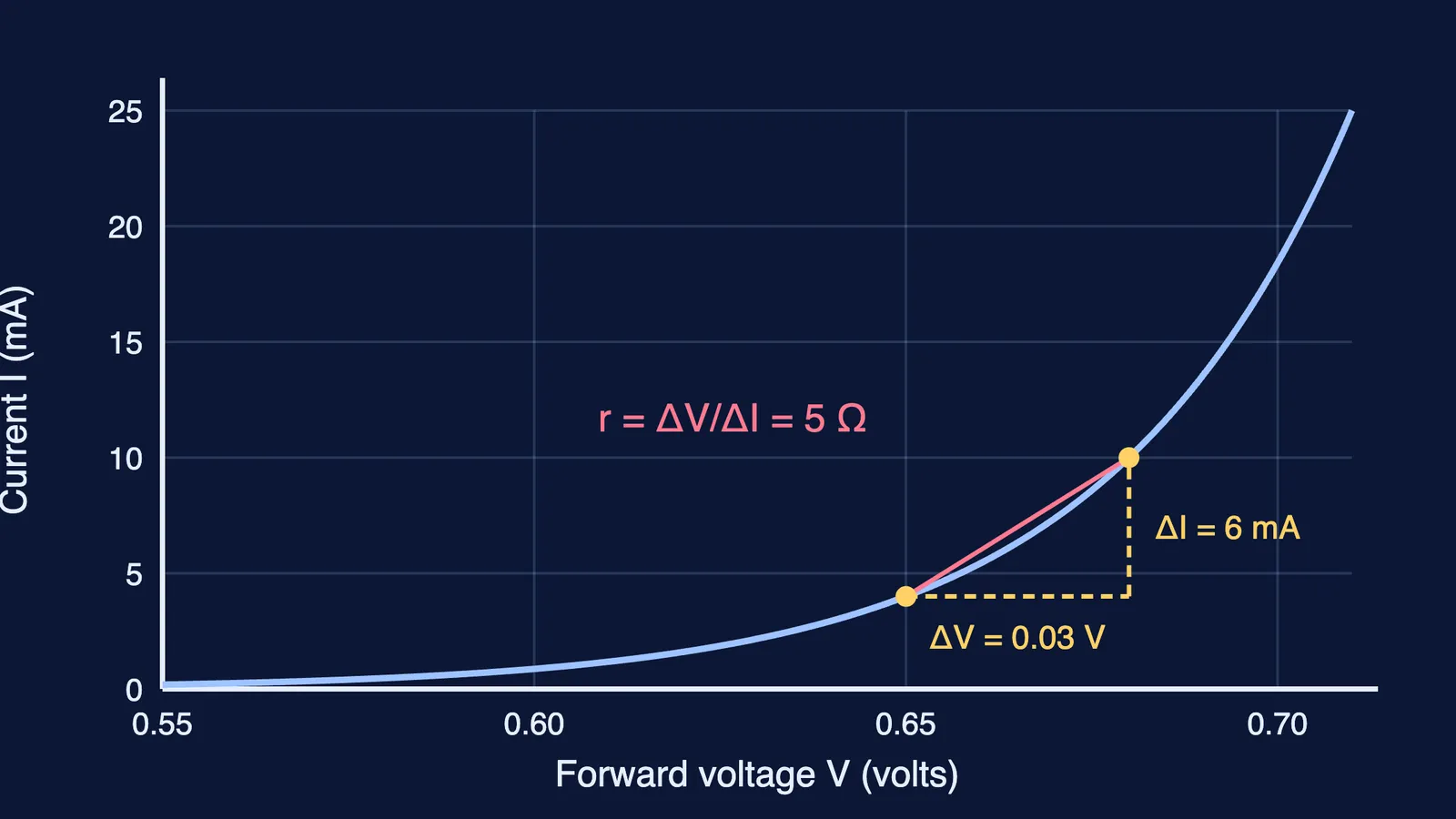
Q9 (hard). Statement I: If the forward voltage across a silicon diode rises from 0.65 V to 0.68 V while the current rises from 4 mA to 10 mA, its dynamic resistance in this range is 5 Ω. Statement II: The dynamic resistance of a diode is the same at every point on its forward characteristic.
Answer: (C). Statement I is correct: rd = ΔV/ΔI = 0.03 V / 0.006 A = 5 Ω. Statement II is incorrect: the forward curve rises roughly exponentially, so rd falls as current grows.
Trap: treating rd as fixed.
Q10 (hard). Statement I: In a rectifier with a capacitor filter, using a smaller capacitor brings the output voltage closer to the peak value. Statement II: Between peaks, the capacitor discharges more slowly when the product of C and the load resistance RL is larger.
Answer: (D). Statement I is incorrect: smaller C means a shorter time constant and more sag between peaks. Statement II is correct, which is why filters use large capacitors.
Trap: thinking a small capacitor "keeps up" better.
How should you use this set?
Answer all 10 with answers covered, then tag each miss: wrong fact, wrong direction (forward or reverse), or wrong A-R link.
For each wrong-fact miss, rewrite the statement so it is true. If an idea feels shaky, such as how drift and diffusion balance at the junction, the Fermi Concept Library has a lesson for every concept in physics, with its place in the map. Then move on to our semiconductor electronics practice questions with solutions and the chapter guide to electronic devices for NEET to plan revision.


