

On this page
p-Block assertion-reason questions test whether each statement is true and whether the reason is the actual cause. These 10 original items (6 assertion-reason, 4 Statement I/II pairs) run from easy to hard, each built on a real slip.
Every item stays inside Unit 10, p-Block Elements (Group 13 to Group 18), of the NMC's NEET (UG)-2026 syllabus. The 2026-27 NCERT books have no separate p-block unit, so every fact here is checked against NCERT Class 11 Chemistry Unit 3, Classification of Elements (Reprint 2026-27), plus Unit 4, Chemical Bonding. New to the chapter? Start with our guide on how to prepare p-Block Elements for NEET.
How do you answer assertion-reason questions on p-block trends?
Judge A and R separately first. Only if both are true, ask: is R the cause NCERT gives for A? NCERT keeps naming four causes: size, effective nuclear charge, repulsion in the small n = 2 shell, and the number of valence orbitals.
The keys for every assertion-reason item below:
(A) Both A and R are true and R is the correct explanation of A.
(B) Both A and R are true but R is NOT the correct explanation of A.
(C) A is true but R is false.
(D) A is false but R is true.
Assertion-reason questions on p-block elements
Q1 (easy). Assertion (A): Noble gases have positive electron gain enthalpies. Reason (R): An electron added to a noble gas atom has to enter the next higher principal quantum level.
Answer: (A). NCERT Unit 3 gives R as the cause: the extra electron would start a new shell, a very unstable configuration.
Trap: reading a positive ΔegH as easy electron gain; it means energy is absorbed.
Q2 (easy). Assertion (A): Oxygen has an oxidation state of +2 in OF₂. Reason (R): Oxygen is more electronegative than fluorine.
Answer: (C). R is false: fluorine is more electronegative (Pauling 4.0 against oxygen's 3.5 in NCERT Table 3.8), so each F takes −1 and oxygen is +2.
Trap: assuming oxygen is −2 in every compound.
Q3 (medium). Assertion (A): The electron gain enthalpy of fluorine is less negative than that of chlorine. Reason (R): Fluorine is more electronegative than chlorine.
Answer: (B). Both are true: NCERT Table 3.7 gives F −328 and Cl −349 kJ/mol, and Table 3.8 gives F 4.0 and Cl 3.0 (NCERT Unit 3). But higher electronegativity would predict the opposite; the cause is repulsion in fluorine's compact n = 2 shell.
Trap: treating electronegativity and electron gain enthalpy as one property.
Q4 (medium). Assertion (A): Boron has a higher first ionization enthalpy than beryllium. Reason (R): Boron has a greater nuclear charge than beryllium.
Answer: (D). R is true (Z = 5 against Z = 4), but A is false. NCERT explains that boron loses a 2p electron, more shielded than beryllium's 2s electron, so boron's value is slightly lower.
Trap: applying the period trend without checking which orbital the electron leaves.
Q5 (medium). Assertion (A): Phosphorus forms PCl₅, but nitrogen does not form NCl₅. Reason (R): Nitrogen has only four valence orbitals (2s and 2p), whereas phosphorus can also use 3d orbitals.
Answer: (A). NCERT Unit 3 says the first member of each group has only four valence orbitals, so its maximum covalency is 4; the second member has nine. PCl₅ forms by sp³d hybridisation (NCERT Unit 4), while NCl₅ would need five bonds.
Trap: blaming nitrogen's higher electronegativity, true but irrelevant.
Q6 (hard). Assertion (A): The first ionization enthalpy of oxygen is lower than that of nitrogen. Reason (R): An oxygen atom is smaller than a nitrogen atom.
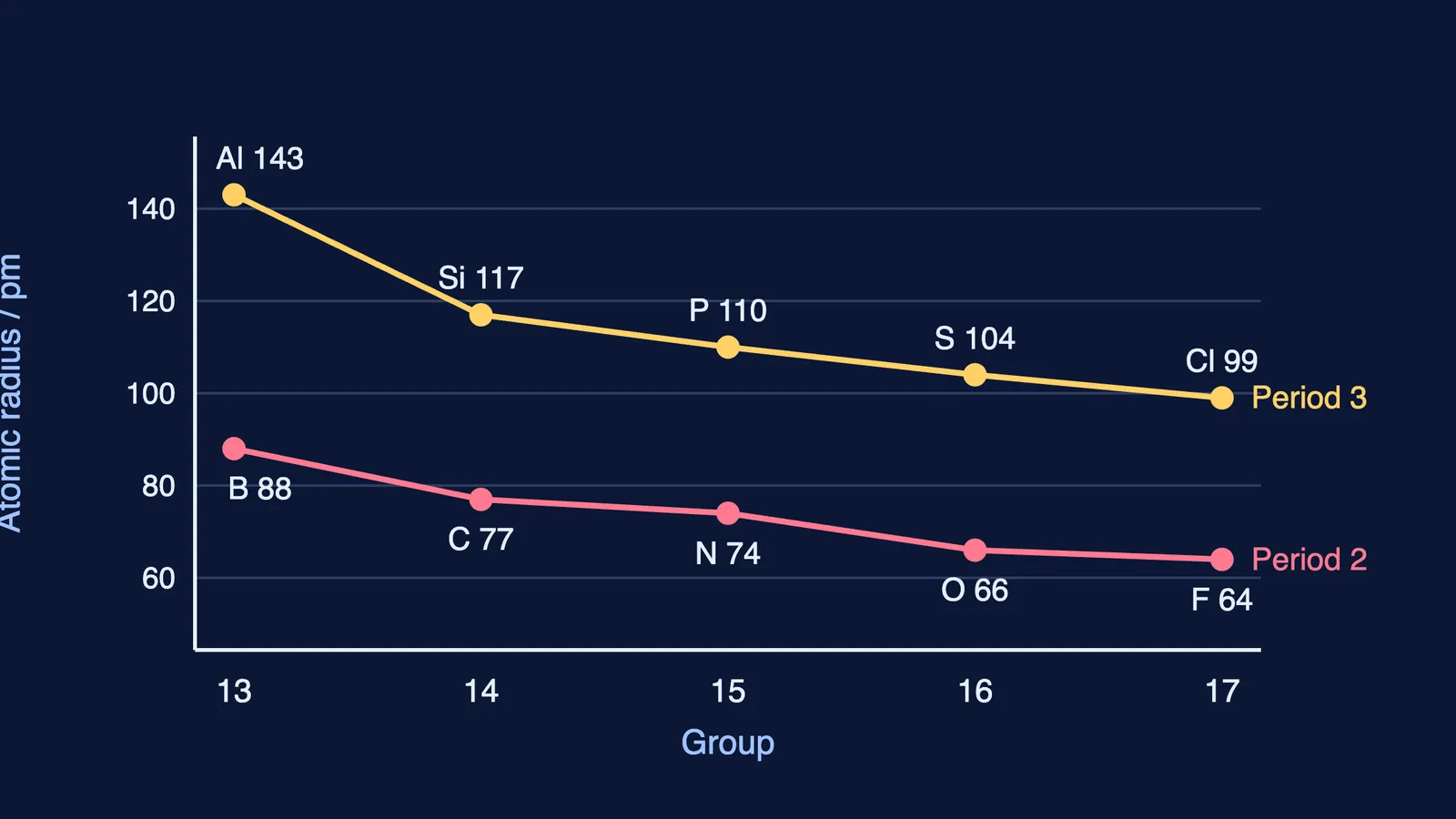
Answer: (B). Both are true: NCERT Table 3.6(a) gives O 66 pm and N 74 pm (NCERT Unit 3). But a smaller atom should hold its electrons more tightly, so R predicts the opposite. NCERT's cause: two of oxygen's 2p electrons share an orbital, and their repulsion makes one easier to remove.
Trap: picking (A) because size usually drives ionization trends.
Statement I and Statement II questions on p-block elements
The keys for every statement pair:
(A) Both statements are correct.
(B) Both statements are incorrect.
(C) Statement I is correct, Statement II is incorrect.
(D) Statement I is incorrect, Statement II is correct.
Q7 (easy). Statement I: The p-block comprises groups 13 to 18, and the outer configuration runs from ns²np¹ to ns²np⁶. Statement II: The chalcogens are the group 17 elements.
Answer: (C). Statement I matches NCERT section 3.6.2 (Unit 3). The chalcogens are group 16; group 17 is the halogens.
Trap: mixing up groups 16 and 17.
Q8 (medium). Statement I: Pauling electronegativity increases down group 17, from fluorine to astatine. Statement II: Atomic radius increases across period 3, from aluminium to chlorine.
Answer: (B). NCERT Table 3.8(b) gives F 4.0 falling to At 2.2, and Table 3.6(a) shows radius falling from Al 143 pm to Cl 99 pm, as charted above.
Trap: reversing a trend you know by name.
Q9 (medium). Statement I: CO and N₂O are acidic oxides, as expected for oxides of non-metals. Statement II: An amphoteric oxide such as Al₂O₃ behaves as an acid towards bases and as a base towards acids.
Answer: (D). Statement II matches NCERT section 3.7.3 (Unit 3), which lists CO, NO and N₂O as neutral oxides, neither acidic nor basic.
Trap: assuming every non-metal oxide is acidic.
Q10 (hard). Statement I: Carbon, nitrogen and oxygen form pπ–pπ multiple bonds, such as C=O, C≡N and N=O, more readily than the heavier members of their groups. Statement II: The maximum covalency of the first member of each of groups 13 to 17 is 4.
Answer: (A). Both are in NCERT section 3.7.2 on the anomalous second-period elements (Unit 3). Boron reaches covalency 4 in [BF₄]⁻.
Trap: rejecting Statement II because boron usually shows a valence of 3, as in BF₃.
How should you use this set?
Write all ten keys before checking.
For each miss, note whether a statement or the link fooled you.
For every (B) answer, write the cause NCERT actually gives.
Redo the misses after three days.
The p-block NEET practice questions give single-correct practice, and our assertion-reason strategy guide walks through the method.
If a cause such as orbital penetration feels shaky, the Fermi Concept Library gives every concept in physics, chemistry, biology, mathematics and computing its own lesson and its place in the map.


