On this page
In kinematics, most assertion-reason statements sound true. Marks go to whoever can tell a true reason from the correct one. These 10 original questions run easy to hard.
What do these kinematics questions cover?
Every item stays inside Unit 2, Kinematics, of the NEET (UG)-2026 syllabus published by the National Medical Commission. Each was checked against NCERT Class 11 Physics, Chapter 2, Motion in a Straight Line, and Chapter 3, Motion in a Plane (Reprint 2026-27). Take g = 10 m/s², no air resistance. New to the chapter? Read our guide on how to prepare kinematics for NEET.
How do you answer assertion-reason questions?
Judge each statement alone. If both are true, say "A, because R" and check that it holds.
Assertion-reason keys (Q1 to Q6):
(A) Both A and R are true and R is the correct explanation of A.
(B) Both A and R are true but R is NOT the correct explanation of A.
(C) A is true but R is false.
(D) A is false but R is true.
Statement I and II keys (Q7 to Q10):
(A) Both statements are correct.
(B) Both statements are incorrect.
(C) Statement I is correct, Statement II is incorrect.
(D) Statement I is incorrect, Statement II is correct.
Assertion-reason questions on kinematics
Q1 (easy). Assertion (A): The magnitude of a body's displacement can never be greater than the distance it travels. Reason (R): Displacement is measured along the straight line joining the start and end points, the shortest route between them.
Answer: (A). Both are true. No path is shorter than the straight line between its ends, so path length ≥ |displacement|. R is the direct cause of A.
Trap: picking (B) because R sounds like a definition.
Q2 (easy). Assertion (A): The slope of a position-time graph at an instant gives the velocity at that instant. Reason (R): The area under a velocity-time graph between two instants gives the displacement in that interval.
Answer: (B). Both are true. A follows from v = dx/dt. R is a separate graph rule, not the reason for A.
Trap: linking two graph facts just because they sit together.
Q3 (medium). Assertion (A): A ball thrown vertically upward has zero acceleration at its highest point. Reason (R): The ball's velocity at its highest point is zero.
Answer: (D). A is false: the acceleration is g downward throughout, including at the top. R is true; zero velocity does not mean zero acceleration.
Trap: reading "momentarily at rest" as "not accelerating".
Q4 (medium). Assertion (A): A particle in uniform circular motion is accelerated even though its speed does not change. Reason (R): Its velocity keeps changing direction, and acceleration is the rate of change of velocity.
Answer: (A). Both are true, and R is why A holds: the turning velocity gives a centripetal acceleration v²/r towards the centre.
Trap: thinking "uniform" rules out acceleration.
Q5 (medium). Assertion (A): Two stones thrown from level ground at the same speed, at 30° and 60° to the horizontal, land at the same distance. Reason (R): For a given launch speed, the horizontal range is greatest at 45°.
Answer: (B). Both are true. The real reason for A is range = u² sin 2θ/g with sin 60° = sin 120°. The 45° maximum is a different consequence of that formula.
Trap: accepting R because 30° and 60° flank 45°.
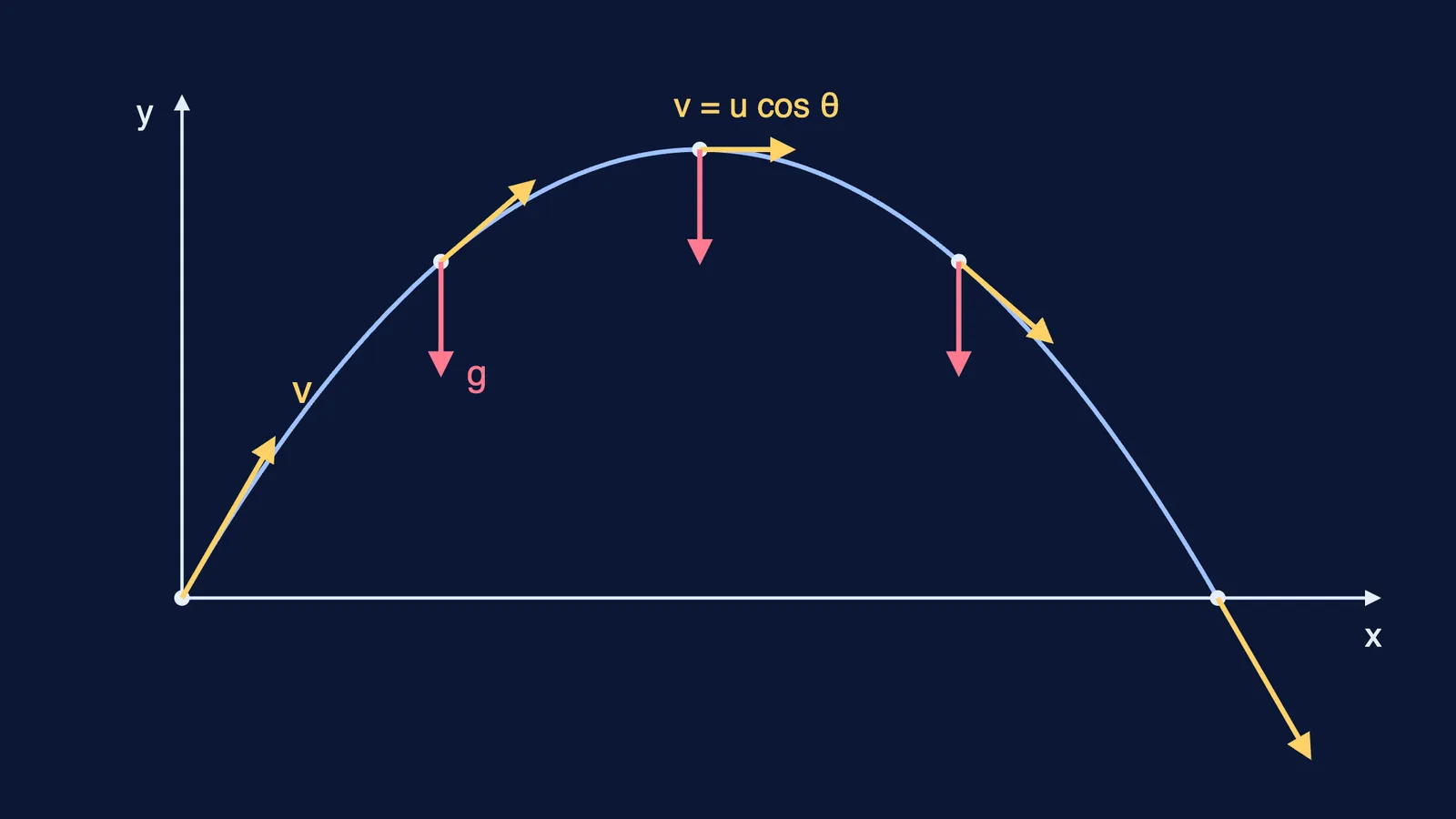
Q6 (hard). Assertion (A): For a projectile launched at an angle between 0° and 90°, its speed is least at the highest point. Reason (R): At the highest point, the projectile's acceleration is zero.
Answer: (C). A is true: the horizontal component u cos θ never changes and the vertical one is zero only at the top, so speed is least there. R is false: the acceleration is g everywhere.
Trap: mixing up "vertical velocity is zero" with "acceleration is zero".
Statement I and Statement II questions on kinematics
Q7 (easy). Statement I: For a body starting from rest with constant acceleration, the distances covered in successive equal time intervals are in the ratio 1 : 3 : 5 : 7. Statement II: The velocity-time graph of such a body is a parabola.
Answer: (C). I is correct: a dropped stone falls 5, 15, 25 and 35 m in successive seconds. II is incorrect: v = at is a straight line; the x-t graph is the parabola.
Trap: swapping the shapes of the v-t and x-t graphs.
Q8 (medium). Statement I: The sum of two non-zero vectors is always larger in magnitude than each of them. Statement II: The scalar product of two perpendicular non-zero vectors is zero.
Answer: (D). I is incorrect: vectors of 5 units and 3 units in opposite directions add to 2 units, less than either. II is correct: A·B = AB cos 90° = 0.
Trap: adding magnitudes like plain numbers.
Q9 (hard). Statement I: A girl running at 8 m/s through rain falling vertically at 6 m/s should tilt her umbrella backwards, away from her direction of running. Statement II: Relative to her, the rain falls at 14 m/s.
Answer: (B). Both are incorrect. Relative to her, the rain comes from the front at √(8² + 6²) = 10 m/s, about 53° from the vertical, so she should tilt the umbrella forwards.
Trap: adding the speeds (14 m/s) instead of the velocity vectors.
Q10 (hard). Statement I: A particle moves along the x-axis with x = 3t − t² (x in metres, t in seconds). In the first 3 s its displacement is zero, but it travels 4.5 m. Statement II: Its acceleration is constant at −2 m/s².
Answer: (A). Both are correct. v = 3 − 2t, so it turns at t = 1.5 s after 2.25 m and returns 2.25 m to x = 0. a = dv/dt = −2 m/s².
Trap: not checking where v = 0.
How should you use this set?
Sort every miss: wrong about A, wrong about R, or wrong about the link.
For each link miss, write the real reason in one line.
For each truth miss, reread that NCERT section.
If Q6 or Q9 was hard to picture, the Fermi Simulation Lab has interactive simulations for ideas that are easier to see than to read.
For timed MCQs on this chapter, try our kinematics NEET practice questions with solutions. For a method for any subject, see our strategy for assertion-reason questions.