On this page
The 10 original questions below stay inside NCERT Class 12 Physics Chapter 8, Electromagnetic Waves and Unit 15 of the NMC syllabus for NEET (UG)-2026. Most hinge on a statement that is true but is not the reason.
How do you answer assertion-reason questions?
Judge each statement on its own. If both are true, ask whether R is the direct cause of A as the textbook gives it. Our step-by-step strategy for assertion-reason questions covers the method.
Use these keys for questions 1 to 6:
(A) Both A and R are true and R is the correct explanation of A.
(B) Both A and R are true but R is NOT the correct explanation of A.
(C) A is true but R is false.
(D) A is false but R is true.
Use these keys for questions 7 to 10:
(A) Both statements are correct.
(B) Both statements are incorrect.
(C) Statement I is correct, Statement II is incorrect.
(D) Statement I is incorrect, Statement II is correct.
Assertion-reason questions on electromagnetic waves
Q1 (easy). Assertion (A): An electron moving in a straight line at constant velocity does not radiate electromagnetic waves. Reason (R): Only accelerated charges radiate electromagnetic waves.
Answer: (A). Both true, and R is the cause of A: uniform motion gives only a steady magnetic field, so nothing is radiated.
Trap: thinking any moving charge radiates.
Q2 (easy). Assertion (A): Electromagnetic waves can travel through a vacuum. Reason (R): Electromagnetic waves are longitudinal, with the electric field along the direction of travel.
Answer: (C). A is true: the fields sustain each other, so no material medium is needed. R is false: E and B are both perpendicular to the direction of travel, so the waves are transverse.
Trap: carrying over the picture of sound waves.
Q3 (medium). Assertion (A): In a vacuum, radio waves and gamma rays travel at the same speed. Reason (R): Radio waves come from accelerated electrons in aerials, while gamma rays come from radioactive decay of nuclei.
Answer: (B). Both true, but R does not explain A. The speed in vacuum is c = 1/√(μ0ε0), which depends only on μ0 and ε0, not on the source or the wavelength.
Trap: choosing (A) because R sounds relevant.
Q4 (medium). Assertion (A): While a capacitor is charging, a magnetic field exists in the gap between its plates, though no charge crosses the gap. Reason (R): A changing electric field gives a displacement current, ε0 dΦE/dt, which is a source of magnetic field just like a conduction current.
Answer: (A). Both true, and R is the reason: in the gap, the displacement current alone produces the field.
Trap: believing only moving charges make magnetic fields.
Q5 (medium). Assertion (A): Infrared waves are called heat waves because they have the highest frequency of all electromagnetic waves. Reason (R): Water molecules in most materials readily absorb infrared, which increases their thermal motion.
Answer: (D). A is false: infrared has a lower frequency than visible light, and gamma rays have the highest. R is true, and R is the real reason for the name.
Trap: linking "heat" with "most energetic".
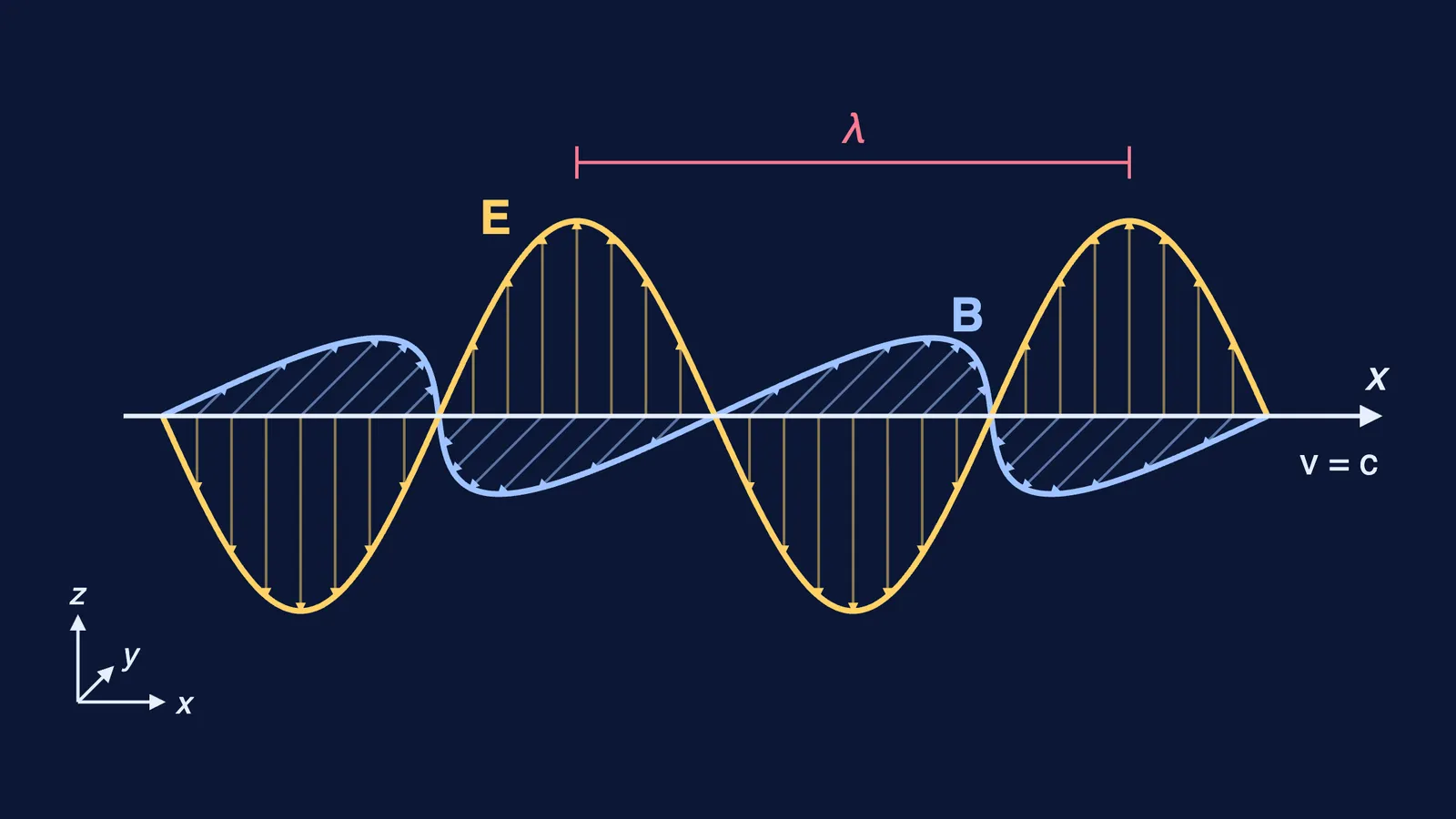
Q6 (hard). Assertion (A): In a plane electromagnetic wave in vacuum with a peak magnetic field of 2 × 10⁻⁸ T, the peak electric field is 6 V/m. Reason (R): In an electromagnetic wave, the electric and magnetic fields are a quarter cycle (π/2) out of phase.
Answer: (C). A is true: E0 = cB0 = 3 × 10⁸ × 2 × 10⁻⁸ = 6 V/m. R is false: both fields vary as sin(kx − ωt), so they peak and pass through zero together.
Trap: borrowing the π/2 phase gap from an inductor or capacitor in an AC circuit.
Statement I and Statement II questions on electromagnetic waves
Q7 (medium). Statement I: Ultraviolet light passes easily through ordinary window glass, so you can get sunburnt behind a closed window. Statement II: Microwaves have shorter wavelengths than infrared waves.
Answer: (B). Both incorrect. Ordinary glass absorbs UV. Microwaves span about 0.1 m to 1 mm, longer than infrared (1 mm to 700 nm).
Trap: treating "micro" as the smallest wavelength.
Q8 (medium). Statement I: A charge oscillating at frequency ν radiates electromagnetic waves of frequency 2ν. Statement II: In a microwave oven, the frequency is chosen to match the resonant frequency of water molecules, so energy passes efficiently to food containing water.
Answer: (D). Statement I is incorrect: the wave has the same frequency as the oscillating charge. Statement II is correct.
Trap: inventing a factor of 2.
Q9 (hard). Statement I: The wave Bᵧ = B0 sin(2.0 × 10³ x − 6.0 × 10¹¹ t) T has a wavelength of about 3.1 mm, which lies in the microwave band. Statement II: The electric field of this wave oscillates along the z-axis.
Answer: (A). Both correct. λ = 2π/k = 2π/(2.0 × 10³) ≈ 3.1 × 10⁻³ m, inside 0.1 m to 1 mm. The wave travels along x and B along y, so E lies along z.
Trap: reading 2.0 × 10³ as the wavelength instead of k.
Q10 (hard). Statement I: A capacitor is charged by a steady current of 0.40 A, so the displacement current across the gap between its plates is also 0.40 A. Statement II: Once the capacitor is fully charged by a DC battery, the displacement current in the gap is at its maximum.
Answer: (C). Statement I is correct: in the gap, the displacement current equals the conduction current in the leads. Statement II is incorrect: once charging stops, E is constant, dΦE/dt = 0 and the displacement current is zero.
Trap: thinking the largest field means the largest displacement current.
How should you use this set?
Answer all 10 with the answers covered, then tag each miss: wrong fact, wrong number, or wrong A-R link.
Rewrite every false statement so it becomes true. If the picture of E and B moving together in Q6 and Q9 is hard to hold in your head, the Fermi Simulation Lab has interactive simulations for ideas that are easier to see than to read. Then try our electromagnetic waves NEET practice questions with solutions and plan revision with the chapter guide to electromagnetic waves for NEET.