On this page
Here are six assertion-reason items and four Statement I / Statement II pairs on Cell: The Unit of Life, each block running from easy to hard. Every statement was checked against Chapter 8 of NCERT Class 11 Biology (reprint 2026-27). The NMC NEET (UG)-2026 syllabus lists the chapter under Unit 3, Cell Structure and Function, from cell theory to the nucleus.
How do you answer assertion-reason questions on the cell?
Use these keys throughout.
Assertion-reason:
(A) Both A and R are true and R is the correct explanation of A.
(B) Both A and R are true but R is NOT the correct explanation of A.
(C) A is true but R is false.
(D) A is false but R is true.
Statement pairs:
(A) Both statements are correct.
(B) Both statements are incorrect.
(C) Statement I is correct, Statement II is incorrect.
(D) Statement I is incorrect, Statement II is correct.
Judge A alone, then R alone. Only if both are true, ask: "Does NCERT give R as the reason for A?" Most false lines here swap a feature between two structures, or a finding between two scientists.
New to the chapter? Start with our guide on how to prepare Cell: The Unit of Life for NEET, then try the Cell: The Unit of Life practice questions with solutions.
Assertion-reason questions on Cell: The Unit of Life
Q1 (easy). Assertion (A): For every living organism, the cell is the basic unit of both structure and function. Reason (R): No part smaller than a whole cell can carry on an independent life.
Answer: (A). Both are true, and NCERT section 8.1 draws A from R with the word "hence". Trap: picking (B) because R sounds like a separate fact about unicellular life.
Q2 (easy). Assertion (A): Rudolf Virchow modified the hypothesis of Schleiden and Schwann and gave the cell theory its final shape. Reason (R): Virchow concluded that the cell wall is a unique character of plant cells.
Answer: (C). A is true. R is false: NCERT credits Schwann with the cell-wall conclusion. Virchow showed that new cells arise from pre-existing cells. Trap: matching the right finding to the wrong scientist.
Q3 (medium). Assertion (A): Polar molecules slip freely through the lipid bilayer by simple diffusion, with no carrier protein needed. Reason (R): In the membrane, the hydrophobic tails of the phospholipids face the inner part of the bilayer.
Answer: (D). A is false: NCERT says polar molecules cannot pass through the nonpolar bilayer, so they need a carrier protein. R is true, and it is the reason A fails. Trap: simple diffusion is right for neutral solutes, not polar ones.
Q4 (medium). Assertion (A): The middle lamella holds neighbouring plant cells together. Reason (R): Plasmodesmata traverse the cell wall and middle lamella and connect the cytoplasm of neighbouring cells.
Answer: (B). Both are true, but the gluing comes from what the middle lamella is made of, mainly calcium pectate, as NCERT section 8.5.2 says. Plasmodesmata are channels, not glue. Trap: both lines are about joining cells, so they feel linked.
Q5 (hard). Assertion (A): In the Singer and Nicolson model of the membrane, proteins can drift sideways through the bilayer. Reason (R): The membrane lipid behaves like a quasi-fluid rather than a rigid solid.
Answer: (A). Both are true, and NCERT says the quasi-fluid nature of the lipid enables this lateral movement of proteins. Trap: choosing (B) because A is about proteins and R is about lipids.
Q6 (hard). Assertion (A): The Golgi apparatus remains in close association with the endoplasmic reticulum. Reason (R): The Golgi apparatus is an important site of formation of glycoproteins and glycolipids.
Answer: (B). Both are true, but NCERT's explanation for A is different: vesicles carrying material from the ER fuse with the cis face of the Golgi. Trap: any true Golgi fact feels like a fair reason.
Statement I and Statement II questions on the cell
Q7 (easy). Statement I: Pili and fimbriae are the main structures bacteria use for motility. Statement II: A bacterial flagellum has three parts: filament, hook and basal body.
Answer: (D). NCERT section 8.4.1 says pili and fimbriae do not play a role in motility. Statement II is correct. Trap: anything sticking out of a bacterium gets read as a way to move.
Q8 (medium). Statement I: Leucoplasts are colourless plastids, and amyloplasts among them store starch, as in potato. Statement II: Aleuroplasts store oils and fats, while elaioplasts store proteins.
Answer: (C). Statement I is correct. Statement II swaps the two: elaioplasts store oils and fats, aleuroplasts store proteins. Trap: the names are unfamiliar, so a swap goes unnoticed.
Q9 (hard). Statement I: Because no membrane surrounds the nucleolus, its contents merge with the surrounding nucleoplasm. Statement II: A cell busy making proteins tends to have bigger nucleoli, and more of them.
Answer: (A). Both match NCERT section 8.5.10; the nucleolus is a site of active ribosomal RNA synthesis. Trap: assuming every structure inside the nucleus has its own membrane.
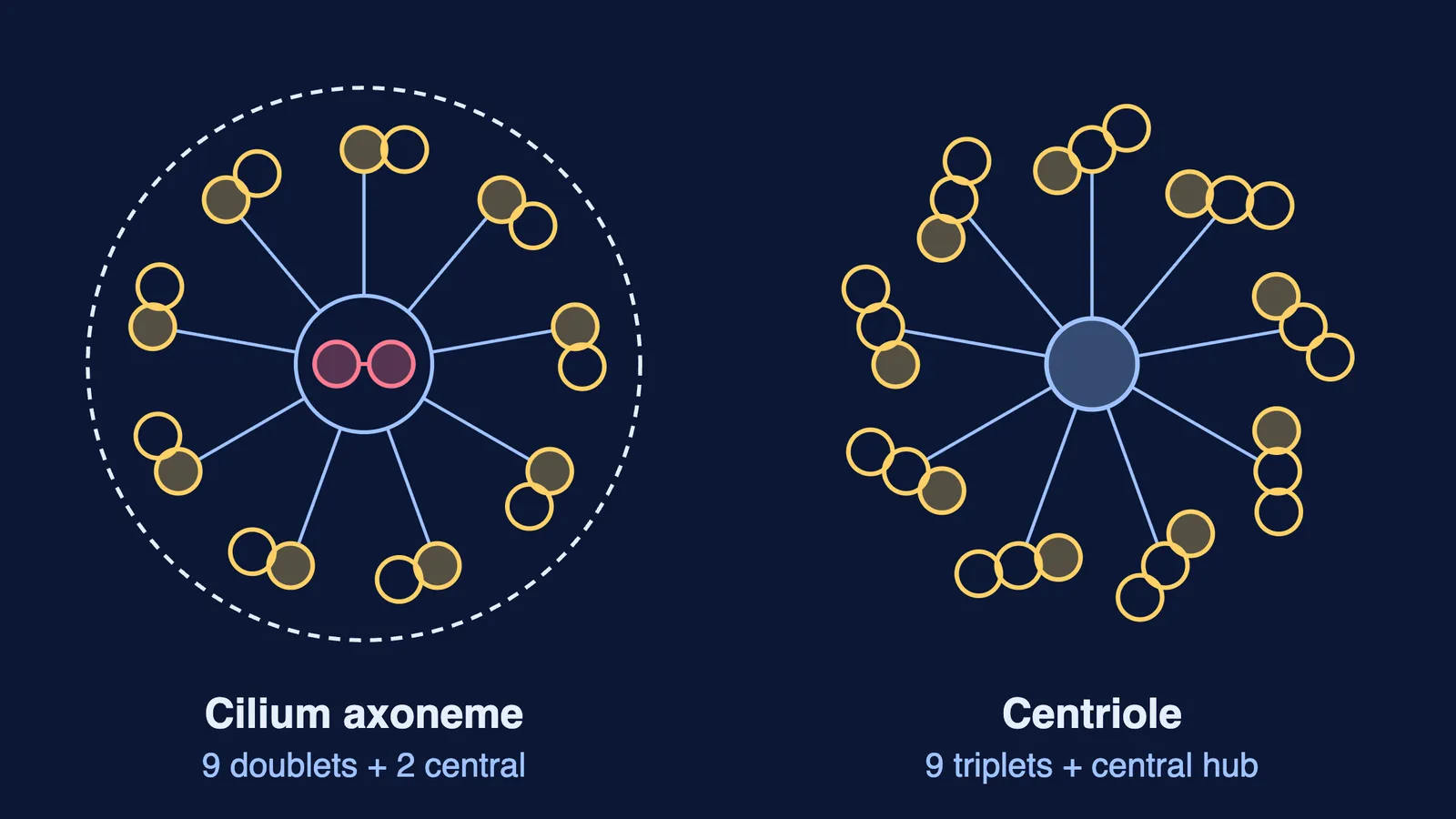
Q10 (hard). Statement I: The axoneme of a cilium has nine peripheral triplets of microtubules and a central pair. Statement II: Each of the nine peripheral fibrils of a centriole is a doublet, linked to a central hub by radial spokes.
Answer: (B). Both are incorrect. NCERT gives the axoneme nine peripheral doublets plus a central pair (the 9+2 array) and the centriole nine peripheral triplets. Trap: the counts are swapped, and the correct detail in each line hides the error.
How should you use this set?
Do all ten in 12 minutes without notes, writing T or F above each line before choosing a key.
Sort every miss: a wrong fact (reread that NCERT section) or a wrong link (run the same-paragraph test).
Two days later, redo the misses and write a new false version of each by swapping one feature between two organelles.
Every key appears two or three times here, so a run of the same letter tells you nothing.
If a miss comes from a concept you cannot picture, such as how a 9+2 axoneme differs from a centriole, the Fermi Concept Library has every concept in biology with its own lesson. For more on the format itself, read our assertion-reason strategy.