On this page
Anatomy of flowering plants sits in Biology Unit 2, Structural Organisation in Animals and Plants, of the NEET (UG)-2026 syllabus issued by the National Medical Commission. Every statement below was checked against Chapter 6 of NCERT Class 11 Biology, Reprint 2026-27.
If the chapter is new to you, read our guide on how to prepare Anatomy of Flowering Plants for NEET first.
How do you answer assertion-reason questions?
Judge each line on its own as true or false. Only when both are true, ask: is R the direct reason NCERT gives for A? A true fact about the same tissue is not enough.
Use these keys for Q1 to Q6:
(A) Both A and R are true and R is the correct explanation of A.
(B) Both A and R are true but R is NOT the correct explanation of A.
(C) A is true but R is false.
(D) A is false but R is true.
For the full method, see our assertion-reason question strategy.
Assertion-reason questions on plant anatomy
Q1 (easy). Assertion (A): In a young dicot stem, the innermost layer of the cortex is known as the starch sheath. Reason (R): Cells of this layer store plenty of starch grains.
Answer: (A). Both are true, and NCERT gives the starch grains as the reason for the name.
Trap: thinking only roots have an endodermis. A dicot stem has one too, as the innermost layer of its cortex.
Q2 (easy). Assertion (A): In a dorsiventral leaf, the lower (abaxial) epidermis generally bears more stomata than the upper (adaxial) epidermis. Reason (R): The palisade parenchyma lies just above the lower epidermis.
Answer: (C). A is true; the upper epidermis may even lack stomata. R is false: the palisade is adaxial, under the upper epidermis, and the loose spongy parenchyma extends to the lower epidermis.
Trap: mixing up adaxial (upper) and abaxial (lower).
Q3 (medium). Assertion (A): The vascular bundles of a monocot stem are closed. Reason (R): Each vascular bundle of a monocot stem is surrounded by a sclerenchymatous bundle sheath.
Answer: (B). Both are true, but "closed" has nothing to do with the sheath. A bundle is closed because it has no cambium, so it cannot form secondary xylem and phloem.
Trap: reading "closed" as "enclosed by something".
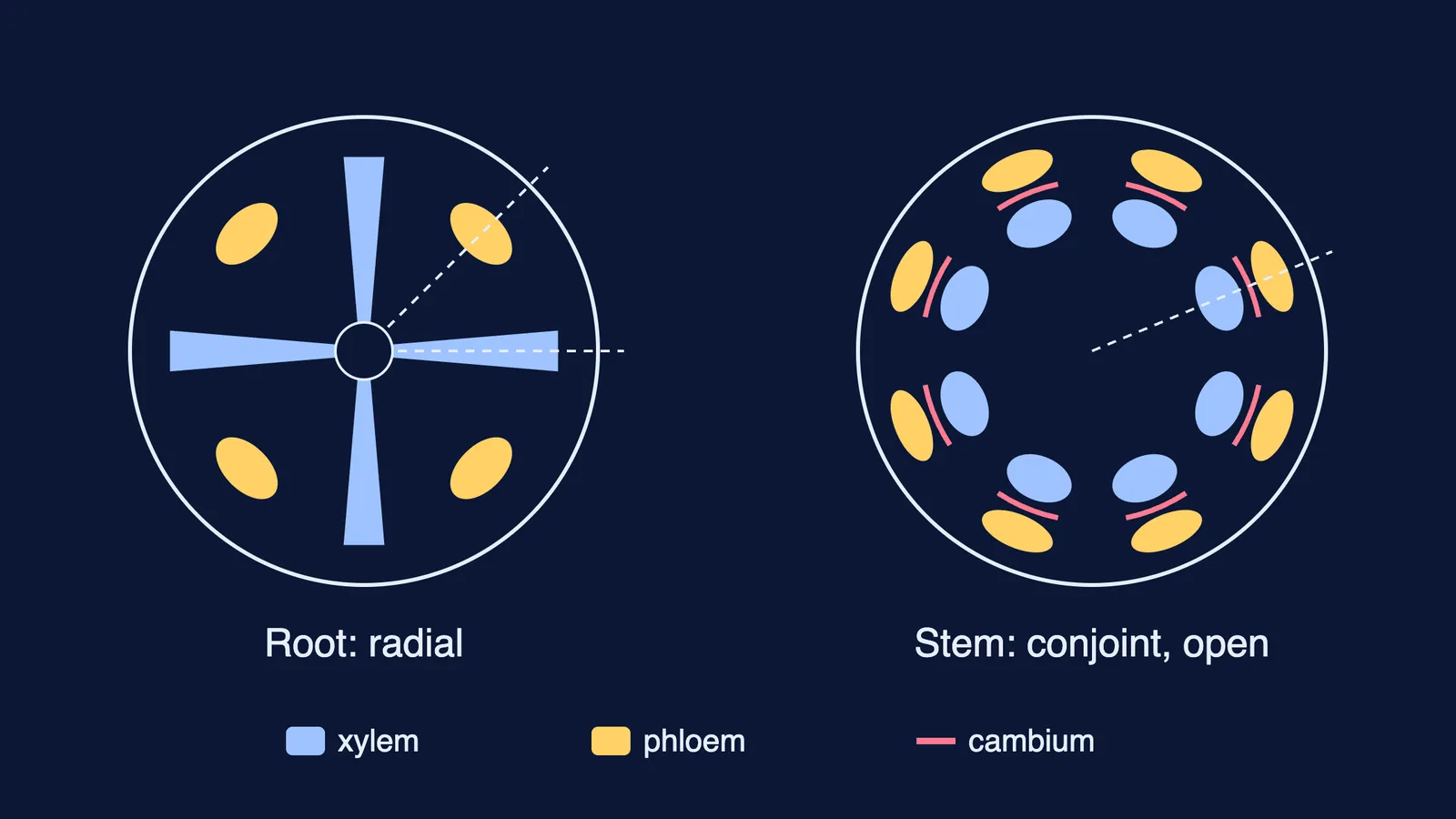
Q4 (medium). Assertion (A): A transverse section of a young sunflower root shows conjoint vascular bundles. Reason (R): In roots, xylem and phloem patches alternate with each other on different radii.
Answer: (D). A is false: R describes the radial arrangement, which is what a root shows. Conjoint bundles, with xylem and phloem on the same radius, are common in stems and leaves.
Trap: assuming every dicot organ has the conjoint, open bundles of the dicot stem.
Q5 (hard). Assertion (A): Monocot roots do not undergo secondary growth. Reason (R): The pith of a monocot root is small and inconspicuous.
Answer: (C). A is true. R is false: NCERT describes the monocot root's pith as large and well developed; the small, inconspicuous pith belongs to the dicot root.
Trap: carrying the dicot root's features over to the monocot root.
Q6 (hard). Assertion (A): In a dicot root, the pericycle is part of the stele. Reason (R): The stele includes all the tissues on the inner side of the endodermis.
Answer: (A). Both are true, and R explains A: the pericycle lies just inside the endodermis, so by NCERT's definition it belongs to the stele, along with the vascular bundles and pith.
Trap: treating "stele" as "vascular bundles only" and marking A false.
Statement I and Statement II questions
Use these keys for Q7 to Q10:
(A) Both statements are correct.
(B) Both statements are incorrect.
(C) Statement I is correct, Statement II is incorrect.
(D) Statement I is incorrect, Statement II is correct.
Q7 (medium). Statement I: A waxy cuticle covers the epidermis of roots as well as stems. Statement II: Trichomes on the shoot are usually multicellular and help prevent water loss due to transpiration.
Answer: (D). Statement I is wrong: NCERT says the cuticle is absent in roots. Statement II is correct.
Trap: generalising "epidermis has a cuticle" to every organ.
Q8 (medium). Statement I: In a dicot stem, the pericycle occurs as semi-lunar patches of collenchyma above the phloem. Statement II: In a dicot stem, the vascular bundles lie scattered through a large ground tissue.
Answer: (B). Both are wrong. The pericycle patches are sclerenchyma (collenchyma forms the hypodermis), and a ring of vascular bundles is characteristic of the dicot stem; scattered bundles belong to the monocot stem.
Trap: knowing the shape of a structure but not its tissue.
Q9 (hard). Statement I: In an isobilateral leaf, the mesophyll is not differentiated into palisade and spongy parenchyma. Statement II: In a section of a monocot leaf, the vascular bundles are of nearly similar size, except in the main veins, reflecting parallel venation.
Answer: (A). Both are correct NCERT differences between the monocot and the dorsiventral leaf.
Trap: rejecting Statement II because of the "except" clause; the exception is part of the true statement.
Q10 (hard). Statement I: Each vascular bundle of a dicot stem is conjoint, open and has exarch protoxylem. Statement II: Conjoint vascular bundles usually have phloem only on the outer side of the xylem.
Answer: (D). Statement I fails on one word: NCERT describes the dicot stem bundle as conjoint, open and with endarch protoxylem. Statement II is correct.
Trap: approving a statement after checking its first two terms.
How should you use this set?
Attempt all ten without notes, writing T or F beside each line before you pick a key.
For every miss, note what went wrong: A, R, or the link between them.
Draw the four transverse sections (dicot and monocot root and stem) from memory and label them, then check against NCERT figures 6.3 and 6.4.
Then try our Anatomy of Flowering Plants NEET practice questions with solutions.
If a term such as stele, endarch or bulliform cell still feels vague, the Fermi Concept Library covers every concept in biology, each with its own lesson.