On this page
Chapter 3 of NCERT's An Introduction to Indian Art Part I (Reprint 2026-27) moves from the Indus cities to the age of Ashoka: polished stone pillars, giant Yaksha and Yakshi figures, a rock-cut cave and the first stupas. This guide maps the chapter to the CBSE Fine Arts curriculum 2026-27 and adds an answer frame and practice questions. The curriculum names no textbook; we follow the NCERT book and map it to Unit 1.
What does Arts of the Mauryan Period cover?
The chapter opens with context. Buddhism and Jainism arose in the Gangetic valley from the sixth century BCE, the Mauryas held power by the fourth century BCE, and in the third century BCE Ashoka backed Buddhism's shraman tradition. The book adds that Yaksha and mother-goddess worship continued alongside.
The works you need to know, as the book groups them:
Pillars. Mauryan pillars were cut from rock, while Achaemenian pillars were assembled from pieces by masons. Capitals show animals such as the bull, lion and elephant on a square or circular abacus decorated with stylised lotuses. Sites: Rampurva, Lauriya-Nandangarh and Basarah-Bakhira (Bihar); Sarnath and Sankisa (Uttar Pradesh).
Yaksha and Yakshini statues. Found at Patna, Vidisha and Mathura; mostly standing, polished, with full, rounded faces.
Dhauli elephant, Odisha. Carved from the rock, modelled in the round, beside an Ashokan rock edict.
Lomus Rishi cave, Barabar hills near Gaya. A chaitya-arch entrance with an elephant frieze in high relief, a rectangular hall and a circular chamber behind it; Ashoka gave it to the Ajivika sect.
Stupas. Bairat in Rajasthan is the book's third-century BCE example; the great stupa at Sanchi began in brick under Ashoka and was later covered in stone.
How do you write an appreciation of the Sarnath Lion Capital?
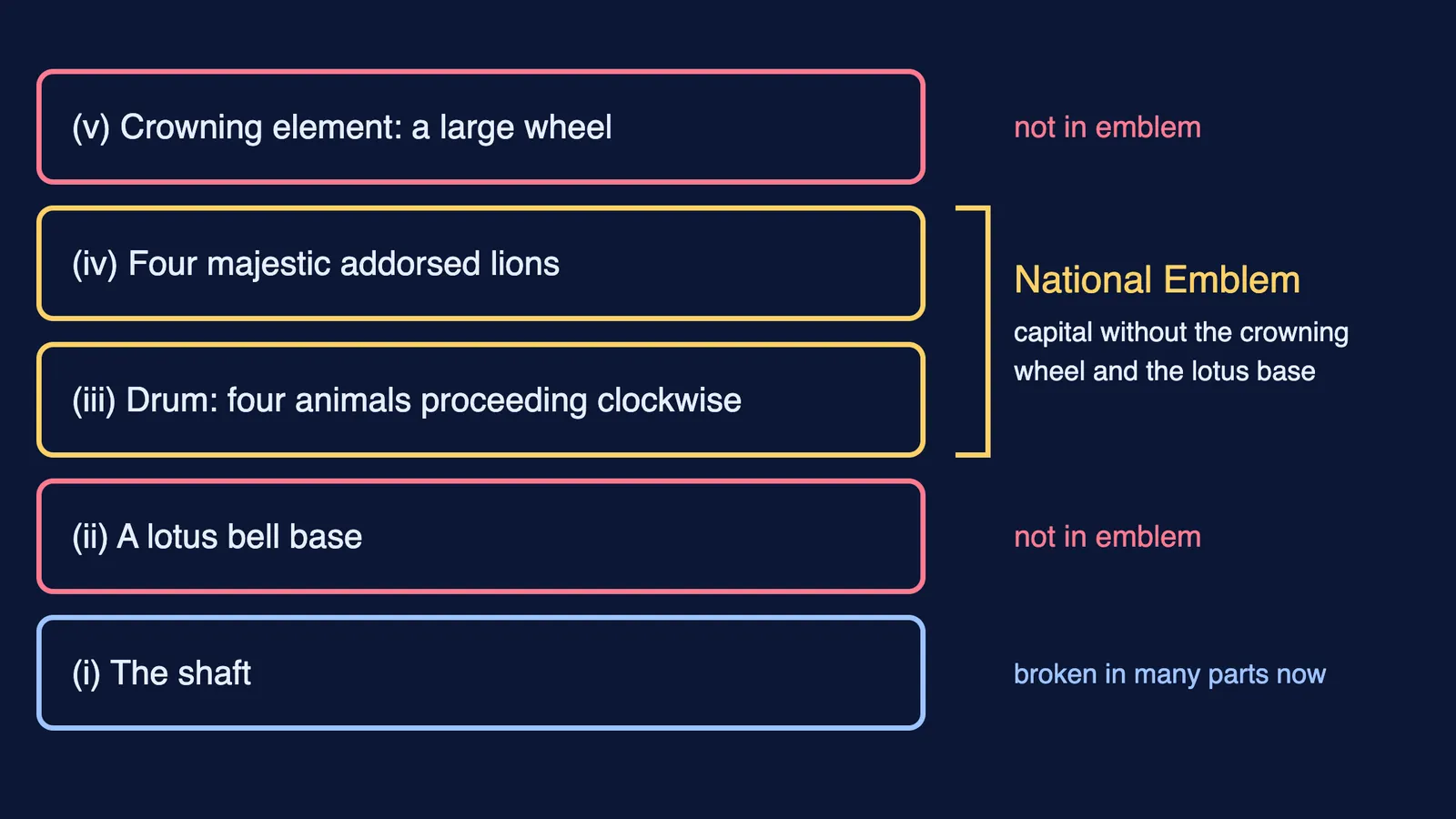
The book lists five original parts: the shaft, a lotus bell base, a drum carrying four animals moving clockwise, four lions seated back to back, and a crowning wheel that now lies broken in the Sarnath site museum. The National Emblem uses the capital without the wheel and the lotus base.
Points to make: heavy Mauryan polish; strong facial muscles and sharp manes; a circular abacus with 24-spoke chakras and a bull, horse, elephant and lion between them; and a form made to be viewed from every side. The capital marks the Buddha's first sermon (Dhammachakrapravartana). The curriculum card dates it circa 3rd century BCE, in polished sandstone, now in the Sarnath Museum (CBSE curriculum).
How do you describe the Didarganj Yakshi (Chauri Bearer)?
She is a life-size, free-standing sandstone figure with a polished surface, kept in Patna Museum. The flywhisk (chauri) is in her right hand; the left hand is lost. Note rounded cheeks and sharp features; necklace beads carved in the round; raised-line garment folds that make the cloth look almost see-through; heavy anklets; and a hair knot behind, so the back is finished too.
How did stupas and patronage grow after Ashoka?
From the second century BCE, stupas gained railings around the circumambulatory path, gateways and carved decoration. The core stayed constant: cylindrical drum, round anda, harmika and chhatra. Inscriptions show patronage was mostly collective, from lay devotees, gahapatis, guilds and kings, and only a few name artisans: Kanha at Pitalkhora, and Balaka, his pupil, at Kondane.
Early on, the Buddha appears only through symbols: footprints, a stupa, a lotus throne, a chakra. Later, life events and Jataka tales fill railings and gateways, told in synoptic, continuous or episodic form. See our guides to Sanchi and stupas in Class 12 History and the Mauryas in Class 12 History.
How many marks does this chapter carry?
The Class 11 theory paper, History of Indian Art, is 30 marks and 2 hours, the same for Painting, Graphics, Sculpture and Applied Art (codes 049 to 052) (CBSE curriculum). Unit 1 carries 15 marks, shared across prehistoric rock painting, the Indus Valley and Buddhist, Jain and Hindu art; there is no separate figure for this chapter. The curriculum's Mauryan line stresses "mirror like polish" and, beside the Chauri Bearer, names the Iron Pillar of Qutab Minar, noting it "has never rusted". Neither this chapter nor any other in Part I discusses that pillar, so ask your teacher about it.
A five-step appreciation frame:
Identify: name, period, material, collection.
Form: posture, proportion, volume.
Surface and technique: polish, relief or in the round.
Detail: two or three precise features.
Meaning: what it marks or shows about the period.
Practice questions (marks are our suggestion):
Give two differences between Mauryan and Achaemenian pillars. (2 marks)
Which two parts of the Sarnath capital were left out of the National Emblem? (2 marks)
Why is the Lomus Rishi cave important for Mauryan architecture? (2 marks)
Appreciate the Didarganj Yakshi using the five-step frame. (4 marks)
Name the parts of a stupa that stayed constant and two features added from the second century BCE. (4 marks)
Unsure where your gaps are? Fermi's AI tutor works out what you already know and builds a plan for the session.