On this page
Apparel is Chapter 7 of Kaushal Vikas, the NCERT skill education textbook for Grade 9 (book code 0916, First Edition, April 2026). It sits in Unit II, Work with Machines and Materials, after the mandatory Chapter 5. Schools pick one vocation per unit: Apparel and Construction are worked illustrations, and Chapter 8 outlines five more. These notes follow the NCERT Apparel chapter.
What does the Apparel chapter cover?
In the book's caselet, student groups make a cushion cover, an apron for the midday-meal server and a dress for younger siblings. The order of work:
Plan: list resources, decide the product, and fill a process chart with tasks, dates and who is responsible.
Site visit: with a teacher, meet a tailor, designer or garment worker; note tools, safety, quality checks and digital tools.
Technical drawing: the design with exact measurements, fasteners and fabric notes (CAD is an option).
Fabric, tools and a bill of materials.
Stitches, paper pattern, fabric preparation, marking and cutting.
Sewing, finishing, packaging and labelling.
How do you choose fabric for a garment?
Match fabric to the job. The book's examples: cotton for a T-shirt (soft, breathable); a polyester-cotton blend for a school uniform (durable, easy to wash, resists creases); soft cotton or muslin for a baby's dress; thick cotton or polyester for a kitchen apron. Pick thread close to the fabric's colour. For how fibres become fabric, see Fabrics Around Us in Class 11 Home Science.
How do you make a bill of materials for apparel?
A bill of materials lists each item, its quantity and cost, plus labour. The book's rules: rolls are usually 1–1.5 m wide, seams and hems need extra cloth beyond the drawing, and labour is costed as hours × hourly rate × times per week.
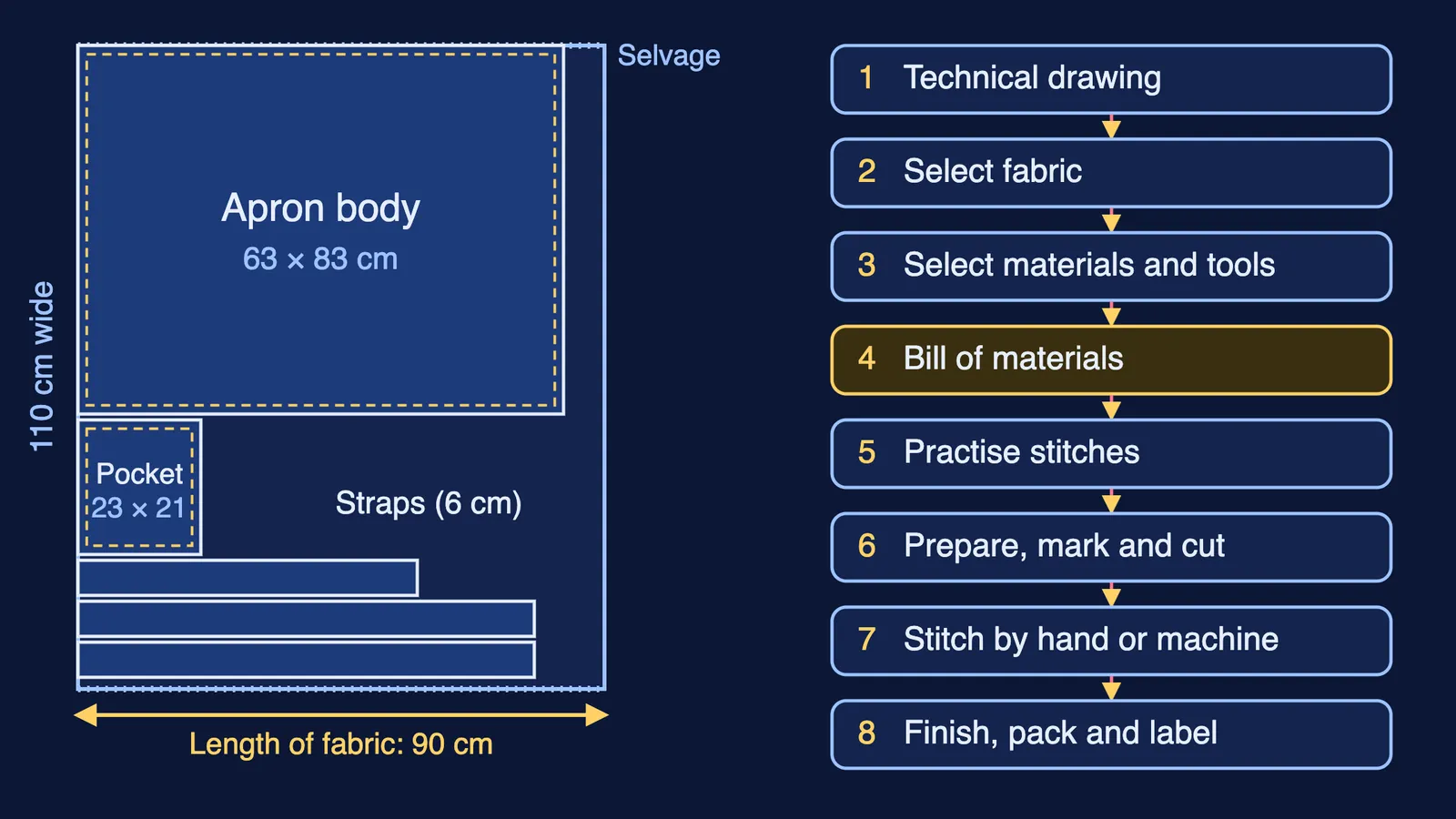
Worked example (our numbers). An apron has a finished body of 60 × 80 cm and a 20 × 18 cm pocket. Add 1.5 cm seam allowance to every edge:
Body: 63 × 83 cm. Pocket: 23 × 21 cm.
Three straps cut 6 cm wide: 58, 78 and 78 cm long.
Laid flat in one layer on a 110 cm-wide roll, the body uses 63 cm of width. The pocket (23 cm) and straps (18 cm) need 41 cm, which fits in the 47 cm left. No piece exceeds 83 cm, so buy 0.9 m.
Fabric: 0.9 m × ₹200 per m = ₹180; thread ₹35
Labour: drafting 1 × ₹40 × 1 = ₹40; cutting 1 × ₹40 × 1 = ₹40; stitching 2 × ₹40 × 2 = ₹160
Materials ₹215 plus labour ₹240 gives ₹455.
Which stitches and steps does the chapter teach?
Hand stitches, practised on a sampler: running (temporary stitching, simple seams), backstitch (strong seams, repairs), split (embroidery outlines), buttonhole (buttonholes, fray-prone edges) and hemming (garment hems).
Paper pattern. Unlike a construction drawing, it is drawn full size, labelled and cut out for reuse.
Prepare, mark and cut. Pre-wash and dry the fabric so shrinkage happens first, iron it, and fold so the selvages meet. Lay the pattern along the fabric's length, pin it, outline it in chalk with 1–2 cm extra for seams, and get your teacher's approval. Cut in long, smooth strokes with the blades parallel to the table.
Sew safely. Lock both ends of a seam with a few backstitches and keep a steady pace so fabric neither slips nor bunches. At a machine, sit centred on the needle, let spare fabric fall to the left and never tug the cloth.
Finish, pack and label. Trim or overlock raw edges, hem the openings, pack against dust and add a label with size and care symbols; see Care and Maintenance of Fabrics in Class 11.
How is Kaushal Vikas assessed in Class 9?
Kaushal Vikas is assessed in school. The CBSE assessment guidelines for 2026-27 weight it as paper-pencil test 40 per cent, demonstration and viva 20 per cent, site visit report 10 per cent, portfolio 20 per cent and teacher observation 10 per cent. The 40-mark test has objective (8), short answer (12), scenario- or case-based (16) and reflective or decision-making (4) sections, and its "Plan and Prepare" area, which includes the bill of materials, carries 14 marks. These cover the whole subject; no chapter has its own marks.
The CBSE 2026-27 curriculum does not name the textbook; this chapter maps to its "Vocation-specific themes" for Work with Machines and Materials (26 suggestive instructional hours).
Practice questions (mark labels are our suggestion):
Which hand stitch suits the bottom edge of an apron? (1 mark)
A cushion cover piece is 40 × 40 cm finished. With 1.5 cm seam allowance on every edge, what size do you cut? (2 marks)
Your group's bill of materials for a cloth tote bag lists fabric and thread but no labour. Add two labour rows using the book's hours × rate × frequency format and your own rate, and say why labour belongs in the bill. (4 marks)
Not sure how to turn a sketch into a costed plan? Fermi's AI tutor works out what you already know and builds a plan for the session.