On this page
How are animal cells kept alive outside the body, checked, stored and used, and how are stem cells classified? Below: scope, worked calculations, practice questions.
What does this chapter cover in 2026-27?
The CBSE Biotechnology curriculum for 2026-27 puts this chapter in Unit VI, Cell Culture and Genetic Manipulation, which carries 30 of the 70 theory marks. The unit's marks are shared with the microbial and plant cell culture chapters, with no per-chapter figure. Listed topics: introduction, culture techniques, applications, stem cell technology.
We could not find an official PDF of the prescribed CBSE textbook, so this guide follows the curriculum's topic list and uses NCERT Biotechnology XII as the reference: Chapter 8 and the stem cell part of Chapter 9 (Reprint 2025-26). The curriculum does not list Chapter 9's organ culture section.
Core Biology lists stem cell technology as one item in its applications chapter (Biology curriculum; see our Class 12 Biology guide to biotechnology and its applications). The elective covers the lab method itself.
How are animal cells grown in the lab?
NCERT notes that animal cells usually need 18 to 24 hours to divide, so stray bacteria soon outgrow them (NCERT Ch 8). All handling happens in a laminar flow hood with HEPA-filtered air (a vertical hood blows air down, not at the worker).
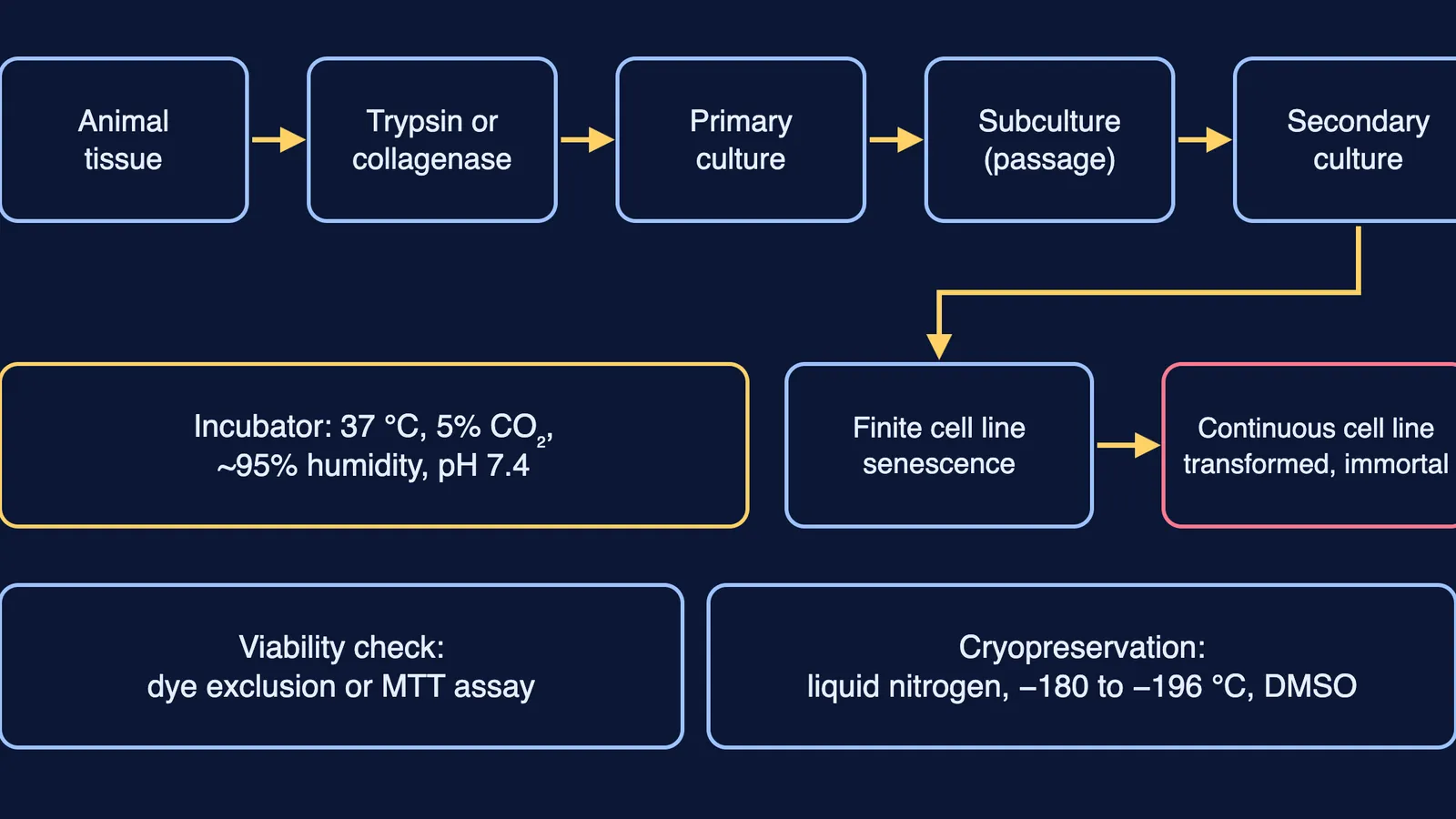
Media are natural (plasma, serum, tissue extracts) or artificial: a basal medium plus serum, hormones and growth factors. Mammalian cells typically sit at 37 °C, 5% CO₂ and about 95% humidity; the CO₂ works with bicarbonate to hold the pH. Phenol red shows the pH: bright red near 7.4, yellow when acidic, pink when alkaline.
Primary culture: cells freed straight from tissue by chopping or by trypsin or collagenase.
Secondary culture: a primary culture after subculturing (passaging) into fresh medium.
Finite cell line: divides a limited number of times, then stops (senescence).
Continuous cell line: transformed, divides indefinitely and is tumorigenic.
Storage is in liquid nitrogen at −180 to −196 °C with DMSO or glycerol; cells are cooled slowly and thawed fast to limit ice-crystal damage.
How do you check that cultured cells are alive?
With trypan blue, live cells keep the dye out and dead cells take it in. In the MTT assay, mitochondrial enzymes of living cells turn yellow MTT into purple formazan (NCERT Ch 8).
Worked example 1 (our numbers). A trypan blue count shows 184 clear and 16 blue cells. Viability = 184 ÷ 200 × 100 = 92%.
Worked example 2 (our numbers). You seed 2.5 × 10⁵ cells. Over 72 hours, a 24-hour doubling time gives 3 doublings: 2.5 × 10⁵ × 2³ = 2.0 × 10⁶ cells. An 18-hour doubling time gives 4: 2.5 × 10⁵ × 2⁴ = 4.0 × 10⁶ cells. Both assume steady, uninterrupted doubling.
What are the applications of animal cell culture?
NCERT Ch 8 lists four: a model for how cells interact with disease-causing agents and drugs, virus research, large-scale vaccine production, and protein pharmaceuticals. Its Table 8.3 lists proteins made in CHO (Chinese Hamster Ovary) cells, such as erythropoietin, Factor VIII and tissue plasminogen activator (tPA), and monoclonal antibodies made in hybridoma cells. tPA was the first drug produced through mammalian cell culture.
What are stem cells, and how are they classified?
Stem cells are unspecialised cells that renew themselves by mitosis and can give rise to specialised cell types (NCERT Ch 9).
By source: embryonic (inner cell mass of the blastocyst), fetal, and adult or somatic (most frequent in bone marrow).
Totipotent: form a whole organism, membranes included (the zygote).
Pluripotent: form all three germ layers, but not the placenta.
Multipotent: form one family of cells, as haematopoietic stem cells form blood cells.
Unipotent: form only their own cell type.
NCERT notes the 2012 Nobel Prize to Shinya Yamanaka and John Gurdon for reprogramming mature cells to pluripotency (see our Shinya Yamanaka profile).
Practice questions for the board exam
Question types follow the CBSE 2026-27 sample paper; questions are our own.
MCQ (1 mark): In an MTT assay, the wells holding more living cells turn a deeper (a) yellow (b) purple (c) blue (d) pink. *Answer: (b).*
Assertion-Reason (1 mark): A: A vertical laminar flow hood is considered safer for the operator than a horizontal one. R: Its filtered air flows down onto the work area, not towards the operator. *Answer: both true; R explains A.*
Short answer (2 marks): Why is DMSO added before freezing cells, and why cool them slowly?
Short answer (3 marks): A trypan blue count gives 270 clear and 30 blue cells. Find the viability and say what blue means. *Answer: 90%; blue cells are dead.*
Long answer (5 marks): Take animal tissue to a secondary culture: name an enzyme that frees the cells, explain a passage, give incubator conditions, and name one dye-exclusion and one metabolic viability test.
Not sure where to start? Fermi's AI tutor works out what you already know and builds a plan for the session. Curious about the lab side? See careers in stem cell research in India.