On this page
This glossary covers Chapter 6 of the NCERT Class 11 Biology textbook (Reprint 2026-27), listed under Unit II of the CBSE 2026-27 Class XI Biology syllabus. The current chapter has just two sections: tissue systems (6.1) and dicot and monocot anatomy (6.2). It has no separate sections on tissue types or secondary growth, so terms such as tracheid, sieve tube, periderm and annual ring are left out here.
What are the three tissue systems in a plant?
Source: NCERT section 6.1.
Anatomy: the study of a plant's internal structure, usually through thin transverse sections.
Tissue system: tissues grouped by location and structure. Flowering plants have three.
Epidermal tissue system: the outer covering of the whole plant: epidermal cells, stomata, and hairs or trichomes.
Ground tissue system: every tissue except the epidermis and vascular bundles, made of simple tissues (parenchyma, collenchyma, sclerenchyma). Example: cortex, pericycle, pith and medullary rays.
Vascular tissue system: the conducting tissue, made of two complex tissues, xylem and phloem.
What are stomata, guard cells and subsidiary cells?
Source: NCERT section 6.1.1.
Epidermis: the outer skin of a young plant, usually one cell thick, made of tightly packed, elongated parenchyma cells.
Cuticle: a waxy coat, often thick, on the outside of the epidermis that cuts water loss. It is absent in roots.
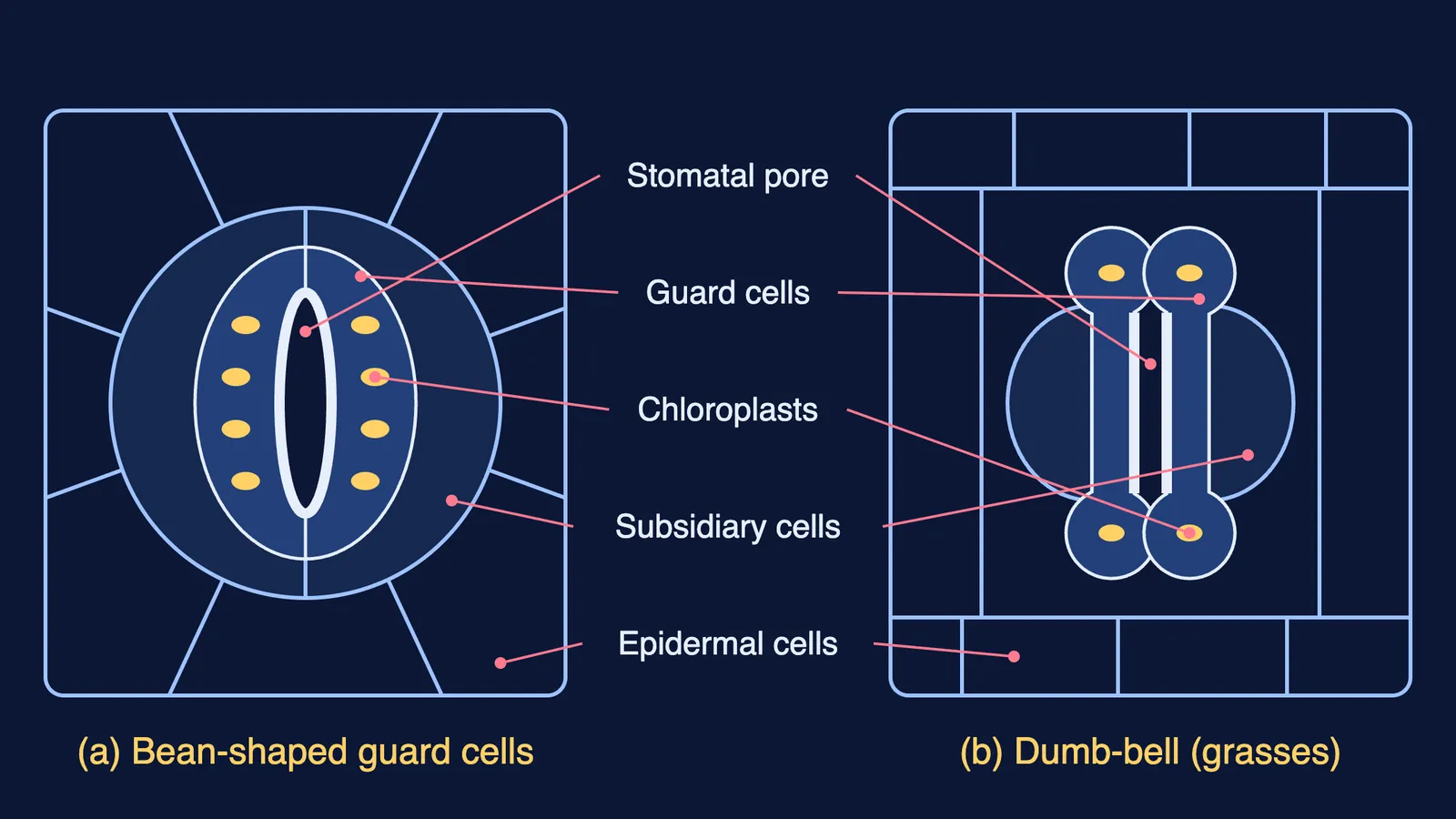
Stomata: openings in the leaf epidermis that control transpiration and gas exchange.
Guard cells: the two cells that surround each stomatal pore and open or close it. They contain chloroplasts, and their walls facing the pore are much thicker than their outer walls. Example: bean-shaped in most plants, dumb-bell shaped in grasses.
Subsidiary cells: epidermal cells next to the guard cells that, in some plants, have become different in shape and size. Don't confuse with: guard cells, which border the pore itself.
Stomatal apparatus: the pore, its guard cells and the subsidiary cells around them, counted as one unit.
Root hairs: single-celled outgrowths of root epidermal cells that absorb water and minerals. Don't confuse with: trichomes, the usually many-celled hairs on stems, which help reduce water loss.
What are radial, conjoint, open and closed vascular bundles?
Source: NCERT section 6.1.3.
Vascular bundle: a strand in which xylem and phloem run together.
Open vascular bundle: a bundle with cambium between xylem and phloem, so it can later add secondary xylem and phloem. Example: dicot stem. Don't confuse with: closed bundle, which has no cambium and forms no secondary tissue, as in monocots.
Radial arrangement: xylem and phloem lie on different, alternating radii. Example: roots. Don't confuse with: conjoint, where xylem and phloem sit on the same radius, usually with phloem outside, as in stems and leaves.
Endarch: protoxylem lies towards the centre of the stem, as in each dicot stem bundle.
Which terms describe the root and stem?
Source: NCERT sections 6.2.1 to 6.2.4.
Epiblema: the outermost layer of the root; many of its cells grow out as root hairs.
Cortex: the layers between the outer skin and the vascular region; in roots, thin-walled parenchyma with air spaces between cells.
Endodermis: the innermost cortex layer. In roots it is one layer of barrel-shaped cells with no gaps between them.
Casparian strips: bands of suberin, a waterproof, waxy substance, on the radial and tangential walls of root endodermal cells. Don't confuse with: cuticle, the wax on the outer epidermis.
Starch sheath: the endodermis of a dicot stem, named for its many starch grains.
Pericycle: thick-walled layers just inside the endodermis. In roots they start lateral roots and the vascular cambium; in a dicot stem they form half-moon patches of sclerenchyma over the phloem.
Conjunctive tissue: parenchyma lying between the xylem and phloem patches of a root.
Stele: the central core inward of the endodermis: pericycle, vascular bundles and pith.
Polyarch: having many xylem bundles, usually more than six, typical of the monocot root. Don't confuse with: the dicot root, which usually has two to four xylem patches.
Pith: the central parenchyma. Small or hard to see in a dicot root; large in a monocot root and dicot stem.
Hypodermis: the zone just below the stem epidermis: collenchyma in a dicot stem, sclerenchyma in a monocot stem.
Medullary rays: radial parenchyma layers between neighbouring bundles of a dicot stem.
Bundle sheath: a layer wrapping each vascular bundle. Example: sclerenchyma around each scattered bundle of a monocot stem, which also lacks phloem parenchyma and has water-containing cavities.
What is the difference between a dorsiventral and an isobilateral leaf?
Source: NCERT sections 6.2.5 and 6.2.6.
Dorsiventral leaf: the typical dicot leaf, with different upper and lower halves. Don't confuse with: isobilateral leaf, the monocot type, with stomata on both surfaces and mesophyll not split into palisade and spongy layers.
Adaxial and abaxial epidermis: the upper and lower leaf surfaces. In a dorsiventral leaf the abaxial side usually has more stomata.
Mesophyll: chloroplast-rich parenchyma between the two epidermal layers.
Palisade parenchyma: tall cells packed side by side under the upper epidermis. Don't confuse with: spongy parenchyma, round or oval cells below it with large air spaces.
Bulliform cells: big, colourless, empty-looking cells along the veins of the upper epidermis in grass leaves. When they lose water, the leaf rolls inwards and loses less water.
How to learn these terms
Draw the stomatal apparatus from memory, then label pore, guard cells, subsidiary cells and chloroplasts. NCERT Exercise 4 asks you to explain stomata with a labelled diagram.
Draw one cross-section of each organ and label each layer, outside to centre.
Turn each "Don't confuse with" pair into a flashcard.
Practise naming a section from its features, as NCERT Exercise 3 does.
If a term still has no picture attached, the Fermi Concept Library gives each biology concept its own lesson. For the chapter overview, read our Anatomy of Flowering Plants Class 11 guide, then test yourself with these anatomy of flowering plants practice questions with solutions.