On this page
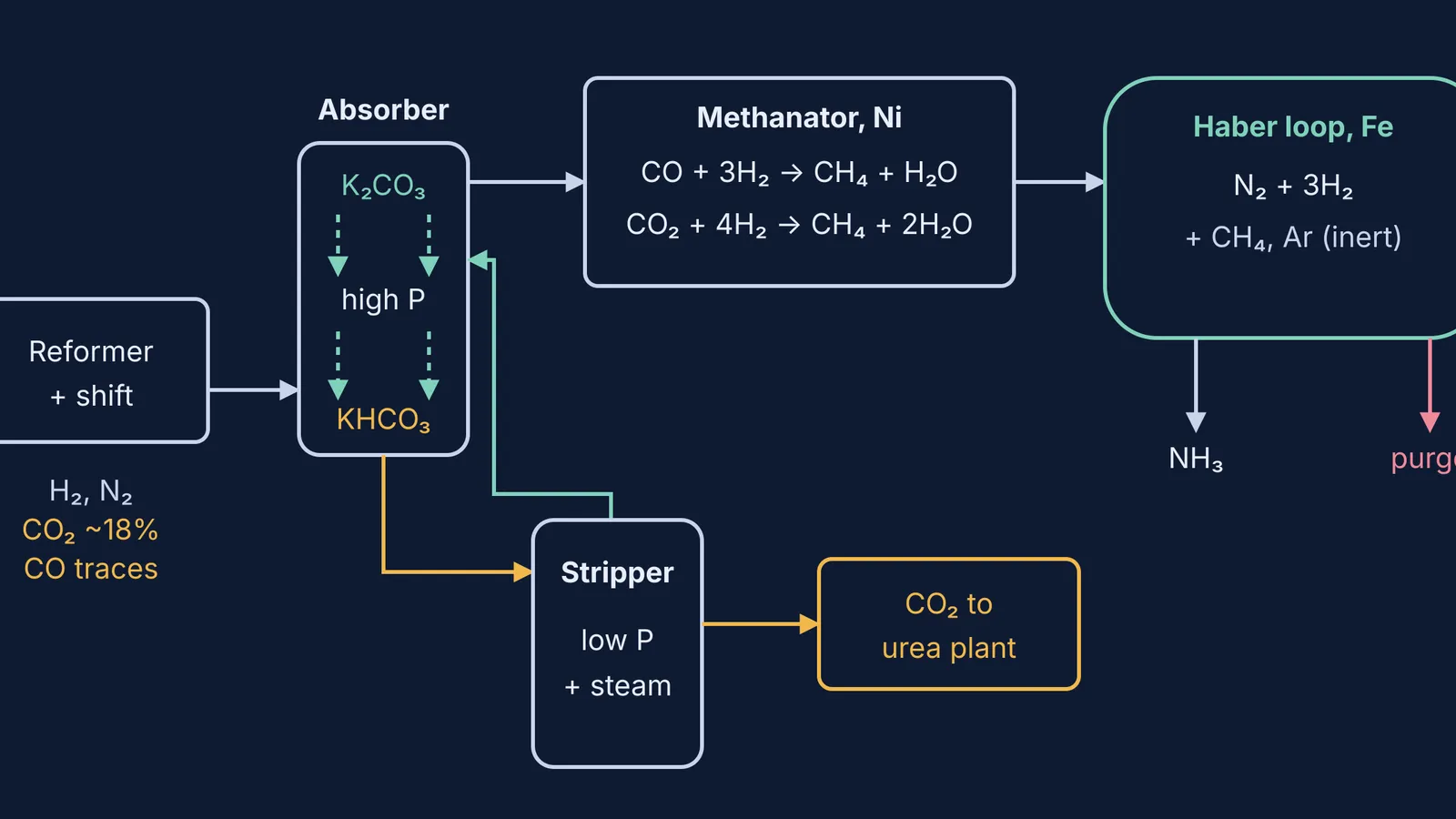
NCERT writes the Haber process as N₂ + 3H₂ ⇌ 2NH₃ and starts with clean gases. In a plant that makes its hydrogen from natural gas, the hydrogen arrives mixed with carbon dioxide and a little carbon monoxide, left over from steam reforming and the water gas shift. Both must be removed before the gas reaches the iron catalyst. Here are the two clean-up steps and a check on whether the CO₂ removed can feed a urea plant.
What is in the gas before it reaches the Haber loop?
The hydrogen comes from steam reforming followed by the water gas shift, as explained in how hydrogen is made by steam reforming and the water gas shift. An ammonia plant adds a secondary reformer: air is blown in to supply the nitrogen, and its oxygen burns part of the gas for heat.
The European Commission's reference document on ammonia, acids and fertiliser plants (2007) describes the conventional route. Gas leaving the secondary reformer holds 12–15% CO on a dry basis. After a hot iron-oxide shift and a cooler copper-based shift, the residual CO is 0.2–0.4%. Nearly all the carbon from the feed is now CO₂: about 18% of the dry gas by our idealised count below, roughly a fifth.
Why must CO₂ and CO be removed before ammonia synthesis?
The same document says the small amounts of CO and CO₂ left in the gas "can poison the ammonia synthesis catalyst". Oxygen-containing molecules bind to the iron surface and block the sites where N₂ should be adsorbed.
There is a second problem. CO₂ reacts with ammonia to form solid ammonium carbamate, 2NH₃ + CO₂ → NH₂COONH₄, which would deposit in the cold parts of the loop. So the gas is cleaned in two steps: a bulk step that removes almost all the CO₂, then a polishing step for the last traces of both oxides.
How does hot potassium carbonate absorb CO₂?
The gas rises through a column against a falling stream of hot potassium carbonate solution:
K₂CO₃ + CO₂ + H₂O ⇌ 2KHCO₃
Check the balance: 2 K, 2 C, 6 O and 2 H on each side.
The absorber runs at high pressure, and a high partial pressure of CO₂ helps twice. By Henry's law, more CO₂ dissolves. By Le Chatelier's principle, more CO₂ pushes the equilibrium right, towards KHCO₃.
The loaded solution then goes to a stripper, where the pressure is let down and steam is blown through. Lower pressure and steam cut the partial pressure of CO₂ above the liquid, so CO₂ escapes and the equilibrium shifts left. KHCO₃ turns back into K₂CO₃, which is pumped back to the absorber.
Potassium carbonate is not the only solvent. The reference document lists aqueous amines such as activated methyl diethanolamine (aMDEA) alongside it, and gives residual CO₂ after this step as usually 50–3000 ppmv. Both bind CO₂ reversibly. NaOH would hold CO₂ firmly as carbonate and not release it when the pressure drops, so it could not be reused.
What does the methanator do with the last CO and CO₂?
The second step turns the remaining traces into methane over a nickel catalyst at around 300 °C:
CO + 3H₂ → CH₄ + H₂O, ΔH = −206 kJ/mol
CO₂ + 4H₂ → CH₄ + 2H₂O, ΔH = −165 kJ/mol
The first equation is steam reforming written backwards. Reforming is endothermic, so the reformer runs very hot to favour CO + 3H₂. The methanator runs much cooler, where the exothermic reverse direction is favoured. Residual carbon oxides after methanation are usually below 10 ppmv, and the water formed is condensed out.
Methane does not poison the iron catalyst, but like argon it is inert. Unreacted gas is recycled, so inerts would build up; a small purge stream is bled off continuously, which the reference document says keeps inerts at about 10–15% of the loop gas. Every CH₄ the methanator makes must leave this way, taking some hydrogen with it. The clean gas is what lets the loop run at the conditions in why the Haber process uses 450 °C and 200 atm.
Methanation is exothermic, so if the shift or absorber fails and much more CO or CO₂ arrives, the catalyst temperature can run away.
Worked example: is there enough CO₂ for the urea plant?
In a fertiliser complex, the CO₂ from the stripper goes next door to make urea, 2NH₃ + CO₂ → CO(NH₂)₂ + H₂O; the chemistry is in how urea is made from ammonia and CO₂. Is it enough? Take the ideal case: natural gas only, every reaction complete, air as the nitrogen source.
Nitrogen. 2 NH₃ needs 1 N₂ from air. Air has about 0.2095 mol O₂ and 0.0093 mol Ar per 0.7808 mol N₂, so 1 N₂ brings 0.268 O₂ and 0.012 Ar.
Hydrogen. The ammonia needs 3 H₂. The 0.268 O₂ burns 2 × 0.268 = 0.537 H₂ to water. So the plant must make 3.537 H₂ per 2 NH₃. (It really burns a mix of H₂, CO and CH₄; the net balance is the same.)
CO₂ made. Overall, CH₄ + 2H₂O → CO₂ + 4H₂, so 3.537 H₂ comes with 3.537 ÷ 4 = 0.884 CO₂.
Gas composition. Dry gas after the shift: 3 H₂ + 1 N₂ + 0.012 Ar + 0.884 CO₂ = 4.896 mol, of which CO₂ is 0.884 ÷ 4.896 = 18%.
CO₂ per tonne of NH₃. 2 NH₃ is 34.06 g; 0.884 CO₂ is 38.9 g. That is 1.14 t of CO₂ per tonne of NH₃.
CO₂ urea needs. 1 CO₂ per 2 NH₃ is 44.01 ÷ 34.06 = 1.29 t per tonne of NH₃.
Compare. 1.14 ÷ 1.29 = 0.884. If all the ammonia went to urea, process CO₂ would cover about 88% of the need, a shortfall of about 12%.
This is an idealised stoichiometry estimate, not a figure for any real plant. Real plants also burn natural gas to heat the reformer, and some recover CO₂ from that flue gas. Naphtha- or coal-based plants have more carbon per hydrogen, so their balance differs.
Part b: the hydrogen cost of methanation. Take 100 mol of gas with 0.3% CO and 0.1% CO₂, illustrative values within the ranges above. Hydrogen used = 3 × 0.3 + 4 × 0.1 = 1.3 mol, giving 0.4 mol CH₄ and 0.5 mol H₂O. With about 74 mol of H₂ present, that is under 2%. Methanating all 0.884 CO₂ from step 3 would need 4 × 0.884 = 3.54 H₂, every bit of hydrogen the plant made. That is why the bulk CO₂ is absorbed, not methanated.
If step 2 trips you up, the Fermi Problem Library has worked problems with a step-by-step solver that explains the reasoning.
Quick checklist
After the shift, the dry gas is roughly a fifth CO₂, with traces of CO.
CO and CO₂ poison the iron catalyst; CO₂ would also form solid carbamate with NH₃.
Bulk CO₂: K₂CO₃ + CO₂ + H₂O ⇌ 2KHCO₃ at high pressure, reversed at low pressure with steam. Amines such as aMDEA are also used.
Traces: CO + 3H₂ → CH₄ + H₂O and CO₂ + 4H₂ → CH₄ + 2H₂O over Ni, both exothermic.
CH₄ and Ar are inerts, removed by a purge.
Ideal gas-based plant: about 1.14 t CO₂ per t NH₃ against 1.29 t for full urea conversion, about 12% short.