

On this page
Every urea plant starts from two gases, ammonia and carbon dioxide. The route goes through ammonium carbamate, the compound JEE uses for the Kp = 4P³/27 question, and the plant runs that equilibrium in the opposite direction. This post covers the two steps, why reactors run at high pressure with extra ammonia, and where biuret, the impurity fertiliser rules limit, comes from.
What are the two steps in making urea?
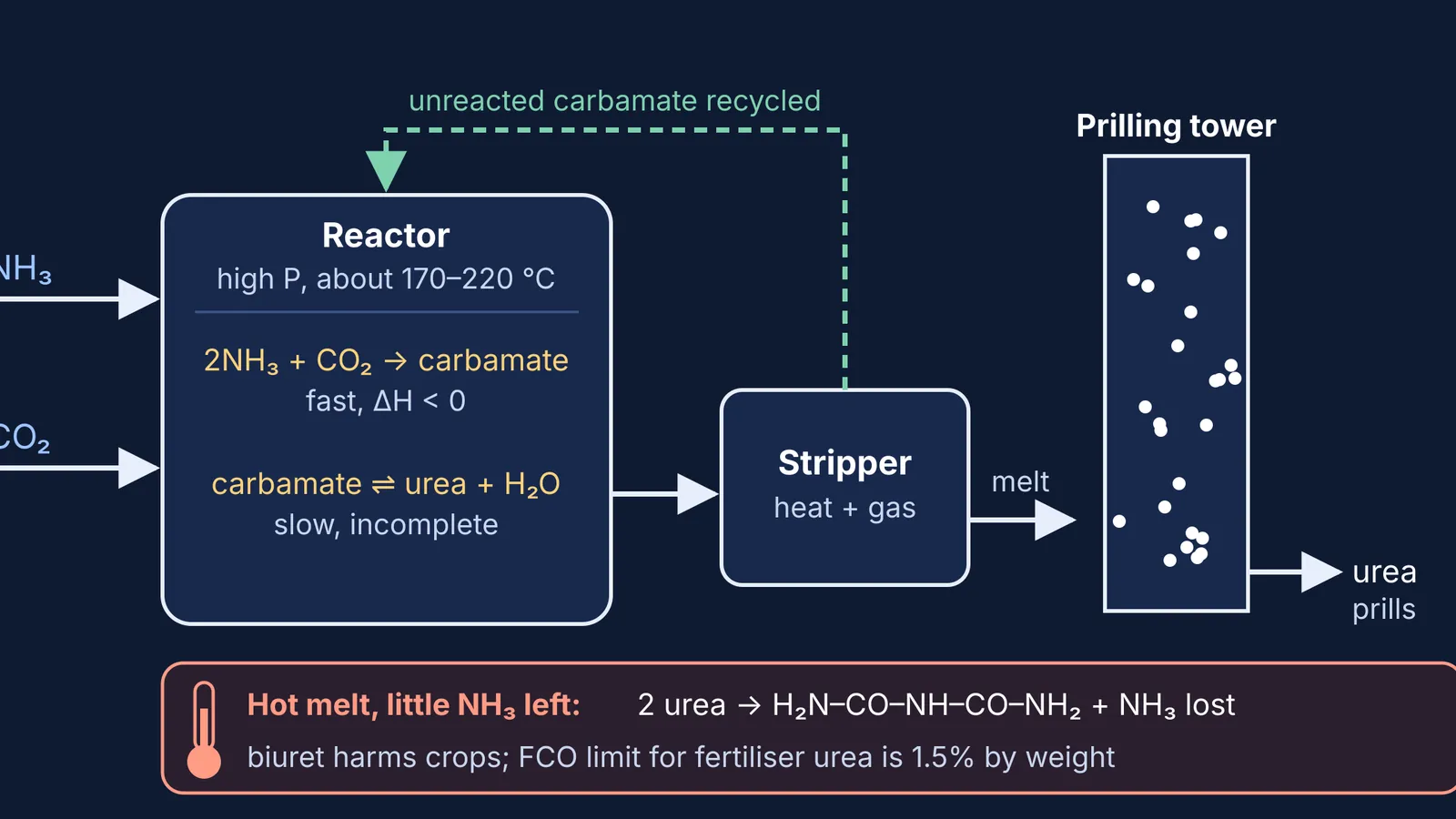
Step 1: ammonia and CO₂ form ammonium carbamate.
2NH₃ + CO₂ → NH₂COONH₄
Check the balance: 2 N, 6 H, 1 C and 2 O on each side. This step is fast and strongly exothermic.
Step 2: carbamate loses water to give urea.
NH₂COONH₄ ⇌ NH₂CONH₂ + H₂O
Check: 2 N, 6 H, 1 C and 2 O on the left; urea (2 N, 4 H, 1 C, 1 O) plus water (2 H, 1 O) on the right. This step is slow, only slightly endothermic, and it never goes to completion. Both enthalpy signs are listed in the production section of the Wikipedia article on urea.
Add the two steps and the carbamate cancels:
2NH₃ + CO₂ → CO(NH₂)₂ + H₂O
This is not Friedrich Wöhler's 1828 route from ammonium cyanate. Industry uses NH₃ and CO₂ because an ammonia plant makes both; the CO₂ is a by-product of making its hydrogen.
Why do urea reactors run at such high pressure?
Look at step 1 backwards. The carbamate decomposition is:
NH₂COONH₄ ⇌ 2NH₃(g) + CO₂(g)
One formula unit gives three moles of gas. This is the sealed-flask equilibrium in ammonium carbamate: why Kp = 4P³/27 and not P³. In that problem the carbamate decomposes until the gas pressure is tiny. A plant wants the opposite. It needs carbamate to stay in the hot liquid long enough to turn into urea. By Le Chatelier's principle, raising the pressure pushes the equilibrium towards the side with fewer gas moles, which is carbamate.
Temperature pulls the other way. Step 2 is slow, so the reactor must be hot, but heat also decomposes carbamate, so pressure has to rise with temperature. The final conditions are a compromise between rate, equilibrium and corrosion, much like the conditions chosen for the Haber process.
There is no single standard condition. Licensed processes differ: Stamicarbon strips with CO₂, and Saipem (formerly Snamprogetti) strips with ammonia. One urea-stripping patent gives the general range as 170–220 °C and 12–21 MPa (about 120–210 bar). Treat any single figure you see as one plant's design, not a constant.
Why is excess ammonia used, and what happens to unreacted carbamate?
Even under these conditions, step 2 stops well short of completion. A Saipem patent notes that equilibrium limits CO₂ conversion to about 53% for a stoichiometric mixture at 185 °C. The same patent says conventional reactors convert 50–65% of the CO₂ fed in one pass.
Plants raise this in two ways.
Excess ammonia. The feed carries more than 2 mol NH₃ per mol CO₂. The stripping patent above gives an N/C ratio of roughly 2.5 to 4.5. Extra NH₃ helps use up the more valuable CO₂. It also slows biuret formation, as shown below.
Stripping and recycling. The reactor liquid is a mixture of urea, water, excess ammonia and unconverted carbamate. In the stripper, heat and a stream of gas (CO₂ or NH₃) sweep away the NH₃ and CO₂ released by carbamate. That lowers their partial pressures, so more carbamate decomposes. This is the same equilibrium as before, now pushed the other way on purpose. The gases are condensed back to carbamate and returned to the reactor.
What is biuret, and why does fertiliser urea limit it?
When urea is hot and concentrated, two molecules can join and lose ammonia:
2CO(NH₂)₂ → H₂N–CO–NH–CO–NH₂ + NH₃
Check: the left has 2 C, 2 O, 4 N and 8 H. Biuret (C₂H₅N₃O₂) plus NH₃ gives 2 C, 2 O, 4 N and 8 H. It balances.
Ammonia is a product here, so the ammonia-rich reactor mostly suppresses it. The risk comes later, in the evaporators and the prilling or granulation step, where the melt is very hot and most of the ammonia has gone.
Biuret is harmful to crop plants, especially seedlings and leaves sprayed with urea solution. India's Fertiliser (Control) Order, 1985 therefore sets a maximum of 1.5% biuret by weight for urea (46% N), alongside a 46.0% minimum nitrogen. Neem coating, which most Indian urea now carries, slows the conversion of urea nitrogen to nitrate in soil. It is added after the urea is made and does not change this chemistry.
You have met the name before. The biuret test uses alkaline copper(II) sulphate, which turns violet with compounds that have two or more –CO–NH– groups close together, such as the peptide links in proteins. Biuret is not built from amino acids, so it has no peptide bond in the protein sense. But its two –CO–NH– units give the same colour, and the test is named after it. See it among tests for carbohydrates, fats and proteins.
Worked example: how much ammonia and CO₂ does a tonne of urea need?
Use M(urea) = 60.06, M(NH₃) = 17.03, M(CO₂) = 44.01, M(H₂O) = 18.02 and M(biuret) = 103.08 g/mol.
Write the overall equation. 2NH₃ + CO₂ → CO(NH₂)₂ + H₂O. One mole of urea needs 2 mol NH₃ and 1 mol CO₂.
Ammonia per tonne. 2 × 17.03 / 60.06 = 0.567 t of NH₃.
CO₂ per tonne. 44.01 / 60.06 = 0.733 t of CO₂.
Water made. 18.02 / 60.06 = 0.300 t. Check the mass balance: 0.567 + 0.733 = 1.300 t in, and 1.000 + 0.300 = 1.300 t out.
Recycling (illustrative 60% per pass). The reactor must see 0.733 / 0.60 = 1.22 t of CO₂ per tonne of urea; about 0.49 t goes round the loop as carbamate.
Loss to biuret. Suppose 1.0% of the urea (10 kg per tonne) turns into biuret. Moles of urea = 10,000 / 60.06 = 166.5 mol. Two urea give one NH₃, so 83.3 mol NH₃ is released. That is 83.3 × 17.03 = 1.42 kg of NH₃ lost. Biuret formed = 83.3 × 103.08 = 8.58 kg.
Does biuret change the nitrogen label? Urea is 46.6% N and biuret is 40.8% N. A product with 1.5% biuret has 0.985 × 46.6 + 0.015 × 40.8 = 46.6% N. The nitrogen figure barely moves, which is why biuret needs its own limit. The %N calculation itself is worked in how to calculate nitrogen percentage in urea and ammonium sulphate.
For practice switching between decomposition in a flask and formation in a reactor, the Fermi Problem Library has a step-by-step solver that explains the reasoning at each stage.
Quick checklist
Step 1: 2NH₃ + CO₂ → NH₂COONH₄, fast and strongly exothermic.
Step 2: NH₂COONH₄ ⇌ CO(NH₂)₂ + H₂O, slow, slightly endothermic and incomplete.
High pressure stops carbamate decomposing to 3 mol of gas. Temperature is a compromise between rate and carbamate stability.
Excess NH₃ raises CO₂ conversion and suppresses biuret. Unconverted carbamate is stripped and recycled.
2 urea → biuret + NH₃. The Fertiliser (Control) Order limit for urea is 1.5% biuret.


