

On this page
Put a little solid ammonium carbamate in an evacuated flask and it decomposes into ammonia and carbon dioxide until the pressure stops rising. JEE has asked about this equilibrium for decades, and the answer always hinges on one line: Kp = 4P³/27. Many students write P³, or (P/3)³, and lose the question. This post shows where the 4/27 comes from, then works the three versions examiners like: total pressure from Kp, the same flask with ammonia already present, and Kc from Kp.
What is the ammonium carbamate equilibrium?
The reaction is:
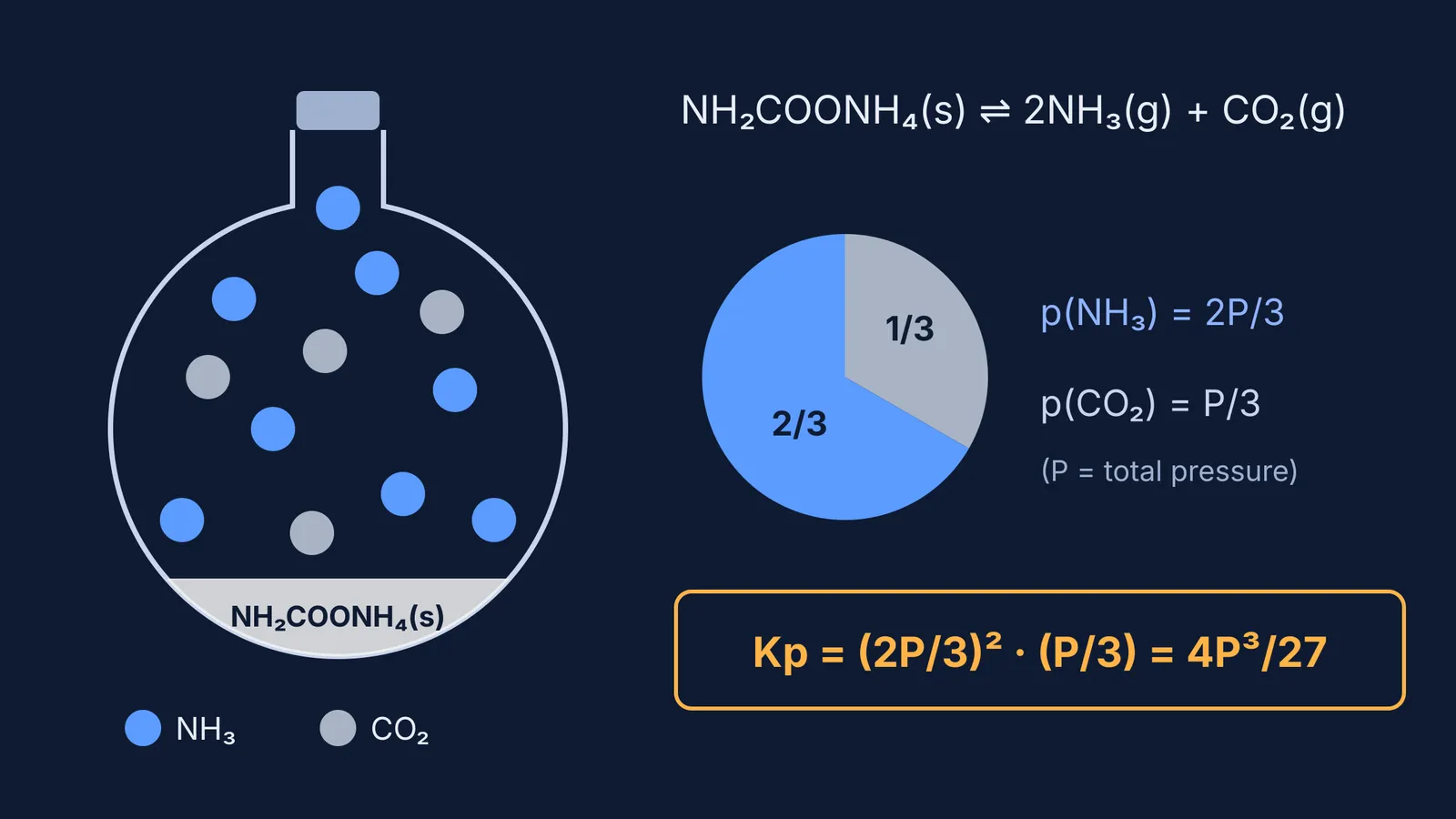
NH₂COONH₄(s) ⇌ 2NH₃(g) + CO₂(g)
Check the balance: on the left there are 2 N, 6 H, 1 C and 2 O. On the right, 2NH₃ gives 2 N and 6 H, and CO₂ gives 1 C and 2 O. It balances.
This is a heterogeneous equilibrium. The solid does not appear in Kp, so:
Kp = p(NH₃)² × p(CO₂)
The ammonia term is squared because its coefficient is 2. The reason solids drop out, and what happens when the solid runs out, is explained in heterogeneous equilibria: why solids drop out of K. That post works the 1 : 1 case, NH₄HS, where Kp = P²/4. Carbamate gives gases in a 2 : 1 ratio, which changes the factor.
Why is Kp = 4P³/27?
Start from an evacuated flask, so every gas molecule comes from the solid. For every mole of CO₂ that forms, exactly two moles of NH₃ form. The partial pressures are therefore always in the ratio 2 : 1.
Write the partial pressures in terms of one unknown. Let p(CO₂) = p. Then p(NH₃) = 2p.
Add them to get the total pressure. P = 2p + p = 3p, so p = P/3.
Write each gas. p(NH₃) = 2P/3 and p(CO₂) = P/3. The mole fractions are 2/3 and 1/3.
Substitute into Kp. Kp = (2P/3)² × (P/3) = (4P²/9) × (P/3) = 4P³/27.
The same method works for any solid that gives two gases. If the solid gives a moles of one gas and b moles of another, Kp = (aᵃ × bᵇ) / (a + b)⁽ᵃ⁺ᵇ⁾ × P⁽ᵃ⁺ᵇ⁾. For NH₄HS, a = b = 1, which gives P²/4. For carbamate, a = 2 and b = 1, which gives 4P³/27. You do not need to memorise this general form. Redo steps 1 to 4 each time and you will not go wrong.
Kp here has units of atm³ (or bar³), because three pressure terms are multiplied. The units of K are discussed in more detail in units of the equilibrium constant.
How do you find the total pressure from Kp?
This is the classic problem. The value Kp = 2.9 × 10⁻⁵ atm³ is the one used in the standard textbook version of the question. Treat it as problem data, not as a measured constant.
Solid ammonium carbamate is placed in an evacuated flask and allowed to reach equilibrium. Kp = 2.9 × 10⁻⁵ atm³. Find the total pressure and each partial pressure.
Set up. Kp = 4P³/27.
Rearrange. P³ = 27Kp/4 = 27 × 2.9 × 10⁻⁵ / 4 = 1.96 × 10⁻⁴ atm³.
Take the cube root. P = 0.058 atm.
Split it 2 : 1. p(NH₃) = 2 × 0.058/3 = 0.039 atm. p(CO₂) = 0.058/3 = 0.019 atm.
Check. (0.0387)² × 0.0194 = 2.9 × 10⁻⁵. It matches.
One condition is hidden in the word "equilibrium": some solid must still be in the flask. If the amount of solid is too small to supply 0.058 atm of gas in that volume, it all decomposes and the pressure ends up lower than this.
What happens if ammonia is already in the flask?
Now the 2 : 1 split no longer holds, because some NH₃ did not come from the solid. This is where students who memorised 4P³/27 go wrong. Go back to partial pressures.
Same Kp. The evacuated flask is first filled with NH₃ at 0.10 atm, then solid carbamate is added. Find p(CO₂) at equilibrium.
Let x be the CO₂ formed. The solid gives x atm of CO₂ and 2x atm of NH₃.
Write the partial pressures. p(CO₂) = x and p(NH₃) = 0.10 + 2x.
Write Kp. (0.10 + 2x)² × x = 2.9 × 10⁻⁵.
Estimate. If 2x is small next to 0.10, then 0.010x = 2.9 × 10⁻⁵, and x ≈ 0.0029 atm. But 2x = 0.0058 is about 6% of 0.10, so the estimate is rough.
Solve properly. Solving the cubic (numerically, or by trying values) gives x = 0.0026 atm.
Check. p(NH₃) = 0.10 + 0.0052 = 0.105 atm. (0.105)² × 0.0026 = 2.9 × 10⁻⁵. It matches.
Without added ammonia, p(CO₂) was 0.019 atm. With it, p(CO₂) is 0.0026 atm, roughly seven times less. This is the common-ion idea applied to a gas. Adding a product pushes the equilibrium back towards the solid, as Le Chatelier's principle predicts. But note what did not change: Kp is still 2.9 × 10⁻⁵ atm³.
If you want to practise more set-ups like this, the Fermi Problem Library has a step-by-step solver that explains the reasoning at each stage, so you can see where the 2 : 1 ratio does and does not apply.
How do you convert Kp to Kc for ammonium carbamate?
Use Kp = Kc(RT)^Δn. Count gas moles only: Δn = (2 + 1) − 0 = 3. The solid is not counted, because it is not a gas. Students often write Δn = 2, by subtracting 1 for the solid; that is wrong. The rule is covered in the Kp and Kc relation and Δn.
Suppose the data are for 298 K. With R = 0.0821 L atm mol⁻¹ K⁻¹:
RT = 0.0821 × 298 = 24.47 L atm mol⁻¹.
(RT)³ = 1.46 × 10⁴.
Kc = Kp / (RT)³ = 2.9 × 10⁻⁵ / 1.46 × 10⁴ = 2.0 × 10⁻⁹ mol³ L⁻³.
The temperature here is an assumption for the example. If a question states a different temperature, use that one.
What mistakes cost marks on this question?
Writing Kp = P³. This ignores the split. It gives P = 0.031 atm instead of 0.058 atm.
Writing Kp = (P/3)³. This treats both gases as if they had equal shares and forgets that NH₃ is squared.
Forgetting the square on NH₃. The exponent follows the coefficient 2 in the balanced equation.
Using 4P³/27 when a gas is added. Use separate partial pressures instead.
Counting the solid in Δn. Δn = 3, not 2.
Ignoring whether solid remains. No solid left means no equilibrium.
Quick checklist
Write NH₂COONH₄(s) ⇌ 2NH₃(g) + CO₂(g) and Kp = p(NH₃)² × p(CO₂).
From an evacuated flask: p(NH₃) = 2P/3, p(CO₂) = P/3, Kp = 4P³/27.
With added gas: use x and partial pressures, not P.
Units of Kp: atm³ or bar³.
Δn = 3 for Kp = Kc(RT)^Δn.
Check that some solid is still present.


