On this page
Algebra Play is Chapter 6 of Ganita Prakash, Grade 8 Part II (book code hegp2, First Edition December 2025, pages 135 to 147). You watch a trick work, use algebra to explain why it always works, then build your own.
CBSE's curriculum page for 2026-27 lists syllabi for Classes 9 to 12 only, so Class 8 follows the NCERT book directly and the chapter is assessed by your school.
What is Algebra Play in Class 8 Ganita Prakash?
The chapter covers five ideas in this order:
'Think of a Number' tricks, including one that recovers a secret date.
Number pyramids, where each box holds the sum of the two boxes below it.
Fun with grids: calendar magic and algebra grids where shapes stand for numbers.
The largest product you can make from three digits.
Decoding divisibility tricks, followed by a Figure it Out set that includes word problems.
The common habit: name the unknown with a letter, write each step as an expression, and let it show why the answer never changes.
How do you explain a 'Think of a Number' trick with algebra?
Our own trick: think of a number, multiply it by 3, add 12, divide by 3, then subtract the number you started with. The answer is always 4.
Call the number x. The steps give 3x, then 3x + 12, then x + 4, then x + 4 − x = 4. The x cancels.
A date trick works the same way: multiply the month M by 4, add 7, multiply by 25, then add the day D. That gives 4M + 7, then 100M + 175, then 100M + 175 + D. If a friend says 1003, subtract 175 to get 828. The day is at most 31, so it fills the last two digits: D = 28 and M = 8, so 28 August.
How do number pyramids and calendar grids work?
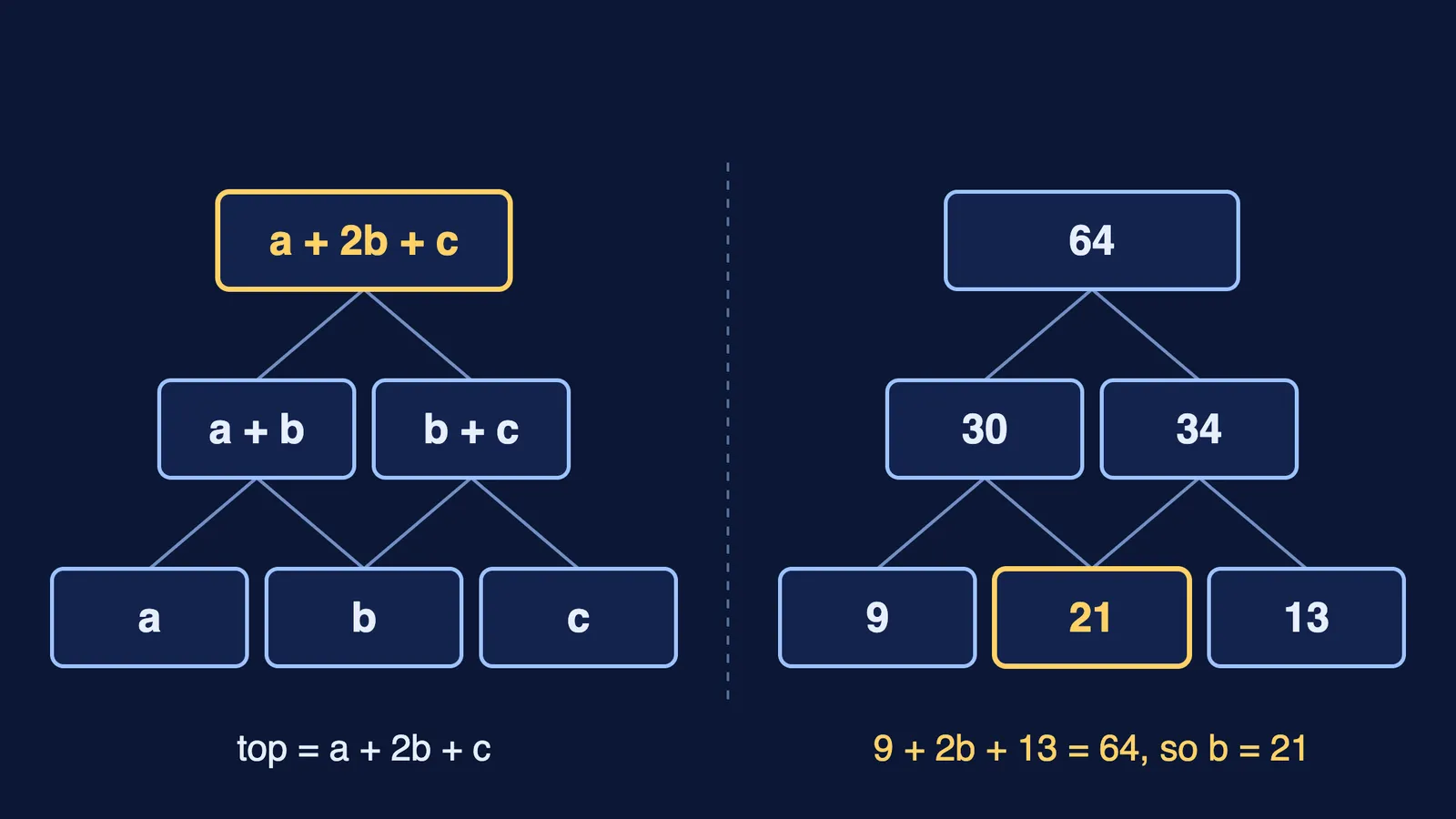
In a pyramid with three rows and bottom row a, b, c, the middle row is a + b and b + c, so the top is a + 2b + c.
Worked example (ours): top 64, bottom row 9, b, 13. Then 9 + 2b + 13 = 64, so 2b = 42 and b = 21. The middle row is 9 + 21 = 30 and 21 + 13 = 34, and 30 + 34 = 64 checks out.
In a calendar, dates in one column differ by 7. Take three stacked dates: a, a + 7 and a + 14. Their sum is 3a + 21. If the sum is 51, then 3a = 30 and a = 10, so the dates are 10, 17 and 24.
How does algebra settle the largest product and divisibility tricks?
For three digits p < q < r placed as a two-digit number times a one-digit number, the book proves the largest product is qp × r: the largest digit multiplies, the other two go in decreasing order. With our digits 4, 6 and 8, that gives 64 × 8 = 512. The nearest rival is 84 × 6 = 504.
For divisibility, write a two-digit number as 10a + b. Reversing gives 10b + a, and (10a + b) − (10b + a) = 9(a − b), so the difference is always a multiple of 9. Try 92: a = 9 and b = 2, so 92 − 29 = 63 = 9 × 7. The same place-value thinking explains why the alternating-sum test for 11 works.
Practice questions (our suggestion)
Our own questions, not the book's exercises; marks are our suggestion.
Think of a non-zero number, add 5, multiply by 4, subtract 20, divide by the starting number. Show the answer is always 4. (2 marks)
A three-row pyramid has bottom row 7, 15, 4. Find the top without filling the middle row. (2 marks)
Four dates in one calendar column add up to 78. Find them. (3 marks)
Place the digits 2, 7 and 9 in the pattern two-digit number × one-digit number to get the largest product. (2 marks)
Pens cost ₹15 and notebooks ₹35. Sixteen items cost ₹380. How many of each? (3 marks)
Answers: 1. 4(x + 5) − 20 = 4x, and 4x ÷ x = 4. 2. 7 + 30 + 4 = 41. 3. 4a + 42 = 78, so 9, 16, 23 and 30. 4. 72 × 9 = 648, just ahead of 92 × 7 = 644. 5. Nine pens and seven notebooks.
How does this chapter connect to the rest of the book?
The chapter opens by recalling two years of using algebra to model situations. In Part I, Chapter 6, We Distribute, Yet Things Multiply, is about algebra and the distributive law, which you use here whenever you expand a step such as 4(x + 5). For Class 9 algebra, see our Ganita Manjari guides to Introduction to Linear Polynomials and Exploring Algebraic Identities.
Not sure where to begin with a puzzle? Fermi's AI tutor works out what you already know and builds a plan for the session.