On this page
Since 1 April 2020, new vehicles sold in India have had to meet the Bharat Stage VI (BS-VI) emission norms (DieselNet summary of Indian standards). Look at a BS-VI diesel truck or bus and you will often find a second, smaller filler cap, usually blue, marked AdBlue or DEF (diesel exhaust fluid). That tank holds no fuel. It holds urea dissolved in water, and the chemistry it drives is a redox reaction you can balance with Class 11 oxidation numbers.
What is AdBlue and why does a diesel truck need it?
A diesel engine runs with a lot of spare air, and hot, oxygen-rich combustion turns some of its nitrogen into NO and a little NO₂, together called NOx.
A petrol car removes NOx with a three-way catalyst, which uses the CO in its own exhaust as the reducing agent. That trick needs an exhaust with almost no spare oxygen, and diesel exhaust has far too much, as our post on what a catalytic converter does explains. So a diesel needs a reducing agent added on purpose. That reductant is ammonia, carried safely as urea.
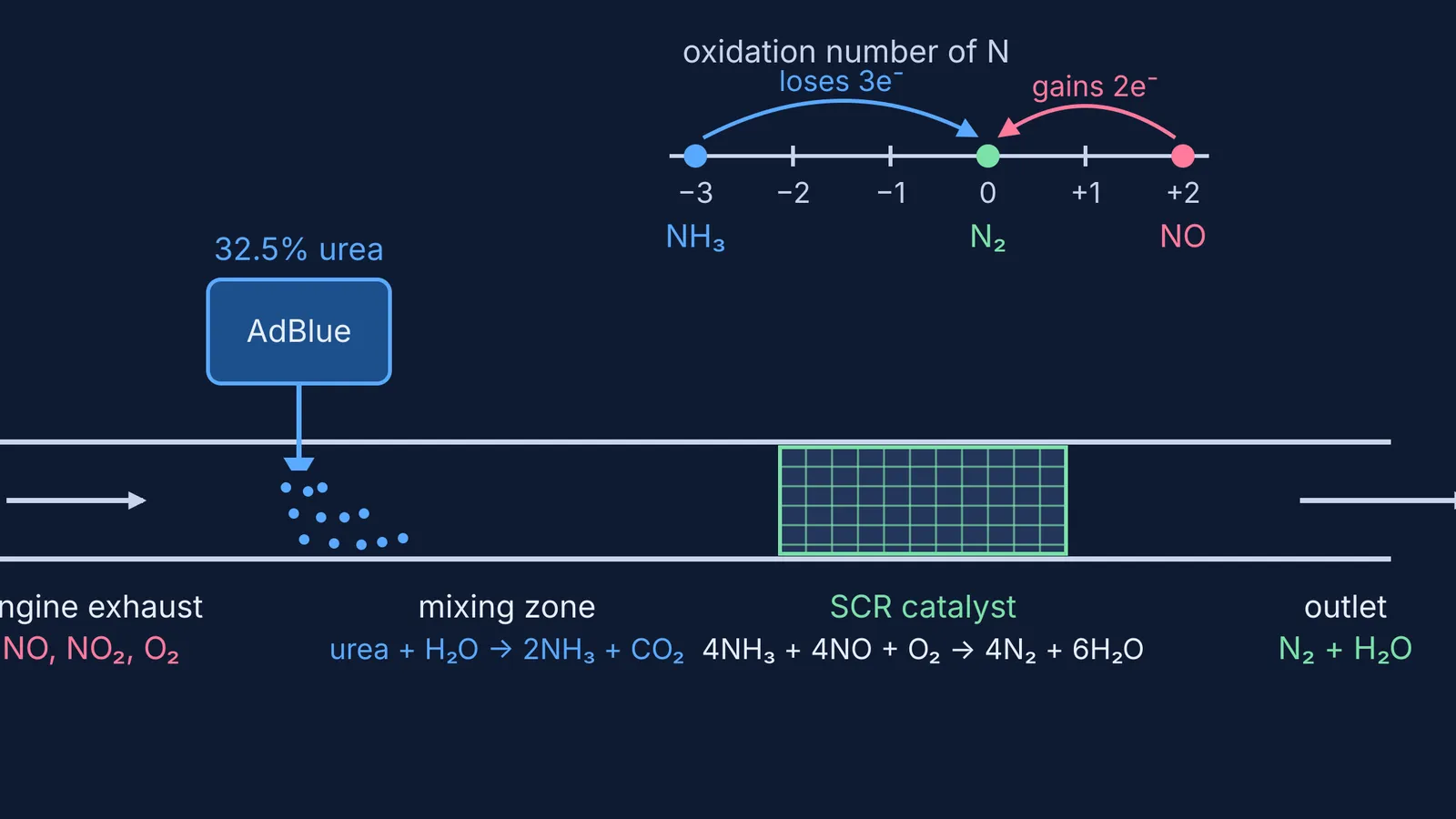
AdBlue is a trade name for the fluid that the international standard ISO 22241 calls AUS 32: technically pure urea in purified water, at 32.5% urea by mass (ISO 22241-1). It is dosed into the exhaust pipe ahead of a catalyst, and the whole system is called selective catalytic reduction, or SCR.
How does urea turn into ammonia in the exhaust?
The fluid is sprayed into exhaust gas that is already hot. The water evaporates first, and the urea then breaks down in two steps (Wikipedia: Diesel exhaust fluid):
Thermolysis. CO(NH₂)₂ → NH₃ + HNCO. The second product is isocyanic acid.
Hydrolysis. HNCO + H₂O → NH₃ + CO₂.
Add them and you get CO(NH₂)₂ + H₂O → 2NH₃ + CO₂. Urea is the diamide of carbonic acid, so this is simply amide hydrolysis. It is the urea factory's reaction run backwards.
This two-step picture is incomplete. At low exhaust temperatures, as in slow city traffic, urea and isocyanic acid also react to form solid by-products such as biuret and cyanuric acid, which can build up as deposits in the pipe.
What reaction does the SCR catalyst run?
The main reaction is called standard SCR (DieselNet: SCR systems):
4NH₃ + 4NO + O₂ → 4N₂ + 6H₂O
Check it: N 8 = 8, H 12 = 12, O 6 = 6.
When NO and NO₂ arrive in roughly equal amounts, a faster route takes over, called fast SCR:
2NH₃ + NO + NO₂ → 2N₂ + 3H₂O
Many systems place an oxidation catalyst upstream to turn part of the NO into NO₂ (2NO + O₂ → 2NO₂) so that this faster reaction can run.
The catalyst is not one fixed material. Common choices are copper- or iron-exchanged zeolites and vanadium oxide catalysts (V₂O₅ with WO₃ on a TiO₂ support). "Selective" means that the ammonia reacts mainly with NOx instead of simply burning in the far larger amount of oxygen present.
Dosing has to be just right. If more ammonia is added than the NOx can use, the excess leaves the tailpipe unreacted. This is called ammonia slip, and DieselNet notes that it rises as the NH₃ to NOx ratio goes above about 1.
Why is SCR a comproportionation reaction?
Assign oxidation numbers to nitrogen: −3 in NH₃, +2 in NO, +4 in NO₂, and 0 in N₂. Nitrogen starts at two different oxidation states and ends at one in between. That is a comproportionation, the opposite of a disproportionation.
Now count electrons for standard SCR:
4 NH₃ lose 4 × 3 = 12 e⁻ (−3 → 0).
4 NO gain 4 × 2 = 8 e⁻ (+2 → 0).
1 O₂ gains 4 e⁻ (two O atoms, 0 → −2).
Electrons lost = 12. Electrons gained = 8 + 4 = 12. For fast SCR: 2 NH₃ lose 6 e⁻; NO gains 2 and NO₂ gains 4, total 6, so no O₂ is needed.
How much AdBlue does it take? A worked example
Part (a). How much urea, and how much AdBlue, are needed to remove 1 kg of NO by standard SCR?
Molar mass of NO = 14.01 + 16.00 = 30.01 g/mol. Moles in 1 kg = 1000 ÷ 30.01 = 33.3 mol.
Standard SCR uses 4 NH₃ for 4 NO, so 1 NH₃ per NO: 33.3 mol NH₃.
One urea gives two NH₃, so urea = 33.3 ÷ 2 = 16.7 mol.
Molar mass of urea = 60.06 g/mol. Mass = 16.7 × 60.06 = 1000 g, so about 1.00 kg of urea.
AdBlue is 32.5% urea, so AdBlue = 1.00 ÷ 0.325 = 3.08 kg.
This is the stoichiometric minimum; real systems adjust dosing continuously.
Part (b). Why 32.5%? Check the freezing point with ΔTf = Kf·m, using Kf = 1.86 K kg mol⁻¹ for water.
Take 1 kg of fluid: 325 g urea and 675 g water.
Moles of urea = 325 ÷ 60.06 = 5.41 mol.
Molality m = 5.41 ÷ 0.675 = 8.02 mol kg⁻¹.
ΔTf = 1.86 × 8.02 = 14.9 K, which predicts a freezing point of −14.9 °C.
The real fluid freezes at about −11 °C (Wikipedia: Diesel exhaust fluid).
The formula is off by about 4 K because ΔTf = Kf·m is a law for dilute solutions, and 8 mol kg⁻¹ is not dilute. The method itself is set out in finding molar mass from depression in freezing point.
So why not add more urea for colder weather? Because 32.5% sits at, or very close to, the eutectic of the urea and water system: the composition with the lowest freezing point. Below it, ice separates on cooling. Above it, solid urea starts to crystallise out instead, at a higher temperature, not a lower one. The specification therefore allows only a narrow band, 31.8 to 33.2% urea (BASF AdBlue data sheet). It is a eutectic (about freezing), not an azeotrope (about boiling).
For more mole and redox problems of this kind, the Fermi Problem Library has a step-by-step solver that explains the reasoning at each stage.
Where else is the same ammonia chemistry used?
Go back to the Ostwald process for nitric acid. Ammonia is burnt to NO, NO is oxidised to NO₂, and NO₂ is absorbed in water: 3NO₂ + H₂O → 2HNO₃ + NO. The absorption tower never catches every last molecule, so the tail gas leaving it still contains some NO and NO₂. Many nitric acid plants clean that gas with the same NH₃-SCR reaction, using a little of the ammonia the plant already has. So the classroom process in Haber and Ostwald process conditions often ends with this reaction at the chimney.
Quick checklist
AdBlue (AUS 32) is 32.5% urea in purified water, defined by ISO 22241.
In hot exhaust: CO(NH₂)₂ → NH₃ + HNCO, then HNCO + H₂O → NH₃ + CO₂.
Standard SCR: 4NH₃ + 4NO + O₂ → 4N₂ + 6H₂O. Fast SCR: 2NH₃ + NO + NO₂ → 2N₂ + 3H₂O.
Nitrogen goes from −3 and +2 to 0: a comproportionation. 12 e⁻ lost = 8 + 4 gained.
About 1 kg urea, or 3.08 kg AdBlue, per kg of NO in theory.
ΔTf = Kf·m predicts −14.9 °C; the real fluid freezes near −11 °C because the solution is not dilute.
32.5% is a eutectic composition; more urea raises the temperature at which a solid appears.