On this page
It is 6 a.m. in December, the room is dark and the quilt is warm. That fog has a name, and it passes; spend it on a routine, not your hardest page.
Why do you feel so sleepy on winter mornings?
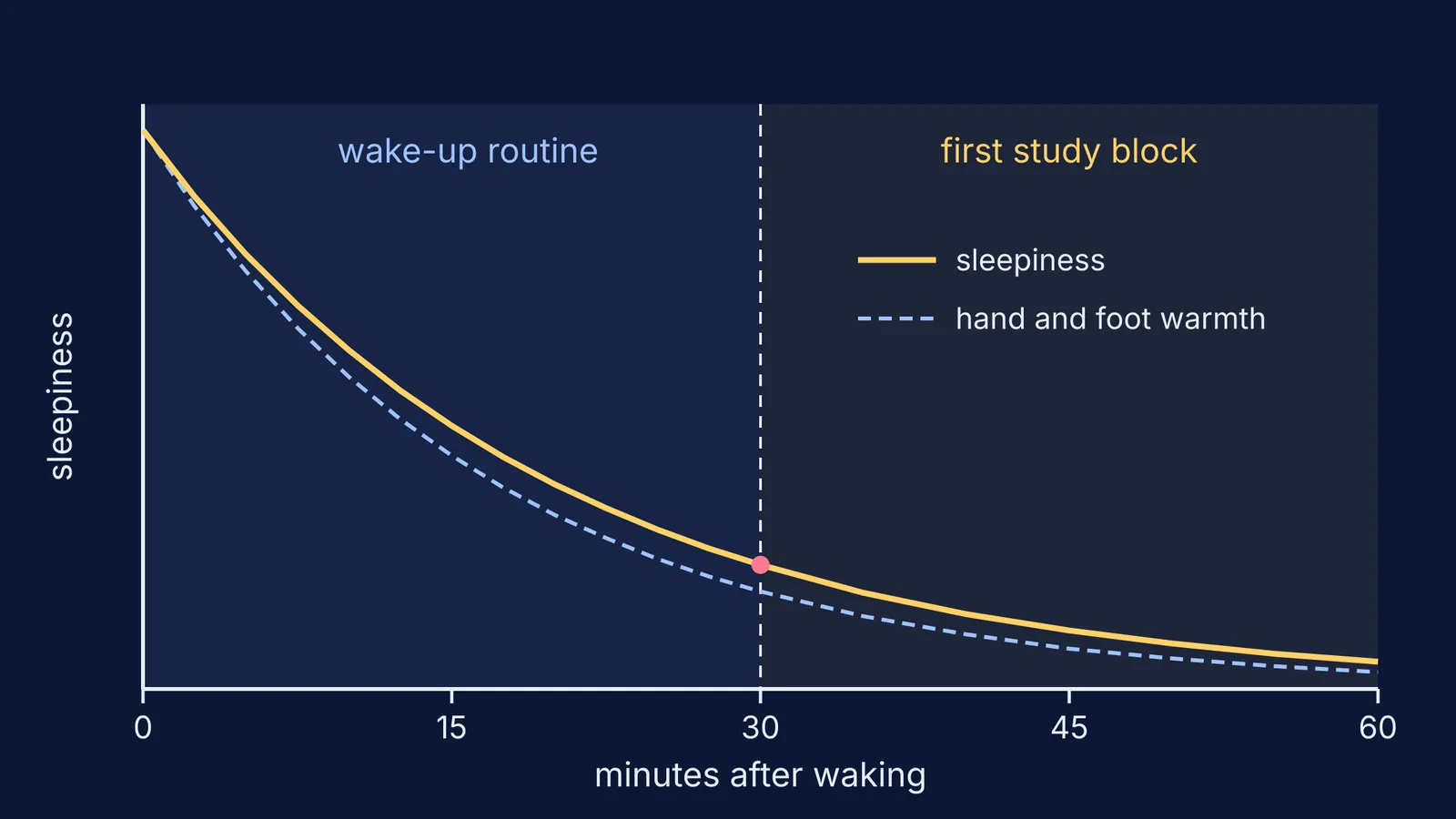
Sleep inertia is the grogginess you feel on waking, a dip in thinking performance that fades as you stay awake, according to a review in Nature and Science of Sleep by Cassie Hilditch and Andrew McHill. In the studies it covers, people typically returned to pre-sleep levels within 30 minutes of waking, sometimes within 15, though full recovery can take an hour or more. Right after waking, impairment can match or exceed the effects of sleep loss, and it is worse after a short night.
The time of day you wake matters too, but sleep is the part you control. Teenagers aged 13 to 18 should sleep 8 to 10 hours per 24 hours, says the American Academy of Sleep Medicine consensus statement. If you go to bed at midnight and wake at 5, no routine will fully clear the fog.
Does bright light or a cold room help you wake up?
Not much, in the first half hour. In a 2025 SLEEP conference study from San Jose State University and NASA Ames, 29 healthy adults wore light-emitting glasses after waking in the morning, and light had limited effectiveness. A 2024 trial in Clocks and Sleep tested a bedroom that brightened to 300 lux, warmed by 3°F over 45 minutes and played sound before the alarm; in 29 adults it had little overall effect.
Light does a slower job: it moves your body clock. In a 2020 study of 37 adolescents in Frontiers in Neuroscience, 2.5 hours of intermittent bright light on both weekend mornings shifted the body clock earlier by about 1.0 hour, against about 0.6 hours in dim room light. An earlier body clock can make it easier to fall asleep earlier, and earlier nights make mornings easier.
Temperature offers a clue, not a cure. A 2004 study in the Journal of Sleep Research found that after waking from an afternoon nap, people's hands and feet cooled at almost the same rate as their sleepiness faded. The Hilditch and McHill review notes that deliberately cooling them has not been tested as a fix. So: leave the quilt for a cool but bearable room rather than waiting in bed to feel awake.
A 30-minute winter wake-up routine
Keep one wake time, weekends included. Then:
Minute 0 to 2: alarm on the far side of the room. Stand up to switch it off, turn on the main light, open the curtains.
Minute 2 to 10: wash, brush, drink water, and put on socks and a sweater.
Minute 10 to 20: move. Step outside if it is light; if not, use the brightest room.
Minute 20 to 30: sit at your desk and read last night's note. Phone in another room.
Minute 30: start the first study block.
None of this is a proven cure; it keeps you up and moving while the fog fades.
What should your first study block be?
Make it easy to start, and decide it in advance. A meta-analysis by Peter Gollwitzer and Paschal Sheeran38002-1) found that if-then plans, called implementation intentions, had a medium-to-large effect (d = 0.65) on reaching goals across 94 independent tests. Write your if-then line the night before.
An example: Riya, in Class 12 and preparing for JEE Main, wakes at 6:00. The note on her desk reads: "If it is 6:30 and I am at the desk, I open the rotational motion sheet at Q7." Her 40-minute block:
6:30 to 6:40: redo two problems she solved yesterday, without looking at the solutions.
6:40 to 7:05: five new problems of medium difficulty, one at a time.
7:05 to 7:10: mark what went wrong and write tomorrow's if-then line.
The long derivation waits until after breakfast. If a method goes wrong, the Fermi Problem Library has a step-by-step solver that explains the reasoning, so she can see where she slipped. If you do not know what to put in tomorrow's note, Fermi's AI tutor can work out what you already know and build a plan for the session. If starting is the hard part, read why you procrastinate studying and how to take the first step.
What if you are still sleepy every morning?
Check your bedtime first: a week of short nights beats any routine. For a morning exam shift, see how to shift your body clock for a morning exam; for drowsiness later in the day, try our plan for feeling sleepy while studying.
If you sleep 8 hours or more and still feel exhausted for weeks, tell a parent and see a doctor. If tiredness comes with feeling low most days, call Tele MANAS, the government's free mental health helpline, on 14416.
Tonight, write one if-then line and leave it on your desk.