

On this page
JEE Main tells you when to be sharp; it does not ask. The National Testing Agency's JEE (Main) 2027 Information Bulletin sets the first shift at 9.00 am to 12.00 noon and the second at 3.00 pm to 6.00 pm, with entry to the centre for the morning shift from 7.00 am to 8.30 am. If you usually sleep at 1 am and wake at 8, a 9 am paper lands in hours your body still treats as night.
The answer is a two-week shift, not one heroic early night.
Why can't you just sleep early the night before?
Your body clock does not reset because your alarm did. Teenage body clocks tend to run late, which is why sleep arrives late (we explain the biology in why teenagers feel sleepy later at night). Go to bed three hours early and you may well lie awake, then wake up foggy.
That fog has a name. Sleep inertia is "a transitional state of lowered arousal occurring immediately after awakening from sleep and producing a temporary decrement in subsequent performance", as a review in Sleep Medicine Reviews defines it. You want it long gone before the first question loads.
How do you shift your sleep for a morning exam shift?
Move in steps. In a study published in the journal Sleep, Stephanie Crowley and colleagues followed 46 teenagers aged 14.5 to 17.9 who usually slept 7 hours or less and went to bed at 11 pm or later on school nights. One group moved bedtime 1 hour earlier than usual in week 1 and 2 hours earlier in week 2, used a personal evening time plan, and sat in bright light (about 6,000 lux for 2.5 hours) on both mornings of the middle weekend.
By week 2, that group fell asleep 1.5 hours earlier and slept 1.2 hours longer on school nights; the comparison group's sleep did not systematically change.
Morning bright light moves the body clock earlier, as an earlier study of adolescents by the same group found. Daylight soon after you wake is the easiest everyday source of bright morning light.
To set your target, count back from your wake-up time. Teenagers aged 13 to 18 should sleep 8 to 10 hours per 24 hours on a regular basis, according to the American Academy of Sleep Medicine consensus.
A two-week plan, worked through
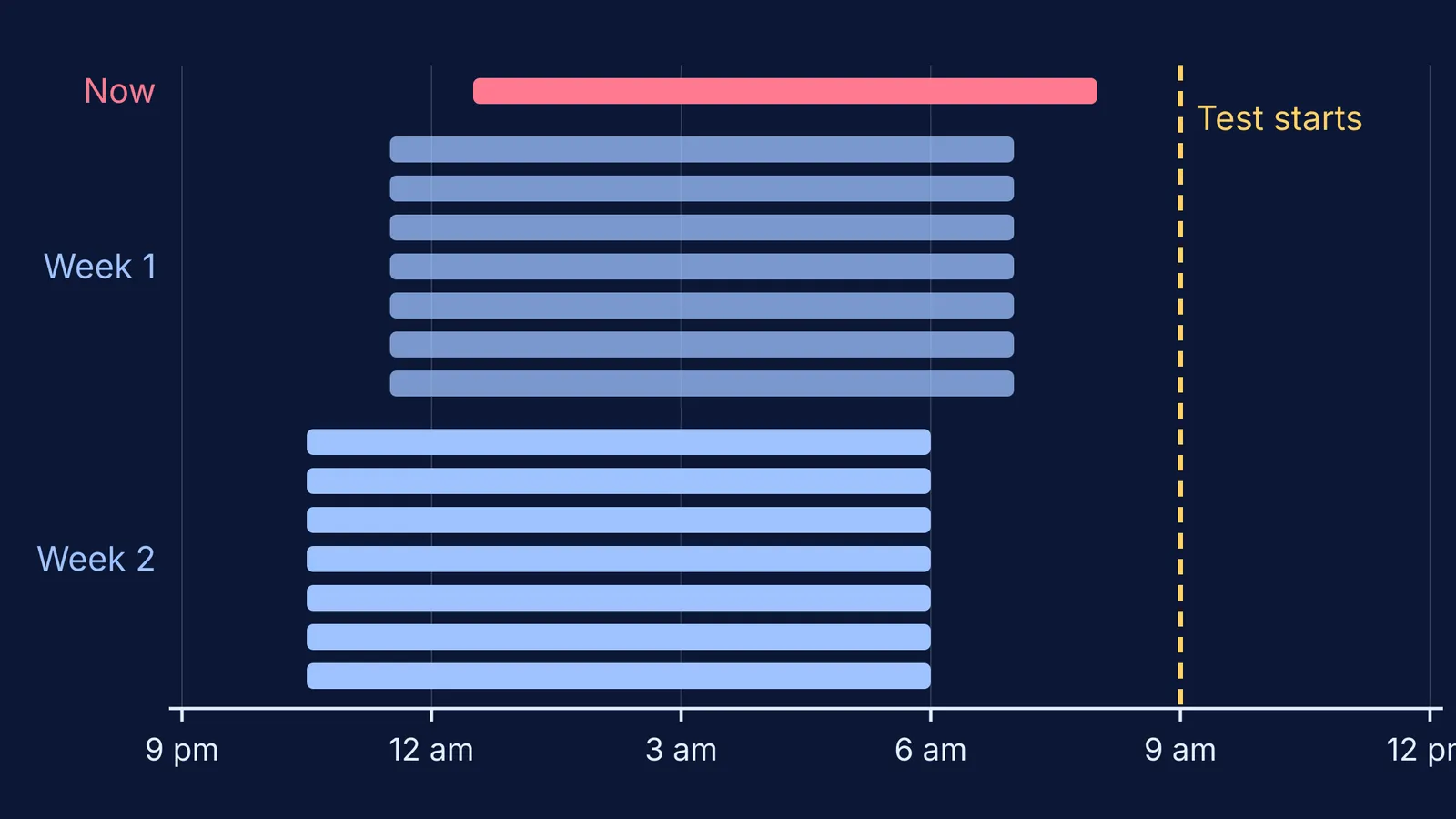
Take a Class 12 student who now sleeps from 12.30 am to 8.00 am. Their centre is 40 minutes away and entry closes at 8.30 am, so on exam day they want to wake at 6.00 am and leave by 7.15. That is a 2-hour move, the same size as in the Sleep study.
When to start matters. NTA's bulletin lists Session 1 admit cards for 13 January 2027 and exam days from 20 January, so you may learn your shift only a week ahead. Start around 6 January and plan for the morning shift.
Days 1 to 7: lights out 11.30 pm, alarm 7.00 am. Get into daylight within the first hour, even a short walk to buy milk.
Days 8 to 14: lights out 10.30 pm, alarm 6.00 am. Same morning light.
Every evening: follow a short time plan. Last new topic by 9 pm, light revision after, phone charging outside the room before lights out.
Weekends: keep the same alarm.
Week 2 mocks: sit full papers from 9.00 am to 12.00 noon at one desk, no phone, no breaks. You learn how the 9 am version of you performs.
Exam day: wake at 6.00, daylight and breakfast, leave at 7.15, inside the centre by 8.00.
A 9 am mock goes better if the first ten minutes are not spent choosing what to revise. Fermi's AI tutor can work out what you already know and build a plan for the session, so you sit down to a clear next step.
What if you get the afternoon shift?
The afternoon shift asks less of your sleep and more of your lunch. Entry runs from 1.00 pm to 2.30 pm and the paper from 3.00 pm to 6.00 pm, per the NTA bulletin. Keep the wake time you built, and move your last week of mocks to 3 to 6 pm so you know how your attention holds late in the paper.
Eat lunch early enough that you are not travelling on a heavy stomach; if the post-lunch slump hits you hard, read why we feel sleepy after lunch. For the things that can still go wrong, keep what to do if you are late or lose your admit card bookmarked.
When should you ask for help?
If you have followed a plan for weeks and still cannot fall asleep, or you feel low or anxious most days, talk to a doctor rather than pushing harder. Parents can help by moving family dinner and TV earlier for these two weeks. Tele MANAS, the national mental-health helpline, is free and 24x7 on 14416 or 1800-891-4416, as IIT Kanpur's counselling service lists.
Mark the date two weeks before your first paper and set the first alarm.


