

On this page
It is a familiar scene in many households: parents are exhausted and ready for bed by 10:00 PM, while their teenage children are wide awake, doing homework or messaging friends. This is often written off as laziness or poor discipline. However, the sleep-wake cycle is governed by deep structures in the brain—much like the vital functions we explore in our guide to the Parts of the human brain: forebrain, midbrain and hindbrain roles—and for adolescents, those structures are running on a different timezone.
Research shows that teenagers are biologically wired to stay up later. Two distinct shifts occur in the adolescent brain that delay their natural sleep cycle, putting them at odds with early school start times.
Why do teenagers feel sleepy later at night?
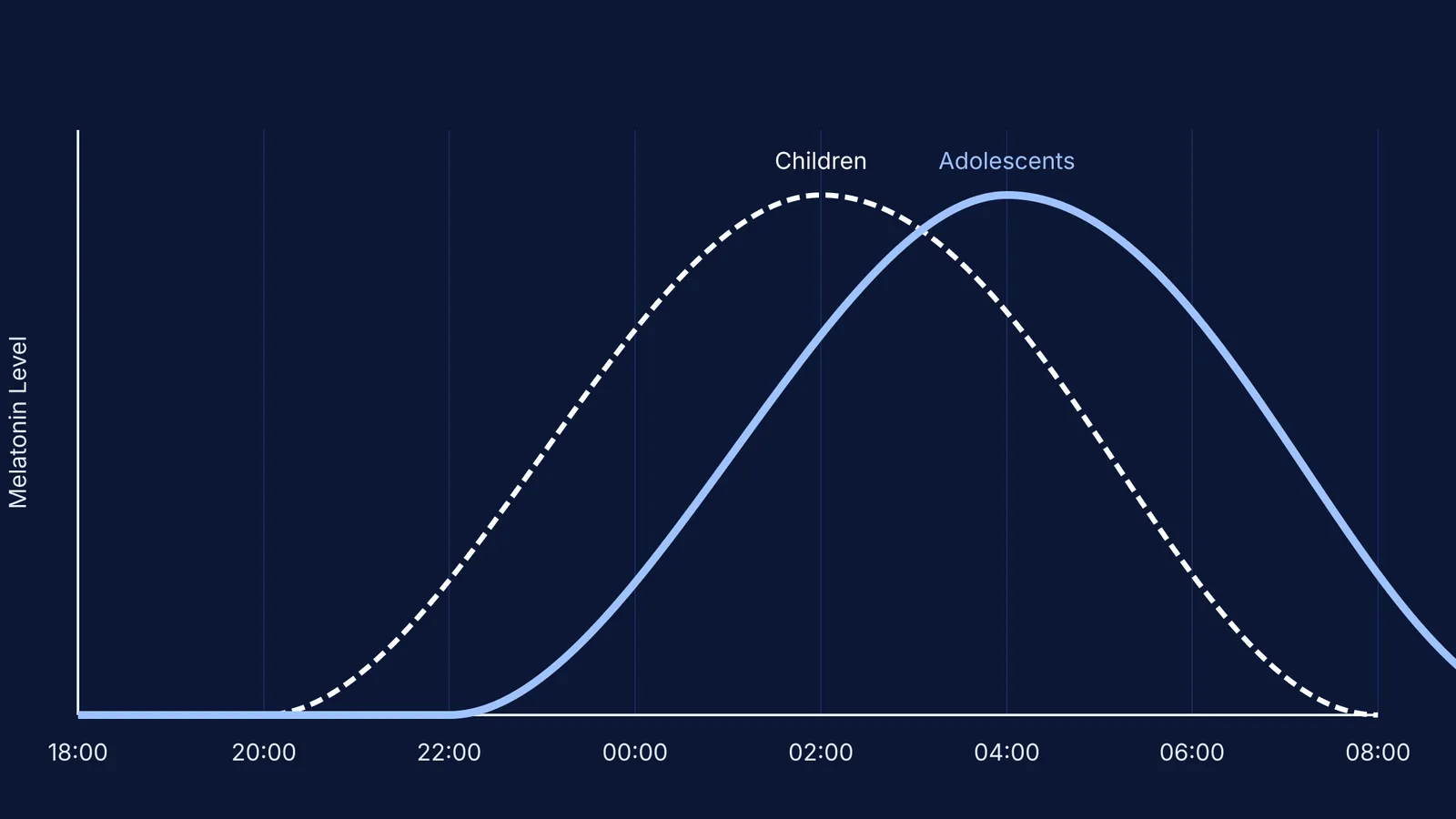
The primary driver is a shift in the circadian clock. In a 2009 review, Hagenauer and colleagues outlined how adolescents experience a 1- to 3-hour delay in their circadian phase (PMC2820578).
The body relies on a hormone called melatonin to signal that it is time to wind down. In prepubertal children, the onset of melatonin secretion—known as dim-light melatonin onset (DLMO)—happens early in the evening, often around 7:30 PM or 8:00 PM. During puberty, this release shifts dramatically. An adolescent's melatonin levels might not rise until 10:00 PM or later. Until that hormone floods the system, the brain simply does not feel tired.
Adolescents also experience a change in "homeostatic sleep pressure." This is the biological drive to sleep that slowly builds up the longer you are awake. In adults and younger children, sleep pressure accumulates steadily over the day. In teenagers, this pressure builds up much more slowly. Because it takes longer for them to feel the physical weight of sleepiness, they can easily push through the early evening hours feeling entirely alert.
Does evening light delay sleep even further?
This natural biological delay is worsened by how the teenage brain responds to light. Melatonin is highly sensitive to the light-dark cycle; bright light tells the brain it is still daytime, halting the hormone's production.
A 2015 study by Crowley, Carskadon, and others tested how the circadian system reacts to different light levels (PubMed). They found that younger adolescents in early to mid-puberty have an increased sensitivity to evening light. When exposed to moderate room light (about 150 lux) before bed, their bodies suppressed melatonin production significantly more than older teens.
This means that studying under bright overhead lights, or staring at the blue light from a laptop or phone, acts as a chemical brake on sleep. The light tricks the highly sensitive adolescent brain into thinking the sun is still up, suppressing the very hormone they need to feel sleepy. Even without the blue light, having a device nearby keeps the brain alert and distracted. A recent study showed that just having it present breaks concentration (read more in Does a phone on your desk hurt focus? The brain drain study).
How can you manage a delayed biological clock?
Because school timetables rarely accommodate the adolescent circadian phase, students have to actively manage their light exposure and routines to get enough rest.
Dim the lights early: Turn off bright overhead lighting and switch to warm, dim desk lamps well before your target bedtime.
Use screen filters: If you must use a computer for late homework, activate "Night Shift" or blue-light filters to reduce the wavelengths that suppress melatonin.
Get bright morning sunlight: The circadian clock needs to be anchored. Exposure to bright, natural sunlight immediately upon waking helps signal the start of a new day and prevents the internal clock from drifting even further.
Keep weekend wake times close: It is tempting to sleep until noon on Saturday to pay off a sleep debt. However, sleeping in drastically shifts the circadian phase later, making Sunday night restless and Monday morning exhausting. Try to keep weekend wake times close to the weekday schedule.
Study actively when tired: Passive reading makes you feel groggy if your sleep pressure is finally catching up, while your mind struggles to focus. If you are trying to master a tough concept late in the day, looking at interactive models is often easier than staring at text. The Fermi Simulation Lab provides interactive simulations for the ideas that are easier to see than to read.
The shift in the teenage sleep cycle is a temporary but powerful phase of human development. By understanding the timing of melatonin and managing evening light, families can stop fighting the biological clock and start working with it.


