

On this page
You sit down after dinner to finish a chapter, and twenty minutes later you are reading the same paragraph for the third time. Drowsiness at the desk usually has a few ordinary causes, and most of them can be fixed tonight without another cup of coffee.
Why do you feel sleepy while studying?
Three common causes often stack up.
Not enough sleep. The CDC recommends 8 to 10 hours of sleep a night for teens aged 13 to 17. If you regularly get less than that, no desk trick makes up for it.
The time of day. Sleep researcher Timothy Monk describes a post-lunch dip in performance: for some people and some tasks, performance drops in the mid-afternoon, linked to a rise in the pull towards sleep at that time.
A passive task. In a lecture study by Evan Risko and colleagues, mind wandering increased with time on task and memory for the lecture fell. Rereading notes is similarly passive: nothing asks you to respond, so attention can drift.
When should you study to avoid feeling sleepy?
Match the task to your energy. Put work that makes you produce something, such as numericals, derivations or a timed set of questions, in the slot where you usually fade. Save reading-heavy work for when you feel most alert, because reading is the easiest thing to do half-asleep.
If the mid-afternoon is your low point, use it for problem practice, a walk or a planned short nap rather than a textbook. Our post on how naps affect memory covers how to nap without waking up groggy.
Does sitting upright help you stay awake?
It can help a little, and it costs nothing. In a randomised trial of 74 people, those asked to sit upright reported more arousal and better mood than those who sat slumped. That study looked at stress, not studying, so treat posture as a nudge rather than a cure.
The bigger rule is simple: do not study in bed. Lying down is what your body does before sleep. Sit at a table and keep the bed for sleeping.
What wakes you up fastest when you are already drowsy?
Switch to an active task. Close the notes and write out what you remember, or solve two problems without looking. If you get stuck, the Fermi Problem Library has a step-by-step solver that explains the reasoning, so you keep working instead of sliding back into rereading.
Walk for 10 minutes. In a small study by Robert Thayer, 18 volunteers rated their energy after either a brisk 10-minute walk or a candy bar. The walk raised self-rated energy for 2 hours, while the sugar snack gave a short lift followed an hour later by more tiredness.
Turn the lights up. A systematic review of 68 studies found that brighter white light raised people's own ratings of alertness in a majority of studies, though many studies found no clear effect. A single dim lamp in a dark room is unlikely to help.
Go easy on caffeine. Read our guide to caffeine and studying before reaching for a third cup of chai or an energy drink.
A 90-minute evening plan you can copy
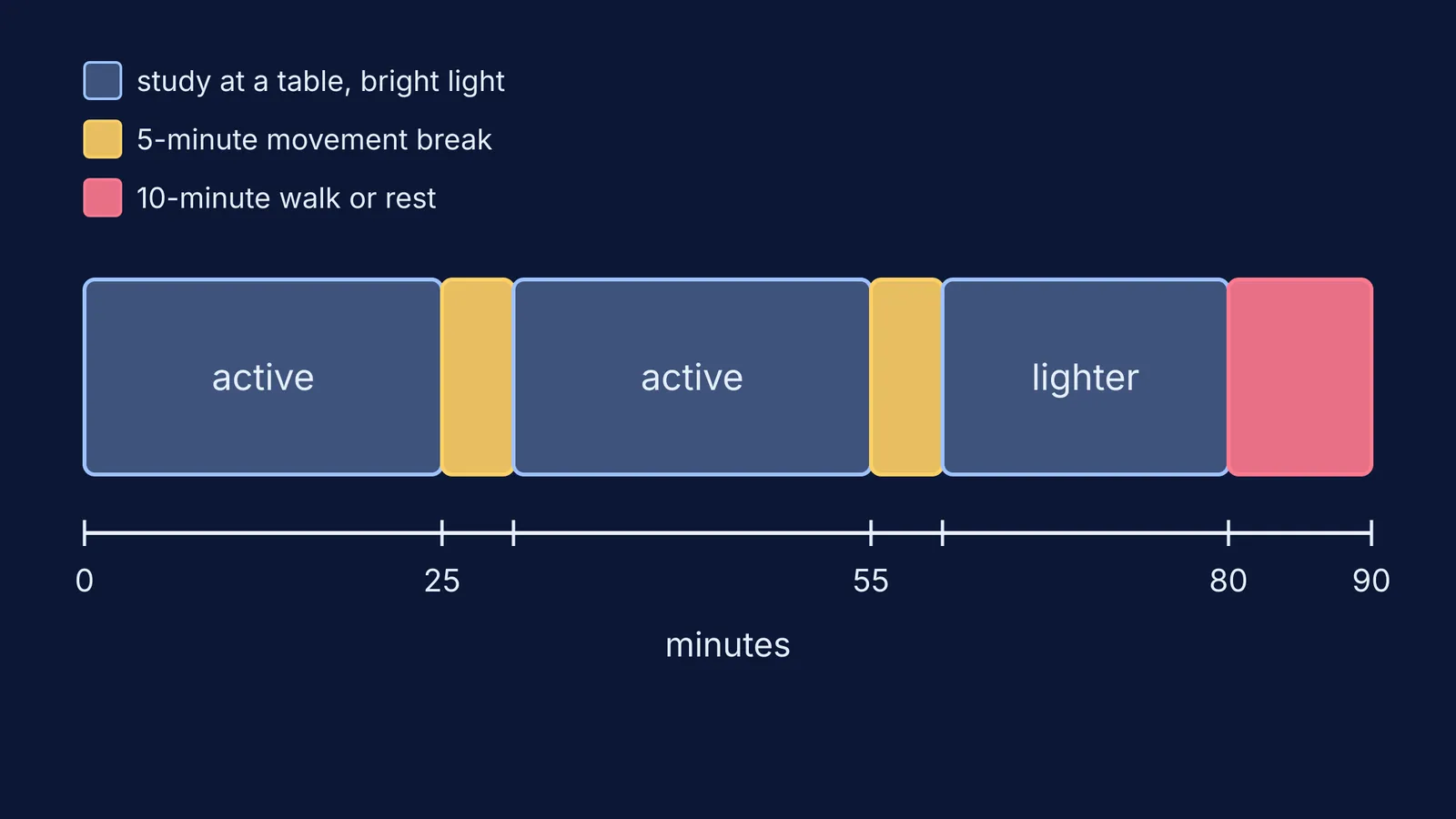
Here is one evening block, say for Class 12 physics. The diagram at the top shows it to scale.
Before you start: sit at a table, switch on the main light, put your phone in another room, and write down the one thing you will finish.
Minutes 0 to 25: active work. Ten numericals from today's chapter, or a page of notes rewritten from memory.
Minutes 25 to 30: stand up and move. Walk to the balcony or climb some stairs. No phone.
Minutes 30 to 55: active work again. Redo two mistakes from the first block.
Minutes 55 to 60: move again.
Minutes 60 to 80: lighter work, such as reading the next topic with a pencil and writing one question per paragraph. If a topic is hard to picture, like electric field lines, the Fermi Simulation Lab has interactive simulations for ideas that are easier to see than to read.
Minutes 80 to 90: a 10-minute walk, or stop for the night.
For breaks that rest your brain, see what to do in study breaks.
When is sleepiness a sign to get help?
Feeling dull after a long day is normal; constant sleepiness is not. The NHS advises seeing a doctor if you have felt tired for a few weeks and are not sure why, if tiredness affects your daily life, or if it comes with other symptoms such as weight loss, mood changes, or gasping or choking noises during sleep.
Parents, if your child is nodding off over books every night, look at bedtime and late-night phone use together before adding study hours. If low mood or exam stress is part of the picture, Tele MANAS on 14416 is the government's free mental health helpline, open 24x7.
Tonight, try one change: study at a table under a bright light, and take the 10-minute walk the moment your eyes start to close.


