On this page
Neon's atomic weight of about 20.2 is the number J. J. Thomson's two parabolas had to explain in 1913: neon is a mixture of atoms of mass 20 and 22. One careful source of that 20.2 is a weighing made three years earlier. Herbert Edmeston Watson weighed a bulb of pure neon, then corrected for the gas not being ideal. His paper, "The Densities and Molecular Weights of Neon and Helium", J. Chem. Soc. Trans. 97, 810–833, is a clean worked example of M = ρRT/P and the compressibility factor Z.
Who was Watson and where did his neon come from?
The paper gives his address as University College, London, and says he "was obliged to leave England" before finishing the helium work. We have not checked other details of his life. We checked the numbers used here against the scanned 1910 volume.
The gas came from Georges Claude in Paris, who had designed an apparatus for producing "the lighter constituents of the atmosphere". Claude gave Sir William Ramsay "about 40 litres of the product, which contained approximately 45 per cent. of mixed helium and neon". The hard part, he wrote, was "its separation from helium."
How did he separate neon from helium?
He tried two methods.
Diffusion through hot quartz. Helium passes through quartz at about 1200 °C, so he hoped it would leave the neon behind. It did not work: neon came through as well, and the summary says plainly that the quartz "is slightly permeable to the latter gas".
Coconut charcoal at liquid-air temperature. Cold charcoal soaks up neon strongly and helium hardly at all. He passed the gas over the charcoal again and again and pumped off fractions, keeping the ones rich in neon.
Spectra could barely show the last helium, because its yellow line at 5876 Å sits next to a bright neon line at 5882 Å. So he checked purity by weighing: the density rose as helium left.
How do you turn one weighing into a "normal litre"?
The paper prints one full calculation (fraction 28, 18 June 1909):
mass of neon: 0.24585 g
volume of bulb at 18 °C: 297.44 mL
pressure: 743.91 mm of mercury (reduced to 0 °C and latitude 45°)
temperature: 291.02 K, with absolute zero taken as −273.0 °C
A normal litre means 1 L at 0 °C and 760 mm. Scale the density to those conditions:
Raw density: 0.24585 ÷ 0.29744 = 0.82655 g/L.
Pressure up to 760 mm: × 760/743.91 = × 1.02163.
Temperature down to 273.0 K: × 291.02/273.0 = × 1.06601.
Result: 0.82655 × 1.02163 × 1.06601 = 0.9002 g/L, the value Watson printed.
Over all his runs the figures ranged from 0.8997 to 0.9006 g, and his final value was 0.9002 ± 0.0003 g. For helium he managed only two runs, 0.17830 and 0.17814 g, and used 0.1782.
Why is M = ρRT/P not quite enough for neon?
The usual ideal-gas route gives:
M = ρRT/P = 0.9002 × 0.082057 × 273.15 ÷ 1 = 20.18 g/mol
That assumes Z = 1. Watson used compressibility data measured by F. P. Burt with the same apparatus. Between 0 and 1 atm, neon's pv rose with pressure, with a coefficient A = +0.00105, "so that the behaviour of the gas on compression resembles that of hydrogen". For helium, pv stayed constant, so A = 0.
A gas with Z above 1 is slightly less dense than an ideal gas, so the measured density must be pushed up. Watson used Berthelot's rule: the limiting density D(1 + A) is proportional to molar mass.
Worked example: from 0.9002 g to 20.200
Limiting density of neon: 0.9002 × (1 + 0.00105) = 0.90115 g/L. Watson wrote 0.9011.
Reference gas: Gray and Burt had found the limiting density of oxygen to be 1.42762 g/L, which gives 32 ÷ 1.42762 = 22.415 L/mol. The paper prints this gas constant as 22.4149.
Neon: M = 32 × 0.90115 ÷ 1.42762 = 20.199, which Watson gave as 20.200.
Helium: A = 0, so M = 32 × 0.1782 ÷ 1.42762 = 3.994.
Same thing with Z: M = (ρRT/P) × Z. With Z = 1.00105, 20.177 × 1.00105 = 20.198.
How close was 20.200, and what did isotopes add?
The standard atomic weight of neon today is 20.1797, listed in the NIST table of atomic weights and isotopic compositions. Watson's 20.200 is 0.10% high, and his helium value of 3.994 is 0.21% below today's 4.0026. He had said his helium figure should be correct "to at least one part in 500".
We can partly trace the neon gap. The NIST WebBook fluid data give neon's density at 273.15 K and 1 atm as 0.899847 g/L. Combined with 20.1797, that means Z ≈ 1.0005 for neon, about half of Burt's 1.00105. The same calculation gives helium Z ≈ 1.0005, not exactly 1. This is our calculation from modern data, not something the 1910 paper could have known.
The isotope arithmetic is the one in average atomic mass from isotope abundance. NIST gives ²⁰Ne at 19.99244 (90.48%), ²¹Ne at 20.99385 (0.27%) and ²²Ne at 21.99139 (9.25%), which averages to 20.180. If you treat neon as only ²⁰Ne and ²²Ne, Watson's 20.200 would imply about 10.4% ²²Ne, against today's 9.25%.
Nothing in the paper hints at isotopes; it hopes the noble-gas atomic weights will reveal a pattern. That is why J. J. Thomson's 1913 neon result was a surprise: a careful 20.2 was not a near miss for 20, but a real average.
Why do helium and neon sit above Z = 1 while xenon sits below?
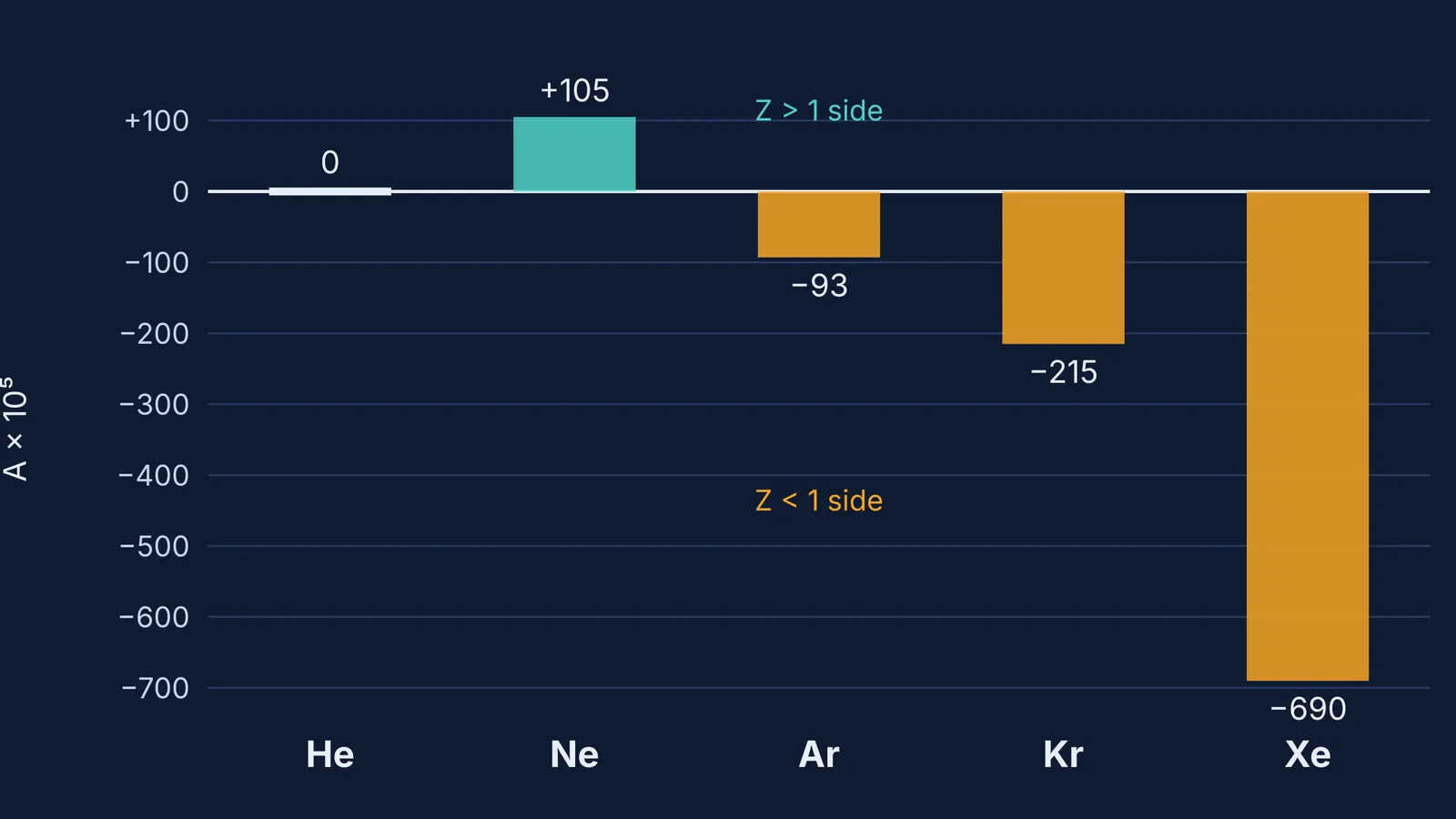
In a companion paper on krypton and xenon, Watson gave a summary table of A × 10⁵ for all five gases, shown in the chart above:
Helium 0, molecular weight 3.994
Neon +105, molecular weight 20.200
Argon −93, molecular weight 39.881
Krypton −215, molecular weight 82.92
Xenon −690, molecular weight 130.22
This is the Class 11 picture. Attractions grow with atomic size. Helium and neon attract so weakly that at 0 °C atomic size wins and Z is just above 1. Heavier atoms attract more, so Z drops below 1, most for xenon. The compressibility factor Z post shows the same split for H₂ and CO₂.
For more gas-law and Z problems with full working, the Fermi Problem Library has a step-by-step solver that explains the reasoning. To revise States of Matter for JEE Main and Advanced, use the Concept Library on Fermi Test Prep.
Why does this matter for JEE and NEET?
Class 11 States of Matter: M = ρRT/P and the compressibility factor Z.
Class 11 Some Basic Concepts: average atomic mass from isotope abundances.
Quick checklist
A normal litre of neon weighed 0.9002 ± 0.0003 g (Watson, 1910).
The ideal formula gives 20.18 g/mol. Correcting for A = +0.00105 gives 20.200.
Helium: 0.1782 g per litre, A = 0, M = 3.994.
Z > 1 means the ideal formula gives too low a molar mass. Z < 1 means it gives too high a value.
20.2 is an isotope average: about 90% ²⁰Ne, 9% ²²Ne.