

On this page
In 1913, the accepted atomic weight of neon was 20.2. At a time when elements were thought to be uniform and identical at the atomic level, a fractional atomic weight was a major puzzle. J.J. Thomson, the physicist famous for discovering the electron, turned his attention to positive ions—also known as canal rays or positive rays. In doing so, he provided the first evidence that stable elements could consist of atoms with different masses.
What was J.J. Thomson's positive rays experiment?
Working with his research assistant Francis Aston, Thomson built a modified discharge tube to study these positive rays. When a gas is ionized in a cathode ray tube, it produces streams of positive ions that move toward the cathode.
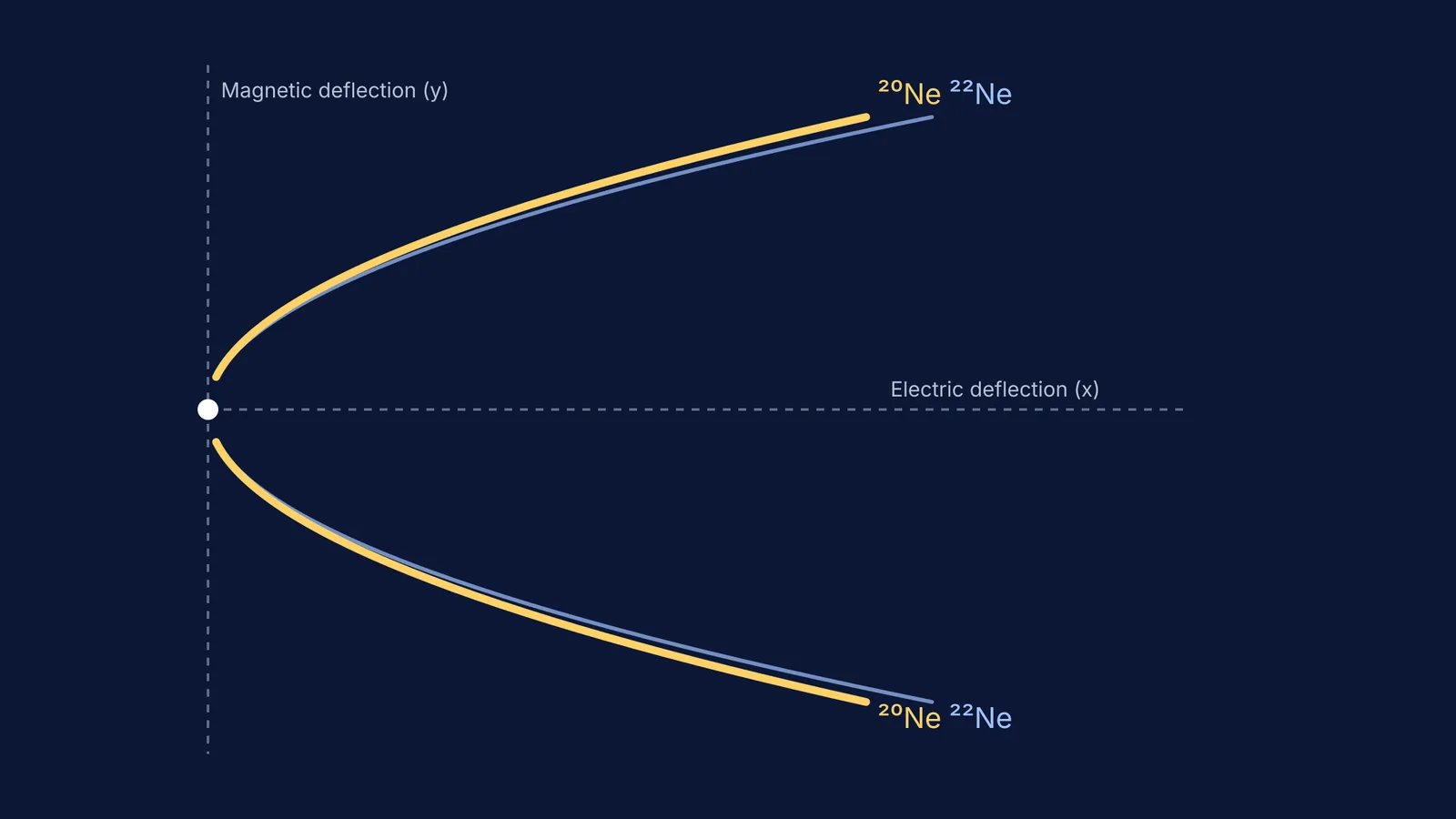
Thomson channeled a thin beam of these positive neon ions through a slit, and then subjected them to an electric field and a magnetic field that were aligned parallel to one another.
The electric field deflected the ions in one direction (horizontally), sorting them by their kinetic energy.
The magnetic field deflected them in a perpendicular direction (vertically), sorting them by their momentum.
The physics behind the parabolas is elegant. A particle's deflection by the electric field is inversely proportional to its velocity squared, while its magnetic deflection is inversely proportional to its velocity. When you combine the two deflections, the velocity terms cancel out to leave a parabolic equation. The exact width of that parabola depends strictly on the particle's mass-to-charge ratio.
Because the ions in the beam travelled at a wide range of speeds, particles with the exact same mass-to-charge ratio traced out a continuous parabolic curve on a photographic plate placed at the end of the tube. This "parabola method" was the direct precursor to modern mass spectrometry.
How did J.J. Thomson discover neon isotopes?
If neon were a single, uniform element with an atomic mass of 20.2, the photographic plate should have shown only one parabola. Instead, when Thomson tested the gas, the plate revealed two distinct parabolas.
The primary, brighter line corresponded to an atomic mass of 20. A second, much fainter line corresponded to a mass of 22.
This was a startling result. Until this experiment, the chemist Frederick Soddy had proposed that isotopes—atoms of the same element with different masses—existed only in heavy, radioactive elements like thorium. Thomson's result provided the first evidence of isotopes in a stable, everyday element. It explained exactly why neon's atomic weight was measured at 20.2: the naturally occurring gas was a weighted average atomic mass consisting of roughly 90% neon-20 and 10% neon-22.
What can students learn from Thomson's anomaly?
Initially, Thomson was cautious about the result, considering whether the mass 22 line might simply be an impurity. However, rather than erasing the faint line as an experimental error, Aston used fractional distillation to separate the gas further, confirming that the mass 22 particles were indeed a heavier version of neon itself.
When studying science today, it is easy to read the final average atomic mass in a textbook and miss the investigation behind it. Thomson didn't just guess the answer; he followed the anomaly.
When you solve a physics or chemistry problem and get an answer that doesn't match the textbook, treat it like Thomson's faint parabola. Do not immediately assume you are entirely wrong.
Check for "impurities" (calculation errors): Thomson first checked if his sample was contaminated. Check your signs, units and basic arithmetic first.
Review your assumptions: Thomson assumed stable elements had a single mass. You might be assuming air resistance is negligible when a problem states it isn't.
Follow the math: If the calculation holds, the "wrong" answer might be pointing to a physical concept you missed, such as a second valid root to a quadratic equation.
If you are trying to understand atomic structure or how fields deflect charges for your exams, the Fermi Problem Library has worked problems with a step-by-step solver that explains the reasoning rather than printing an answer. For visualizing how electric and magnetic fields curve these trajectories, the Fermi Simulation Lab has interactive simulations for the ideas that are easier to see than to read.
By following a faint, unexpected line on a photographic plate, Thomson fundamentally changed chemistry. The atomic weight was no longer the sole defining feature of an element; it became clear that an element's true identity is determined by its atomic number.


