On this page
Textbooks say tautomers turn into each other too fast to be separated. In 1911 two German papers showed that for ethyl acetoacetate, CH₃COCH₂CO₂Et, this is not quite true. Ludwig Knorr, with O. Rothe and H. Averbeck, isolated the pure keto and pure enol forms (Berichte 44, 1138–1157, DOI). Kurt H. Meyer measured the enol by titrating it with bromine (Annalen 380, 212, DOI). Their answers for the equilibrium liquid did not agree. We read both papers through the English abstracts in the Journal of the Chemical Society, Abstracts, 1911, part i, pages 350–352 and 516–517, free on the Internet Archive. Quotations below are from those abstracts.
Who were Knorr and Kurt Meyer?
The abstracts give only their names, so we keep to the chemistry. We did not check other biographical details against a primary source.
How did Knorr isolate the keto and enol forms?
The trick was cold and dryness. The abstract says "all operations must be carried out in the complete absence of moisture", and both forms were handled at −78 °C, where the change between them is slow.
Keto form. It is sparingly soluble in organic solvents when cold, so it crystallised from alcohol or alcohol–ether at −78 °C. It boils at 40–41 °C under 2 mm Hg, has refractive index n_D = 1.4225 and solidifies at −39 °C. The equilibrium mixture solidifies at −45 to −43 °C.
Enol form. It came from the sodium salt of the ester, suspended in light petroleum and treated with HCl gas "in quantity just insufficient for complete decomposition", again at −78 °C. It is "a colourless oil, having an agreeable fruity odour", with n_D = 1.4480. They gave reasons for a cis structure, CH₃–C(OH)=CH–CO₂Et.
Why could the two forms be kept apart?
Because the change between them needs a catalyst. Kept cold, the enol lasted "a long time unchanged". At room temperature it reached equilibrium in ten to fourteen days, but at 100 °C in one minute. The rate was "enormously increased" by acids and bases. HCl gas, "soft alkali glass, and even exposure to air" converted it in seconds or minutes.
This is the acid and base catalysis you learn for keto–enol tautomerism: acid protonates the C=O oxygen first, and base removes the α-hydrogen to give an enolate. Remove every trace of both, and cool, and the two tautomers behave like separate compounds. For the basics, see keto-enol tautomerism and alpha hydrogens.
What did the FeCl₃ test show?
Enols give a coloured complex with FeCl₃. At room temperature both pure forms gave the colour, but Knorr ascribed the keto result to enolisation caused by the FeCl₃ itself. At low temperature the difference showed: the colour developed "much more slowly" with the keto ester, while the enol in ether at −78 °C gave "at once an intense coloration". So a positive FeCl₃ test for ethyl acetoacetate tells you enol is present or can form, not that the liquid is mostly enol.
How did Meyer measure the enol with bromine?
Meyer found that an enol "reacts instantaneously" with bromine in alcohol, while a keto form decolourises it only gradually. So a quick titration counts only the enol. Bromine adds to the C=C and HBr is lost at once, leaving a bromo-ketone:
C₆H₁₀O₃ (enol) + Br₂ → C₆H₉BrO₃ + HBr
Then he added KI and warmed. The bromo-ketone is reduced back to the ketone and iodine is set free:
C₆H₉BrO₃ + 2HI → C₆H₁₀O₃ + I₂ + HBr
The iodine was titrated with thiosulphate, "without the aid of starch":
I₂ + 2S₂O₃²⁻ → 2I⁻ + S₄O₆²⁻
Check the balances: 6 C, 10 H, 3 O, 2 Br in the first; 6 C, 11 H, 3 O, 1 Br, 2 I in the second; 2 I, 4 S, 6 O and a charge of −4 on each side of the third. So 1 enol ≡ 1 Br₂ ≡ 1 I₂ ≡ 2 S₂O₃²⁻. This back-titration is iodometry, as in iodometric vs iodimetric titrations.
Meyer's result: "the liquid ester contains 7.71% of enol and 92.29% of ketone". (Text copies of the scan misprint the first number as "771%".) Freshly distilled ester held 20–25 % enol.
Worked example: three ways to get the enol percentage
M(C₆H₁₀O₃) = 130.14 g mol⁻¹.
From refractive index (Knorr). The equilibrium liquid had n_D = 1.4230 to 1.4232. If n_D varies linearly with composition (an approximation), enol fraction = (1.4231 − 1.4225) ÷ (1.4480 − 1.4225) = 0.0006 ÷ 0.0255 = 0.024. The range 1.4230 to 1.4232 gives 2.0 % to 2.7 %. Knorr reported 2 %.
From the titration (Meyer). 1.000 g of ester with 7.71 % enol holds 0.0771 g of enol, which is 0.0771 ÷ 130.14 = 0.592 mmol. That takes 0.592 mmol of Br₂, which is 94.7 mg. It frees 0.592 mmol of I₂, which needs 2 × 0.592 = 1.185 mmol of thiosulphate: 11.8 mL of 0.100 M solution.
From rate constants (Meyer). For freshly distilled liquid ester at 15 °C he gave k(ketonisation) = 0.00055 and k(enolisation) = 0.000046. At equilibrium the two rates are equal, so K = [enol] ÷ [keto] = k(enolisation) ÷ k(ketonisation) = 0.000046 ÷ 0.00055 = 0.0836. Enol fraction = K ÷ (1 + K) = 0.0772, or 7.7 %.
Step 3 matches 7.71 %, but this is not independent proof. Meyer's equations used the equilibrium ratio to split the measured sum of the two constants, so the match is a check on the arithmetic. His constants for water at 0 °C (2.4 and 0.010) give 0.41 % enol the same way.
Now notice the size of the problem. For 7.71 % enol, the linear rule predicts n_D ≈ 1.4245, well above what Knorr measured.
Why did the two methods disagree?
Nobody knew in 1911. Later that year Meyer and Paul Kappelmeier (Berichte 44, 2718, DOI; abstract on page i 832) checked their own sources of error and still found 7.4 % enol. The abstract says "the difference … remains unexplained".
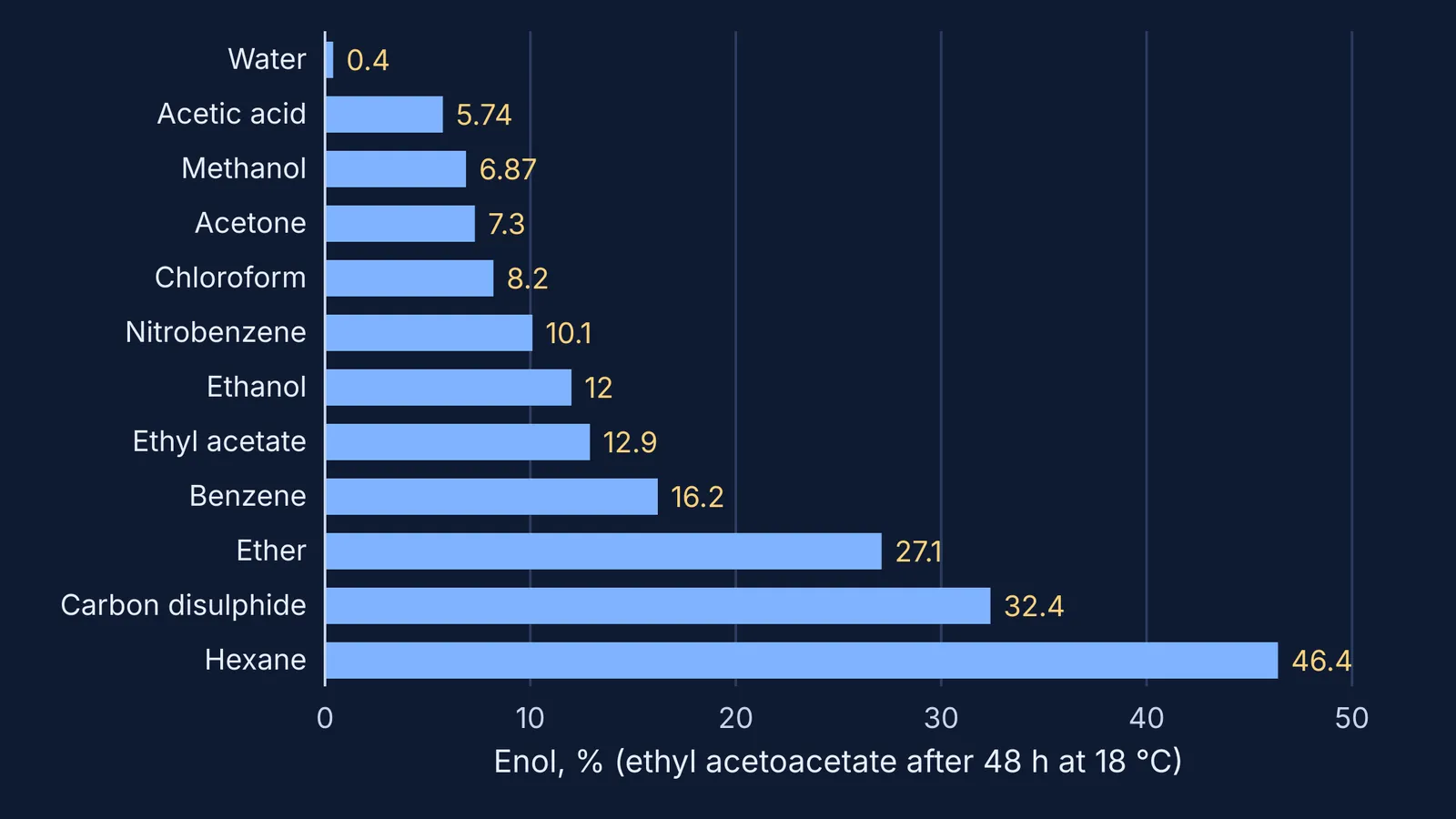
Meyer also showed that the solvent matters. After 48 hours at 18 °C the enol was 0.4 % in water, 12 % in ethanol, 16.2 % in benzene and 46.4 % in hexane. The usual explanation today is that the cis enol has an internal O–H···O=C hydrogen bond, while the more polar keto form is favoured in polar, hydrogen-bonding solvents. The same pattern for acetylacetone is in why acetylacetone has high enol content.
To revise tautomerism concept by concept, use the Concept Library.
What should you write in the exam?
Ethyl acetoacetate is mostly keto (a few per cent enol in the neat liquid), gives a positive FeCl₃ test because of its enol, and its enol is stabilised by conjugation and an intramolecular hydrogen bond. For JEE Main and Advanced practice of this kind, Fermi Test Prep offers test prep with an AI tutor.
Quick checklist
Knorr, Rothe and Averbeck (1911) isolated both tautomers at −78 °C, with no moisture: keto n_D 1.4225, enol n_D 1.4480.
Acids, bases and even glass catalyse the change; at 100 °C the enol equilibrates in one minute.
Meyer: the enol takes up Br₂ instantly; KI then frees I₂, titrated with thiosulphate. 1 enol ≡ 2 S₂O₃²⁻.
Knorr found 2 % enol at equilibrium; Meyer found 7.71 %, and later 7.4 %.
K = k(enolisation)/k(ketonisation); fraction = K/(1 + K).
Enol content rises from 0.4 % in water to 46.4 % in hexane.