

On this page
You learn early that a ketone sits almost entirely in its keto form. Then acetylacetone (pentane-2,4-dione) turns up in a JEE question and the rule seems to break. It doesn't break. Acetylacetone's enol simply gets two extra sources of stability that acetone's enol never gets.
How much enol do acetone and acetylacetone contain?
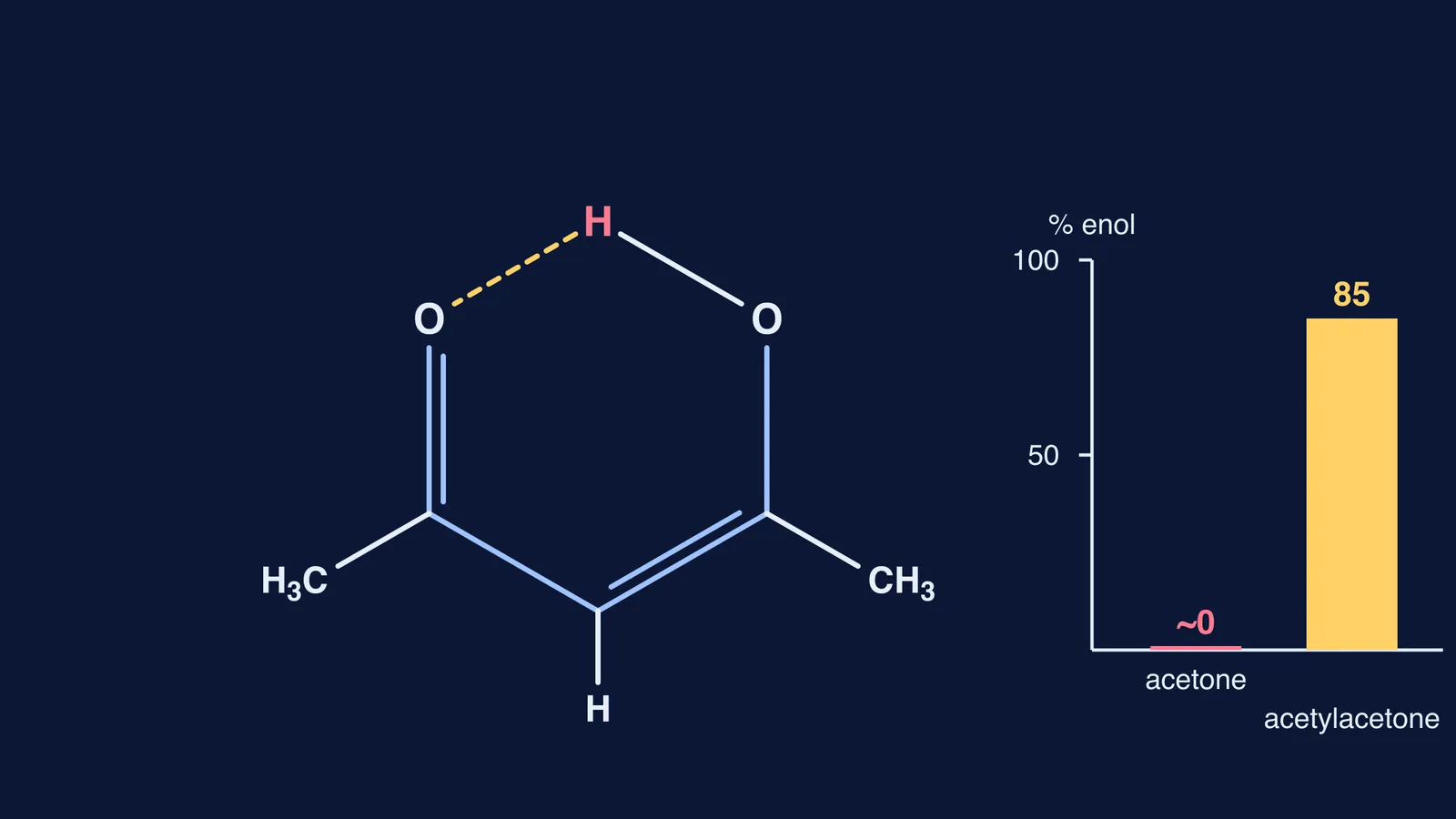
Acetone is more than 99.999% keto tautomer, according to the LibreTexts organic chemistry chapter on keto-enol tautomerism/22:_Carbonyl_Alpha-Substitution_Reactions/22.03:_Keto-Enol_Tautomerism). The same chapter says 2,4-pentanedione (acetylacetone) is in its enol form 85% of the time under normal conditions.
A laboratory paper by Michael Nichols and Mark Waner in the Journal of Chemical Education (2010) describes acetylacetone as heavily favouring the enol (more than 80% enol). In the same paper, ethyl acetoacetate, another 1,3-dicarbonyl compound, heavily favours the keto form (more than 90% keto).
Why does acetone stay in the keto form?
Two tautomers differ only in where one hydrogen and one double bond sit. Turning acetone into its enol trades a C=O for a C=C plus an O–H. The LibreTexts chapter/22:_Carbonyl_Alpha-Substitution_Reactions/22.03:_Keto-Enol_Tautomerism) gives the C=O bond as 749 kJ/mol and the C=C bond as 611 kJ/mol, which is mainly why a keto form is usually 45–60 kJ/mol more stable than its enol.
Acetone's enol (propen-2-ol) has nothing to pay back that cost. Its C=C is isolated, and its O–H has no partner nearby to hydrogen-bond with.
If tautomerism itself feels shaky, start with our explainer on keto-enol tautomerism and the post on how resonance differs from tautomerism.
Why does acetylacetone have high enol content?
In acetylacetone the two carbonyl groups are separated by one CH2 carbon. When that carbon gives a hydrogen to an oxygen, the enol gains two bonuses, both named in the LibreTexts chapter/22:_Carbonyl_Alpha-Substitution_Reactions/22.03:_Keto-Enol_Tautomerism):
Conjugation. The new C=C sits next to the remaining C=O, giving O=C–C=C–OH. The π electrons spread over the whole chain instead of staying in one bond, which lowers the energy.
An intramolecular hydrogen bond. The enol O–H points at the other carbonyl oxygen, and the O–H···O contact closes a six-membered ring, the chelated enol in the diagram above. Because the partner is inside the same molecule, no solvent is needed to supply it.
The Wikipedia article on acetylacetone says the enol has C2v symmetry, with the hydrogen shared equally between the two oxygens. It cites a 2006 paper by Walther Caminati and Jens-Uwe Grabow, The C2v structure of enolic acetylacetone.
To see why a hydrogen bond inside one molecule behaves differently from one between molecules, read our post on intramolecular hydrogen bonding.
Does the solvent change the enol content?
Yes. The Wikipedia article on acetylacetone says the equilibrium constant tends to be high in non-polar solvents, while polar, hydrogen-bonding solvents such as water make the keto form more favourable. A common textbook explanation is that such a solvent competes with the internal hydrogen bond, so the enol loses part of its advantage. A table in the same article lists K(keto→enol) as 42 in cyclohexane, 5.7 in CDCl3 and 0.23 in water.
Here is a conversion you can reuse. If K = [enol]/[keto], the enol fraction is K/(1 + K):
Cyclohexane: 42/43 ≈ 0.98, so about 98% enol.
CDCl3: 5.7/6.7 ≈ 0.85, so about 85% enol.
Water: 0.23/1.23 ≈ 0.19, so about 19% enol.
How do you predict enol content in an exam question?
Ask these four questions about any carbonyl compound:
Is there an α-hydrogen? No α-hydrogen, no enol.
Is there a second C=O placed 1,3 to the first, so the enol C=C can conjugate with it?
Can the enol O–H reach that oxygen and close a six-membered ring?
Does anything weaken the effect, such as an ester group or a polar, hydrogen-bonding solvent?
Worked example: rank acetone, ethyl acetoacetate and acetylacetone by enol content. Acetone has no second carbonyl, so it fails the conjugation and ring checks and comes last. Ethyl acetoacetate passes those checks but trips on the last one. The usual textbook reason is that the ester oxygen's lone pair already conjugates with its own C=O, so the enol gains less, which fits Nichols and Waner finding ethyl acetoacetate mostly keto. Acetylacetone passes every check with no penalty. The order is acetone < ethyl acetoacetate < acetylacetone.
If questions like this go wrong because you picked the wrong method, the Fermi Problem Library has worked problems with a step-by-step solver that explains the reasoning rather than printing an answer. If the gap is the idea itself, such as conjugation or hydrogen bonding, the Fermi Concept Library covers every concept in chemistry, each with its own lesson and its place in the map.
Next time you meet a 1,3-dicarbonyl, run the four checks before you write anything down.


