

On this page
Organic chemistry is full of double bonds shifting and arrows pointing between structures. Because they look so similar on paper, students often confuse resonance and tautomerism. However, they describe two completely different physical realities.
What is the difference between resonance and tautomerism?
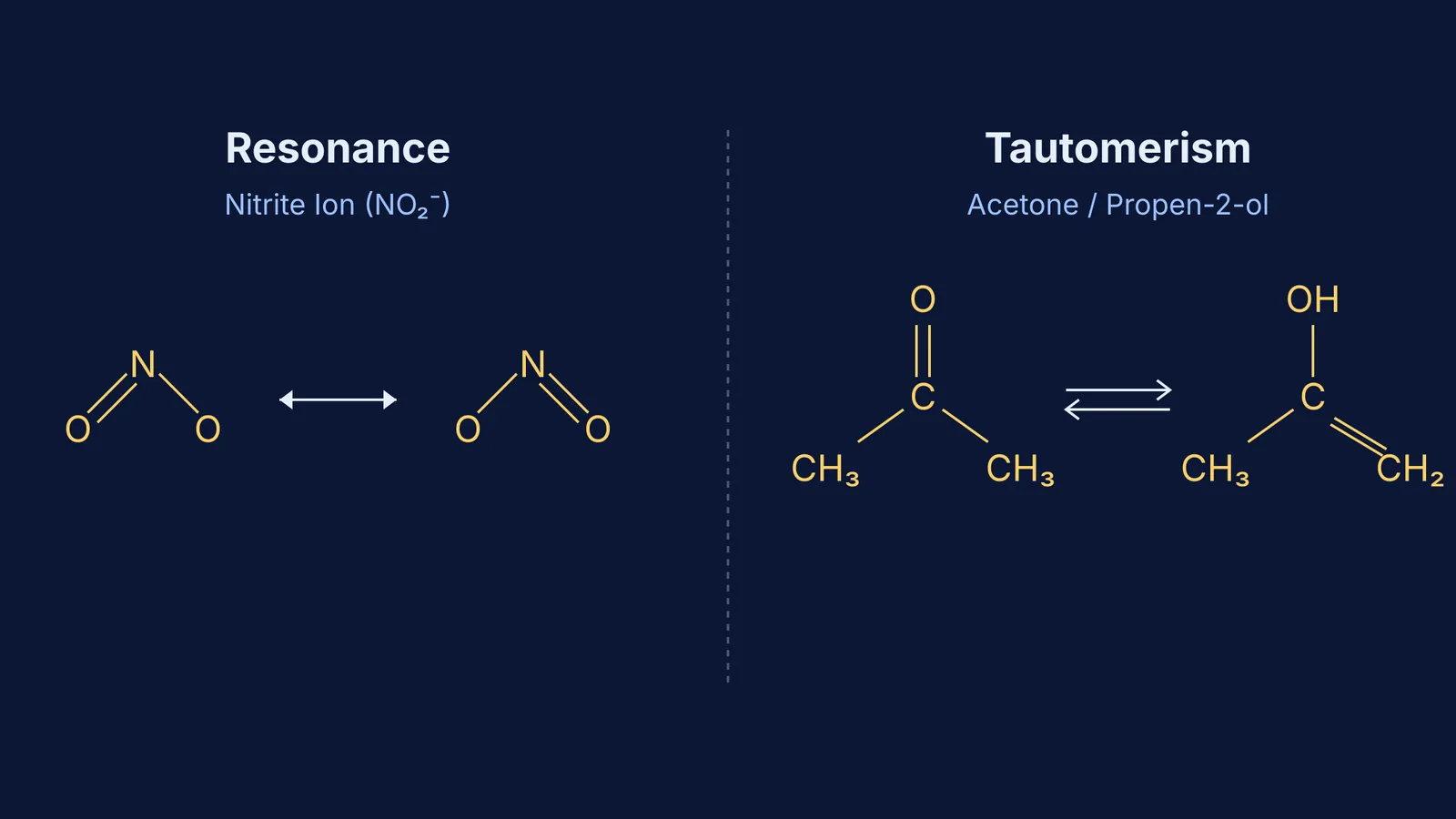
The fundamental difference comes down to what is moving. In resonance, only electrons—specifically pi electrons and lone pairs—change position in your drawing; the atomic nuclei never move. In tautomerism, at least one atom physically migrates to a different part of the molecule, taking a double bond with it.
Because an atom moves, tautomers are true structural isomers. According to chemical definitions, tautomers are constitutional isomers that readily interconvert. They exist together as a mixture in a flask.
Resonance structures, on the other hand, do not exist on their own. The true structure of a resonating molecule is a quantum superposition, or average), of these hypothetical forms.
Does a molecule switch between resonance structures?
No, it does not. A common misconception is that a molecule exhibiting resonance is rapidly flipping back and forth between two states. In reality, it exists as a single, unchanging hybrid.
Think of a mule, which is a hybrid of a horse and a donkey; it does not switch between being a horse one minute and a donkey the next. It is always a mule, possessing characteristics of both parents at the same time. You can observe this unchanging stability in bond lengths. For example, in the nitrite ion, both N–O bonds measure exactly 125 picometres, which falls squarely between a typical 145 pm single bond and a 115 pm double bond). The electrons are delocalised, spreading out to create an average bond order across the whole molecule.
This delocalisation of electrons also makes the molecule significantly more stable. The energy difference between the real hybrid and the most stable theoretical resonance structure is known as resonance energy. Benzene is a classic example: its six carbon-carbon bonds are all perfectly equal, giving it an exceptional stability that a simple ring with alternating single and double bonds would lack.
Are tautomers distinct chemical compounds?
Yes. Because they have different arrangements of atoms, tautomers are real, separate molecules with distinct physical and chemical properties.
They exist in a dynamic equilibrium, meaning they are constantly reacting and turning into one another. The most famous example is keto-enol tautomerism. In a sample of acetone, almost all the molecules exist in the more stable "keto" form. However, a tiny fraction physically shifts a hydrogen atom from a carbon atom to an oxygen atom to become the "enol" form. Depending on the temperature and the solvent used, one tautomer is usually more stable, but both physically share the same flask and can be identified by their unique properties.
Because tautomerism is an actual chemical reaction, it requires an activation energy to proceed. In many cases in organic chemistry, this interconversion can be sped up by adding an acid or a base catalyst.
If you have concept gaps when trying to picture these interconversions, the Fermi Concept Library covers every concept in physics, chemistry, biology, mathematics and computing, each with its own lesson and its place in the map.
How can you tell if a molecule shows resonance or tautomerism?
Examiners love testing this distinction because it proves whether a student has simply memorised a drawing or actually understands the physics underneath it. A common trap in multiple-choice questions is presenting two tautomers and asking if they are resonance structures.
When faced with a pair of structures in an exam or homework assignment, you can use this three-step test to tell them apart:
Check the atomic coordinates. Pick a specific hydrogen atom and see if it is bonded to the same carbon or oxygen in both drawings. If a hydrogen has moved from a carbon to an oxygen (or vice versa), it is tautomerism.
Check the arrow used. Chemists use a single double-headed arrow (↔) exclusively for resonance to show that the structures are part of one hybrid. They use equilibrium arrows (⇌) for tautomerism to show a real, reversible chemical reaction.
Ask if they can be separated. Because they have different physical properties, tautomers can sometimes be trapped or isolated at very low temperatures or by using specific solvents. A resonance structure is a purely theoretical model, meaning it is physically impossible to isolate one.
When faced with wrong-method mistakes while practicing these problems, the Fermi Problem Library provides worked problems with a step-by-step solver that explains the reasoning rather than printing an answer, so you can see exactly where an electron or proton moves.


