On this page
NCERT teaches one way to dissolve gold out of ore: cyanide plus air. In 1906 James Moir, writing from the Chemical Laboratory of the Mines Department, Transvaal, reported a second pair of reagents: thiourea, an acid and hydrogen peroxide. His paper, "Thiocarbamide as a Solvent for Gold", J. Chem. Soc. Trans. 89, 1345–1350, is also a neat lesson in how far a percentage analysis can take you.
What did James Moir find about thiourea and gold?
Thiocarbamide is the old name for thiourea, CS(NH₂)₂. Moir opens with his earlier finding: gold "slowly dissolves in acid solutions of thiocarbamide, and that solution takes place with remarkable rapidity in the presence of suitable oxidising agents." We read the full paper in the scanned 1906 volume; we have not read the earlier note (Proc. 1906, 22, 105).
He dissolved finely divided gold in thiourea solution acidified with sulphuric or hydrochloric acid, "the action being accelerated by the addition of hydrogen peroxide."
From these solutions he isolated two new salts, a sulphate and a chloride. The chloride formed "large, colourless, six-sided plates", which he called the hexahedral compound.
He got the same chloride from potassium gold chloride (KAuCl₄) and thiourea. Boiling it with strong hydrochloric acid turned it into an older compound, AuCl + 2CH₄N₂S, first made by Emerson Reynolds in 1869.
The paper prints only "James Moir, M.A., D.Sc." and his laboratory; we have not checked other details of his life.
Why does gold need both an oxidant and a ligand?
Gold does not dissolve in acid alone. Something must take electrons from the gold, and something must hold the Au⁺ ion that forms. In the cyanide process, which is covered step by step in the cyanide process for gold and silver, O₂ is the oxidant and CN⁻ is the ligand:
4Au + 8CN⁻ + 2H₂O + O₂ → 4[Au(CN)₂]⁻ + 4OH⁻
Moir's system has the same two parts, with H₂O₂ as the oxidant and thiourea as the ligand. Written with the simple bis(thiourea)gold(I) ion (our modern shorthand, not Moir's formula), the reaction in acid is:
2Au + 4CS(NH₂)₂ + H₂O₂ + 2H⁺ → 2[Au(CS(NH₂)₂)₂]⁺ + 2H₂O
Check: Au 2 and 2; thiourea 4 and 4; O 2 and 2. H outside thiourea: 2 + 2 on the left, 4 in 2H₂O. Charge: +2 and +2. Electrons: two Au atoms each lose one (0 to +1), and the two O atoms of H₂O₂ each gain one (−1 to −2).
Binding Au⁺ tightly keeps its free concentration tiny, so by Le Chatelier the oxidation runs much further. Cyanide does the same job.
Why does thiourea bind gold through sulphur?
Thiourea has two kinds of donor atom, S and N. Moir tested two substituted thioureas: "The action of s-diphenyl- and diacetyl-thiocarbamide on gold was tried, but the results were negative." He concluded that thiourea works through its tautomer NH:C(NH₂)·SH, "the hydrogen of the –SH group being replaceable by gold, just as in the recently-discovered gold mercaptides."
Sulphur as the donor fits what you learn today. Au⁺ is a large, polarisable soft acid, and sulphur is a soft donor, as explained in the HSAB principle. A ligand that can bind through two different atoms is ambidentate, like SCN⁻ and NO₂⁻ in ambidentate ligands and linkage isomers.
He argued that the salts contain a complex cation, because they "behave so differently from ordinary aurous compounds".
Worked example: from percentages to a formula
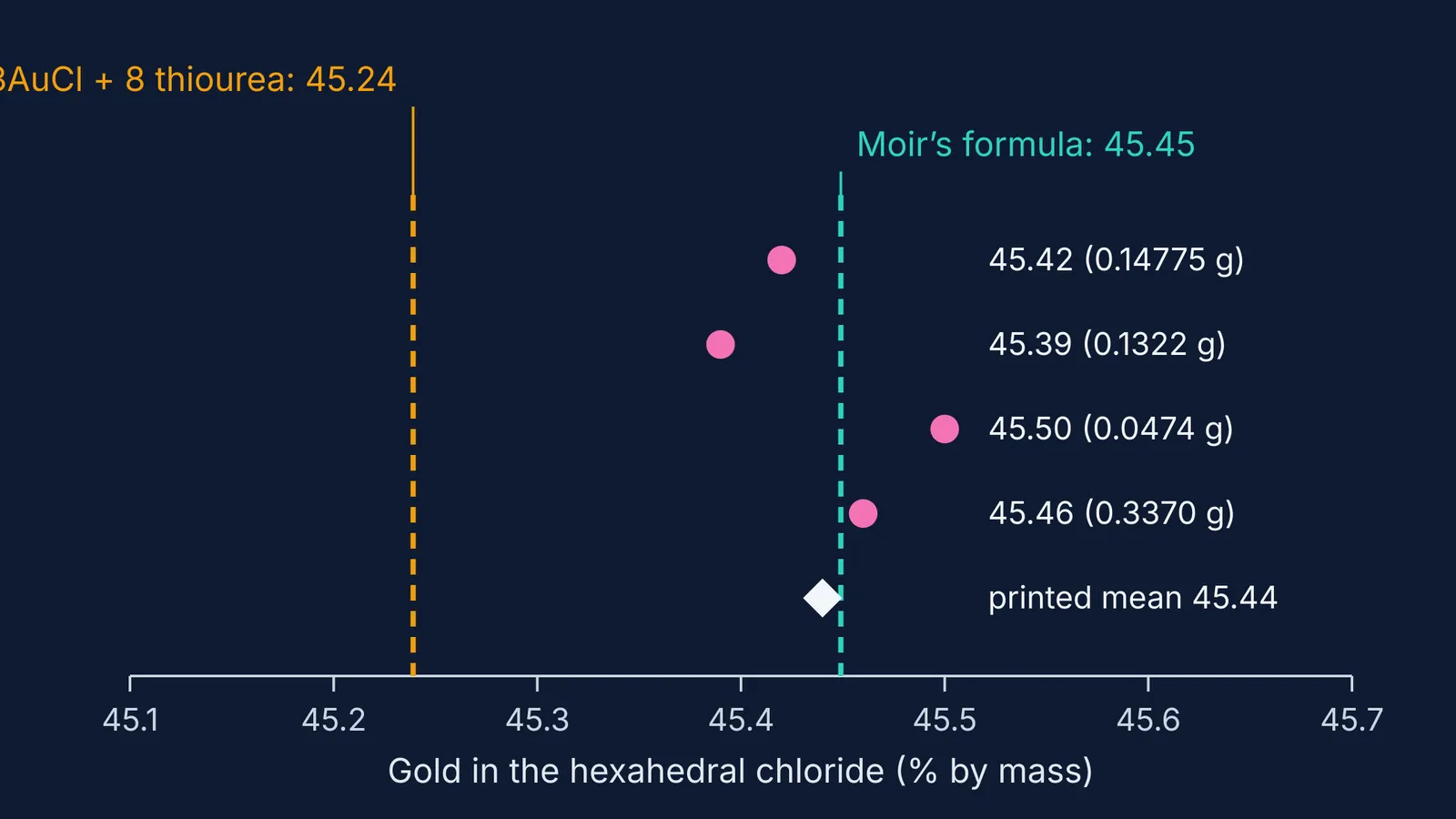
Moir's analysis of the hexahedral chloride gave Au 45.44% (the mean of four ignitions to metallic gold), Cl 8.03% (weighed as AgCl) and S 19.97% (weighed as BaSO₄).
Check one result. 0.2125 g gave 0.0690 g AgCl. Cl = 0.0690 × 35.45 ÷ 143.32 ÷ 0.2125 × 100 = 8.03%.
Divide by atomic masses. Au: 45.44 ÷ 196.967 = 0.2307. Cl: 8.03 ÷ 35.45 = 0.2265. S: 19.97 ÷ 32.06 = 0.6229.
Divide by the smallest. Au : Cl : S = 1 : 0.982 : 2.700. Moir printed 1 : 0.983 and 1 : 2.703.
Find whole numbers. 2.700 is close to 8/3 = 2.667. So Au : Cl : S = 3 : 3 : 8.
Read it as a formula. Each thiourea carries one S, so the salt is roughly 3AuCl with 8 thiourea, or "AuCl + 2⅔CH₄N₂S" as Moir wrote it.
Can the analysis tell two formulas apart?
Moir had two candidates.
The simple addition compound, 3AuCl + 8CH₄N₂S = C₈H₃₂N₁₆S₈Au₃Cl₃. M = 1306.19, so Au = 45.24%.
His proposal, 3(C₂H₆N₄S₂AuCl) + 2CH₄N₂S = C₈H₂₆N₁₆S₈Au₃Cl₃, with six fewer hydrogen atoms. M = 1300.14, so Au = 45.45%, Cl 8.18% and S 19.73%. He printed 45.47, 8.17 and 19.72, using the atomic weights of his day.
The gap is 0.21% gold. His four gold results were 45.42, 45.39, 45.50 and 45.46%, and he wrote that "an error of even so little as 0·2 per cent. in excess is nearly impossible in the mean of four estimations of gold by ignition." So the gold favours his formula.
The chlorine, 8.03%, is below both predictions (8.14 and 8.18) and slightly closer to the simple formula. The sulphur, 19.97%, is above both. And hydrogen, the only element that actually differs, was never measured: it would be 2.47% for one formula and 2.02% for the other. Moir himself left the door open: "It is just possible, however, that the discrepancy is due to an error in the accepted atomic weight of gold". On these data alone, the analysis cannot settle it.
One piece of chemistry supports him. His route from gold(III) chloride balances as 3AuCl₃ + 8CH₄N₂S = C₈H₂₆N₁₆S₈·3AuCl + 6HCl. Atoms: Au 3, Cl 9, C 8, H 32, N 16, S 8 on each side. Three Au³⁺ becoming Au⁺ gain 6 electrons, so the thiourea must lose 6, which it does by losing 6 H as HCl. Note that C₂H₆N₄S₂ is also the formula of formamidine disulphide, which forms when two thiourea molecules each lose one H and join S–S. Moir did not draw it that way, and this paper cannot say which structure is right.
How well do the other analyses fit?
Reynolds' compound. 0.0534 g gave 0.0273 g Au, which is 51.1% (he printed 51.2). AuCl + 2CH₄N₂S needs 51.21%.
The sulphate. 0.1327 g gave 0.0550 g Au, or 41.45%. Au₂SO₄ + 6CH₄N₂S needs 41.61%. Moir called his own sulphate formula "only tentative".
To practise more percentage-composition and formula problems, the Fermi Problem Library has a step-by-step solver that explains the reasoning.
Why does Moir's paper matter for JEE and NEET?
Class 12 Isolation of Elements: leaching needs an oxidant and a complexing agent, O₂ with CN⁻ or, here, H₂O₂ with thiourea.
Class 12 Coordination Compounds: linear Au(I) complexes, donor atoms, ambidentate ligands, and complex ion versus double salt.
Class 11 Mole concept: from percentage composition to a formula.
For JEE Main and Advanced practice on these chapters, Fermi Test Prep offers preparation with an AI tutor.
Quick checklist
Dissolving gold needs an oxidant and a ligand: O₂ with CN⁻, or H₂O₂ with thiourea in acid.
Thiourea binds Au⁺ through S, a soft donor for a soft acid.
In [Au(CS(NH₂)₂)₂]⁺, Au is +1, two-coordinate and linear.
Moir's chloride: Au : Cl : S = 1 : 0.982 : 2.700, close to 3 : 3 : 8.
His two formulas differ by 0.21% Au and by hydrogen he never measured.