On this page
The cyanide process gets silver and gold out of ore in two redox steps. First the metal is oxidised and dissolved by cyanide and air. Then zinc reduces it back to the solid metal. If you can balance both and say who loses and who gains electrons, you can answer the usual exam questions.
What is the cyanide process for silver and gold?
The ore is crushed and soaked in a dilute solution of sodium cyanide (NaCN) while air passes through it. This is leaching: the metal moves into solution and the rock (gangue) stays behind. The metal is then recovered from the solution by displacement with zinc, which is answer (i) to Question 10 in NCERT's Class 12 Chemistry Exemplar, Unit 6.
According to Wikipedia's article on gold cyanidation, John Stewart MacArthur developed the process in Glasgow in 1887 with Robert and William Forrest. The article adds that it is widely used for silver, usually after froth flotation. NaCN has a second job in the same NCERT Exemplar (answer 33), as a depressant in froth flotation of sulphide ores.
How do you balance the leaching equation for silver?
Balance it by half-equations, as you would any redox reaction in basic solution.
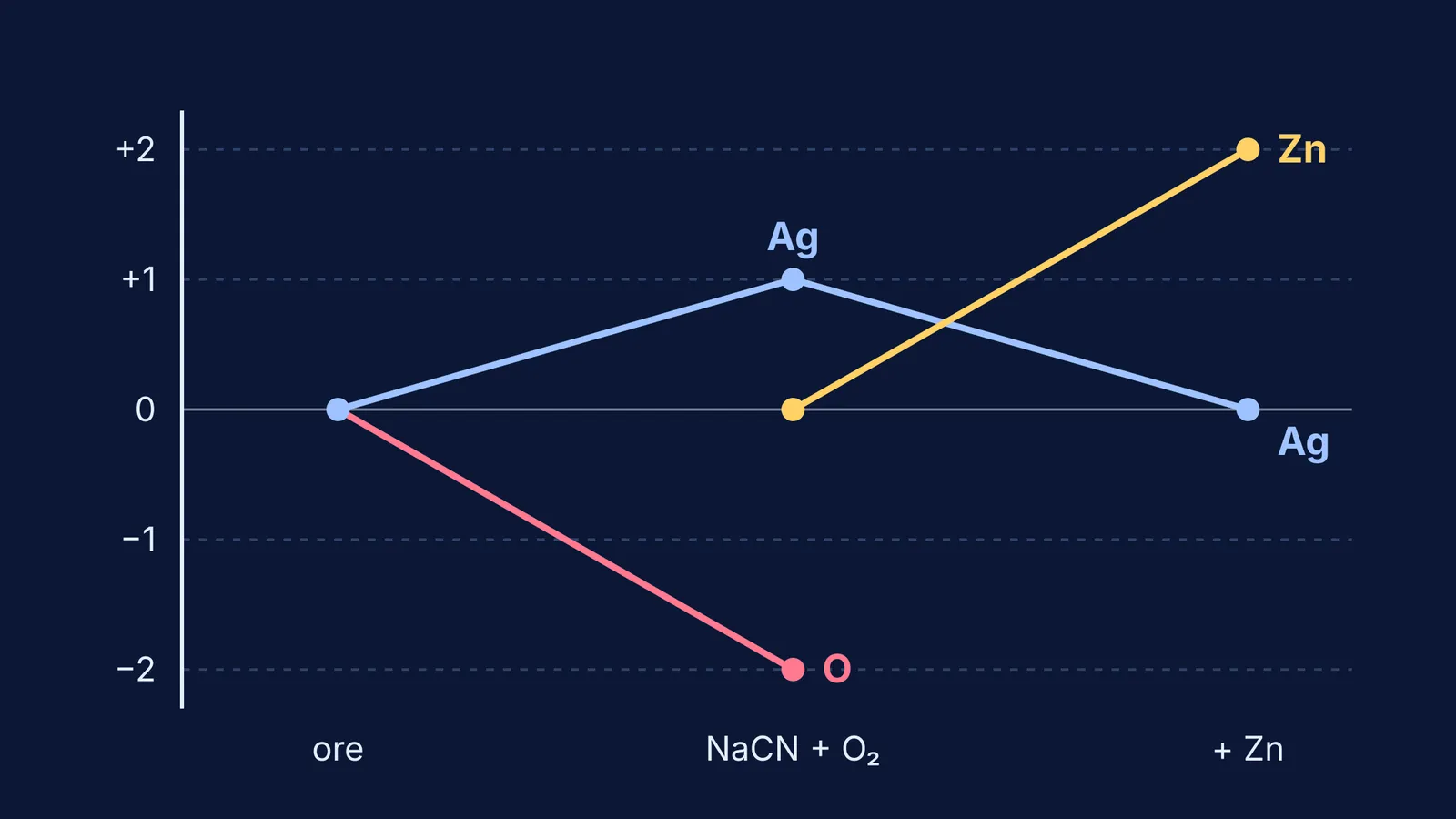
Oxidation: Ag + 2CN⁻ → [Ag(CN)2]⁻ + e⁻. Silver goes from 0 to +1.
Reduction: O2 + 2H2O + 4e⁻ → 4OH⁻. Oxygen goes from 0 to −2.
Equalise electrons: multiply the silver half by 4, so 4 electrons are lost and 4 are gained.
Add them: 4Ag + 8CN⁻ + O2 + 2H2O → 4[Ag(CN)2]⁻ + 4OH⁻.
Add the spectator Na⁺ ions: 4Ag + 8NaCN + O2 + 2H2O → 4Na[Ag(CN)2] + 4NaOH.
Now check it. Silver: 4 and 4. Carbon and nitrogen: 8 and 8. Oxygen: 2 + 2 = 4 on the left, 4 in the OH⁻ on the right. Hydrogen: 4 and 4. Charge: −8 on the left, −4 − 4 = −8 on the right. The gold equation is the same with Au in place of Ag. NCERT's Exemplar answer key writes it as 4Au + 8CN⁻ + 2H2O + O2 → 4[Au(CN)2]⁻ + 4OH⁻ (NCERT Exemplar, Unit 6 answers).
Why does zinc get the silver back?
Zinc is more easily oxidised, so it hands electrons to the silver complex. Again, split it into halves.
Oxidation: Zn + 4CN⁻ → [Zn(CN)4]²⁻ + 2e⁻. Zinc goes from 0 to +2.
Reduction: [Ag(CN)2]⁻ + e⁻ → Ag + 2CN⁻. Silver goes from +1 back to 0.
Multiply the silver half by 2 and add: 2[Ag(CN)2]⁻ + Zn → 2Ag + [Zn(CN)4]²⁻.
Check: 4 cyanide ions and a charge of −2 on each side. The NCERT Exemplar gives the gold version, 2[Au(CN)2]⁻ + Zn → 2Au + [Zn(CN)4]²⁻, and states that "zinc acts as a reducing agent" (NCERT Exemplar, Unit 6 answers). Around 1900, Charles Merrill and Thomas Crowe improved this step by using vacuum and zinc dust, according to the gold cyanidation article.
Why can air dissolve a noble metal at all?
Cyanide changes the electrode potential. In the table of standard electrode potentials), Au⁺ + e⁻ → Au is +1.83 V, but [Au(CN)2]⁻ + e⁻ → Au + 2CN⁻ is −0.6 V. The same table gives +0.401 V for O2 + 2H2O + 4e⁻ → 4OH⁻. Once the gold is tied up in the complex, oxygen's couple sits above gold's under standard conditions, so oxygen can oxidise the gold. Silver follows the same logic: free Ag⁺/Ag is +0.7996 V in that table, above oxygen's couple, so silver needs cyanide to dissolve too.
The gold cyanidation article adds two practical points: too little dissolved oxygen slows the leaching, and the solution is kept above pH 10.5 so that toxic hydrogen cyanide gas does not form.
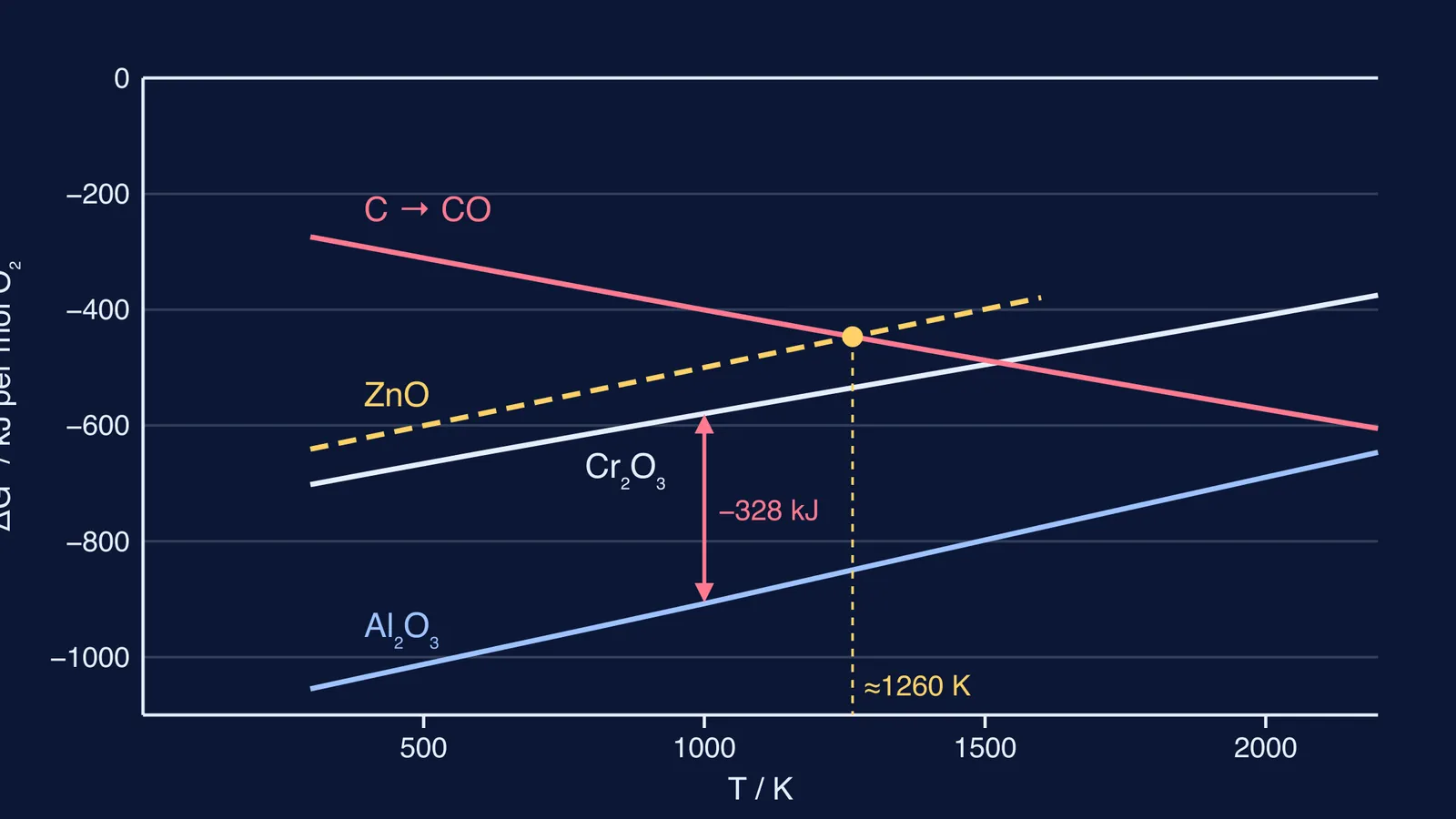
The same habit of comparing two couples runs through how Harold Ellingham built his diagram, and the Mond process for nickel is another route that works through a metal complex.
What traps do exam questions set?
Use this checklist before you mark an answer.
The complex is anionic, [Ag(CN)2]⁻. NCERT Exemplar Question 15 offers "silver is extracted as cationic complex" as an option, and the answer key leaves it out.
Silver and gold have coordination number 2 in the complex; zinc has 4, as [Zn(CN)4]²⁻.
Oxygen is the oxidising agent and zinc is the reducing agent. Cyanide is the complexing agent.
The metal is recovered by displacement, not by roasting or by heating the complex.
When you balance by hand, count the charges as well as the atoms. One O2 takes 4 electrons, so the leaching step needs 4Ag, not 2Ag.
If your mistake is the method rather than the facts, the Fermi Problem Library has worked problems with a step-by-step solver that explains the reasoning rather than printing an answer. If complexes or electrode potentials still feel shaky, the Fermi Concept Library covers every concept in chemistry, each with its own lesson.