On this page
A litre of water dissolves only about a third of a gram of iodine, and the exact amount was once in dispute. In 1908 Harold Hartley and Norman Phillips Campbell measured it properly at five temperatures. Then they used the solubilities to calculate how much heat it takes to dissolve iodine, with the same equation you use for K at two temperatures. Their five-page paper, "The Solubility of Iodine in Water", J. Chem. Soc. Trans. 93, 741–745, is a complete Class 11 thermodynamics problem.
Why did chemists disagree about iodine's solubility?
The paper opens with the spread. At 25.5 °C Meyerhoffer found 0.426 g per litre. At 25 °C Noyes and Seidensticker found 0.3404 g, and McLauchlan found 0.279 g. The highest is about 1.5 times the lowest.
Hartley and Campbell blamed three things:
Impurities and soft glass. Water leaches alkali from ordinary glass, and "the solubility is greatly increased by any substance which gives rise to the formation of polyiodide". They used borosilicate glass and specially purified iodine and water.
Evaporation. In an open flask, "true saturation was never attained ... owing to the rapidity with which the iodine volatilised from the surface layer". They switched to a closed vessel holding about a litre, rocked in a thermostat.
Loss during sampling. The flask that received each sample already held some solid potassium iodide "to diminish the volatility of the iodine".
That last trick is the reaction I₂ + I⁻ ⇌ I₃⁻. Iodine tied up as triiodide cannot evaporate, which is also why iodine dissolves in KI solution but barely in water.
The paper gives the authors' address as the Physical Chemistry Laboratory, Balliol College and Trinity College, Oxford. We have not checked other details of their lives. We read the whole paper and checked the numbers below against the scanned 1908 volume.
How did they measure the iodine?
Each sample, 90 to 160 g of solution, went into the weighed flask. They added excess N/100 sodium arsenite, then titrated the small excess back with N/100 iodine, using starch as indicator. The reaction is:
I₂ + H₃AsO₃ + H₂O → H₃AsO₄ + 2I⁻ + 2H⁺
Check: 2 I, 1 As, 4 O and 5 H on each side, and zero net charge on both sides. The reaction makes acid, and it can run backwards in acid solution. They added about 12 g of sodium bicarbonate per litre "to secure a quick indication of the end point"; the bicarbonate mops up the H⁺.
Titration check: 100 g of saturated solution at 25 °C holds about 0.0339 g of I₂, which is 0.0339 ÷ 253.81 = 1.34 × 10⁻⁴ mol. Each I₂ takes 2 electrons, so that is 2.67 × 10⁻⁴ equivalents, or 26.7 mL of N/100 arsenite.
What did they find?
The mean values, in grams of iodine per 1000 g of water:
18 °C: 0.2765
25 °C: 0.3395
35 °C: 0.4661
45 °C: 0.6474
55 °C: 0.9222
At 25 °C that is 0.3395 ÷ 253.81 = 1.34 mmol per kg, so about 2.9 kg of water is needed to dissolve 1 g of iodine. From 18 to 55 °C the solubility rises 3.3 times.
The individual results are headed "per 1000 grams of solution", but the means say "per 1000 grams of water". Converting the starred individual values with w ÷ (1 − w/1000) reproduces the printed means at 18 to 45 °C, and gives 0.9225 against the printed 0.9222 at 55 °C. The two bases differ by under 0.1%.
How does solubility give the heat of solution?
For I₂(s) ⇌ I₂(aq), the solid has activity 1, so in a dilute saturated solution K is just the solubility. Then the van 't Hoff equation applies directly:
ln(s₂/s₁) = −(ΔH/R)(1/T₂ − 1/T₁)
Hartley and Campbell wrote it as logₑ(C₁/C₂) = (Q/2)(1/T₂ − 1/T₁), using R ≈ 2 cal K⁻¹ mol⁻¹. It is the same equation, with Q in place of ΔH.
Worked example: ΔH from 18 °C and 25 °C
Data: s₁ = 0.2765 at T₁ = 291.15 K; s₂ = 0.3395 at T₂ = 298.15 K.
Ratio: s₂/s₁ = 1.2278, so ln(s₂/s₁) = 0.2053.
Temperature term: 1/T₁ − 1/T₂ = 8.064 × 10⁻⁵ K⁻¹.
Solve: ΔH = R × ln(s₂/s₁) ÷ (1/T₁ − 1/T₂) = 8.314 × 0.2053 ÷ (8.064 × 10⁻⁵) = 21 200 J mol⁻¹, about +21.2 kJ mol⁻¹ (5.06 kcal).
Sign check: solubility rose on heating, so dissolving is endothermic. ΔH is positive, as Le Chatelier's principle predicts.
The paper gives 5.09 Cal at 21.5 °C. In 1908 "Cal." meant kilocalories. Using their R = 2 and T = t + 273, our recalculation gives exactly their four values: 5.09, 5.82, 6.44 and 7.38 kcal at 21.5, 30, 40 and 50 °C.
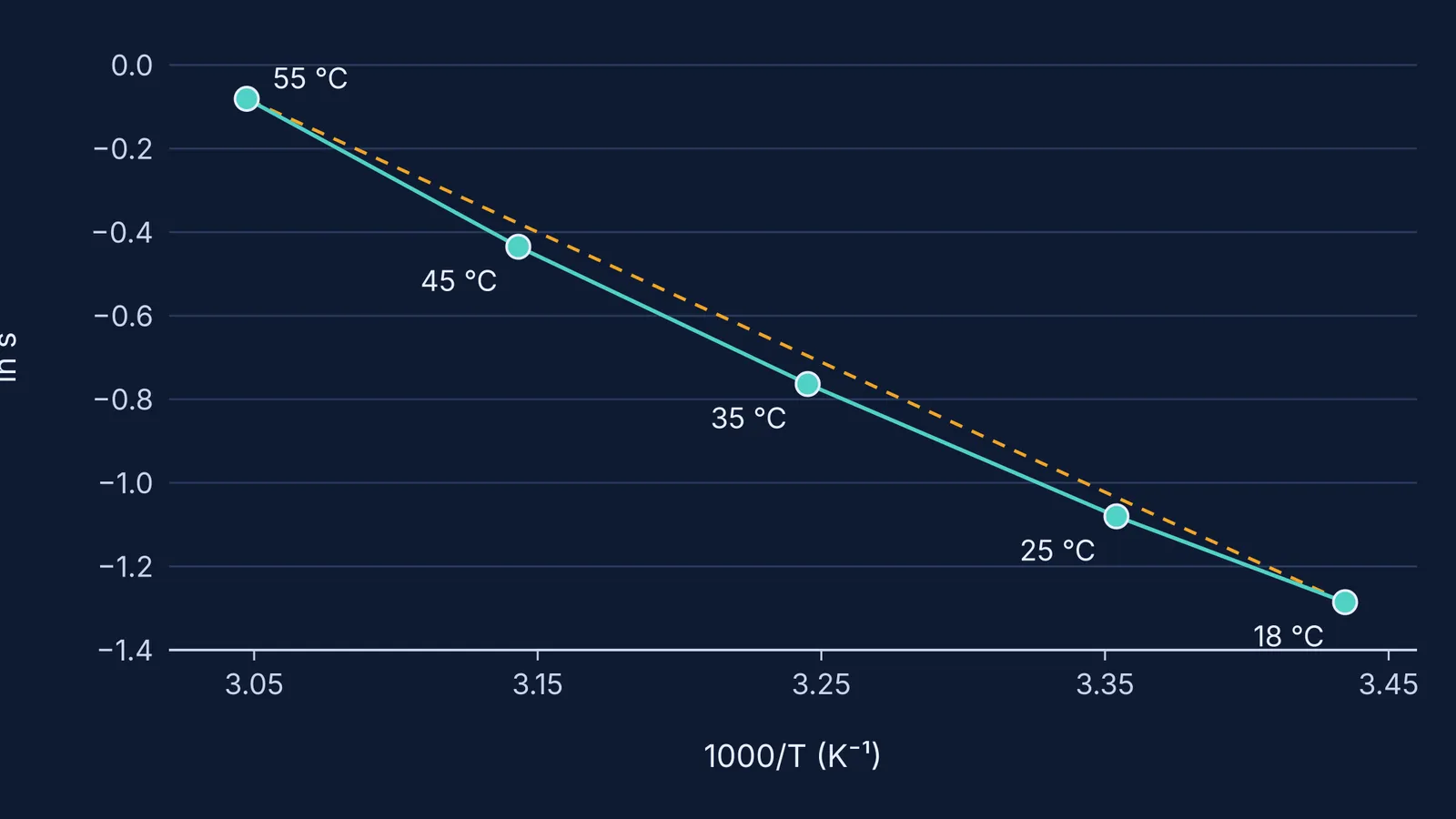
ΔH is not constant: it grows by almost half across the range. The authors say the constant-ΔH assumption is "not strictly fulfilled". You can see it in the chart above, where the points curve away from a straight line. A test: using 21.2 kJ to predict the 35 °C solubility from the 25 °C value gives 0.448 g, but they measured 0.4661 g, about 4% more.
How does Hess's law give the heat of escaping from solution?
Two routes connect solid iodine to iodine vapour:
Direct: I₂(s) → I₂(g), the enthalpy of sublimation.
Through solution: I₂(s) → I₂(aq), then I₂(aq) → I₂(g).
By Hess's law, ΔH(aq → g) = ΔH(sublimation) − ΔH(solution). For sublimation, Hartley and Campbell used 15.1 Cal from the vapour-pressure measurements of Baxter, Hickey and Holmes between 0 and 55 °C. This is solid to vapour, not boiling. So:
At 21.5 °C: 15.1 − 5.09 = 10.01 kcal, as printed.
At 50 °C: 15.1 − 7.38 = 7.72 kcal.
With modern data: the NIST WebBook gives ΔfH° of I₂(g) as 62.42 kJ mol⁻¹ at 298 K. Since solid iodine is the standard state, that is the sublimation enthalpy. Then 62.42 − 21.2 ≈ 41.3 kJ mol⁻¹ for I₂(aq) → I₂(g). Baxter's 15.1 kcal is 63.2 kJ, close to NIST's value. Mixing values from different temperatures makes this an estimate, as the enthalpy of sublimation post warns.
Escaping from water takes less heat than escaping from the solid, because dissolving has already paid part of the cost.
For more van 't Hoff and Hess's law numericals with full working, the Fermi Problem Library has a step-by-step solver that explains the reasoning. If you are revising thermodynamics and equilibrium for JEE Main and Advanced, Fermi Test Prep is JEE test prep with an AI tutor.
Why does this paper matter for JEE and NEET?
Class 11 Equilibrium: the van 't Hoff equation, with solubility as K for a solid in equilibrium with its saturated solution.
Class 11 Thermodynamics: Hess's law cycles and the enthalpy of sublimation.
Class 12 p-block: I₂ + I⁻ ⇌ I₃⁻, and iodimetry with starch.
Quick checklist
Iodine solubility at 25 °C: 0.3395 g per 1000 g water, about 1.34 mmol per kg.
It rises from 0.2765 g (18 °C) to 0.9222 g (55 °C), so dissolving is endothermic.
From 18 to 25 °C, ΔH(solution) is about +21 kJ (5.1 kcal) mol⁻¹.
ΔH rises with temperature, so a single straight-line value is an approximation.
ΔH(aq → g) = ΔH(sublimation) − ΔH(solution), about 10 kcal or 41 kJ mol⁻¹.