On this page
Work, Livelihood and Career is Chapter 1 of the NCERT Human Ecology and Family Sciences Part I textbook for Class 12 (reprint 2026-27). It asks what work means to people beyond the pay it brings.
How many marks is Work, Livelihood and Career worth?
The CBSE Home Science (064) curriculum for 2026-27 gives Unit I, Work, Livelihood and Career, 5 of the 70 theory marks. This is the only chapter in Unit I, so those 5 marks belong to it alone.
Listed topics: work, livelihood and career, including meaningful work; India's traditional occupations; work, age and gender (with KGBV and Beti Bachao, Beti Padhao); attitudes, quality of work life, life skills and soft skills; ergonomics; and entrepreneurship. It does not list the section on ethics and dignity of labour or the Lijjat Papad and Biocon boxes. The practical list has no item for Unit I.
What is the difference between work, livelihood and career?
NCERT treats the three as related but distinct (NCERT Chapter 1).
Work is a set of activities aimed at an outcome, paid or not: volunteering and social work count.
Livelihood is the means by which a person meets basic needs and keeps up a way of life.
Career is personal and keeps changing over a lifetime. NCERT calls it a life management concept: balancing paid and unpaid work, learning and family roles.
Meaningful work is useful to others, done responsibly, enjoyable, and lets you use your own skill, judgement and creativity.
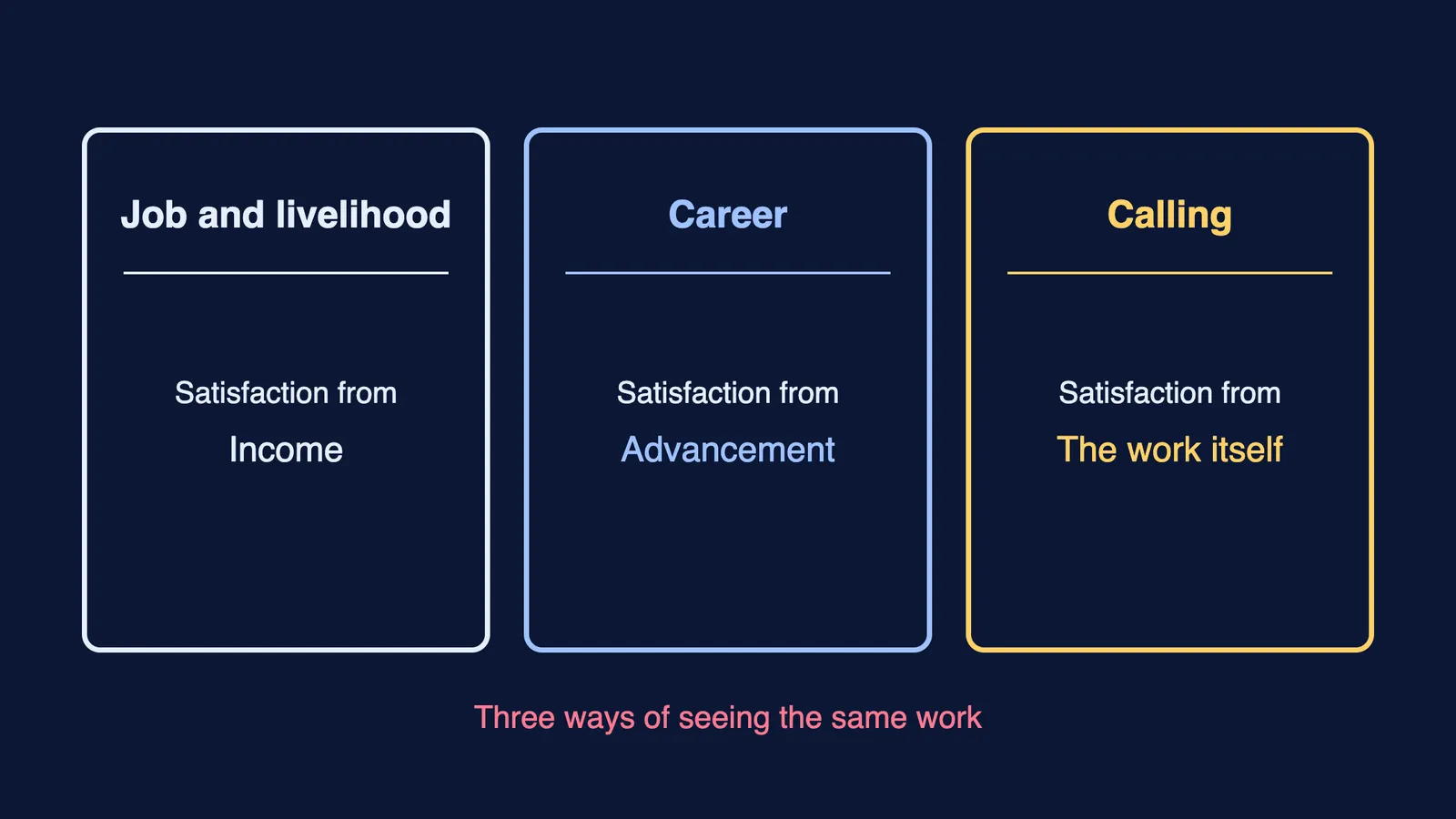
The chapter then gives three popular views of work. Seen as a job and livelihood, work is mainly a source of income. Seen as a career, it is a path upward in post, pay and responsibility. Seen as a calling, the satisfaction comes from the work itself. NCERT's story of three stone breakers shows it: one sees a job, one a living, one a future as a sculptor.
What does the chapter say about gender and traditional work?
Traditional occupations such as farming, fishing, weaving and crafts were passed down within families. NCERT notes that mass-produced goods and weak finance and marketing now squeeze artisans, and names design innovation, training and IPR protection as remedies.
On gender, the chapter separates sex (biological) from gender (socially constructed). It argues that unpaid housework is an economic contribution and notes women's double burden. It names Article 16(1), the Factories Act 1948 (crèche rule for workplaces with more than 30 women), the Maternity Benefit Act 1961 and the Women's Cell in the Ministry of Labour. KGBV began under Sarva Shiksha Abhiyan as residential schooling for out-of-school girls and now runs up to Class XII under Samagra Shiksha.
The curriculum also lists Beti Bachao, Beti Padhao, which this reprint does not describe. The Ministry of Women and Child Development states that the scheme was launched on 22 January 2015 at Panipat, Haryana, in response to the declining child sex ratio.
What are life skills, ergonomics and entrepreneurship?
Life skills help you handle everyday demands. NCERT lists ten. Our grouping, to help recall: thinking (creative, critical), choosing (decision making, problem solving), people (communication, empathy, relationships), self (self-awareness) and coping (with emotions, with stress).
Quality of work life treats workers as assets: pay matters, but so do colleagues, low stress and work-home balance. The soft skills named include communicating clearly and working cooperatively.
Ergonomics, from the Greek for work and natural laws, fits the job to the worker. An ergonomist looks at worker capacity, task demands and the work environment (noise, light, temperature and so on). Its four pillars are anthropometry, biomechanics, physiology and industrial psychology. Benefits include fewer injuries and errors, higher output and better morale.
Entrepreneurship means creating a new enterprise, product or service, or making an old one in a new way. Listed traits include hard work, calculated risk-taking, managing money and time, and coping with setbacks.
Practice questions for Work, Livelihood and Career
The CBSE 2026-27 sample paper tests this chapter with two 1-mark MCQs and a 3-mark question with an internal choice. The questions below are ours.
(1 mark, MCQ) Which is one of the four pillars of ergonomics? (a) Anthropometry (b) Accounting (c) Advertising (d) Agronomy
(1 mark, MCQ) A Factories Act crèche is required once a workplace employs more than (a) 10 (b) 20 (c) 30 (d) 50 women.
(2 marks) Give two reasons why unpaid work at home should count as an economic contribution.
(3 marks) A bakery owner is unsure whether ergonomic changes are worth the cost. State three benefits she and her staff could expect.
(4 marks) Anjali wants to start a millet snack business. Explain four traits she needs as an entrepreneur.
(5 marks) Using one example of each, explain how the same work can be seen as a job, a career and a calling.
Answers: Q1 (a). Q2 (c).
For where Home Science leads, see BSc Home Science career options. Other Class 12 chapters: Early Childhood Care and Education and Consumer Education and Protection.
Revising several subjects at once? Fermi's AI tutor works out what you already know and builds a plan for the session.