On this page
Open a thermodynamics data table and you find a puzzle. For H₂O(l) → H₂O(g) at 25 °C, ΔG° is positive, about +8.6 kJ mol⁻¹. A positive free energy change is supposed to mean "not spontaneous", so liquid water should not turn into vapour at room temperature. Yet a wet floor dries within the hour and clothes dry on the line. Nothing is wrong with the data. The answer is in the small degree sign on ΔG°, and working it out gives you one of the neatest checks in physical chemistry: the vapour pressure of water, calculated from a free energy table.
What is ΔG° for the evaporation of water at 25 °C?
Use standard Gibbs energies of formation from one table. The NBS values are:
ΔfG°[H₂O(l)] = −237.13 kJ mol⁻¹
ΔfG°[H₂O(g)] = −228.57 kJ mol⁻¹
So ΔG° = −228.57 − (−237.13) = +8.56 kJ mol⁻¹ at 298 K.
The same table gives ΔH° = −241.82 − (−285.83) = +44.01 kJ mol⁻¹ and ΔS° = 188.83 − 69.91 = +118.9 J K⁻¹ mol⁻¹. Evaporation takes in heat and increases entropy. At 298 K the enthalpy term wins narrowly, so ΔG° comes out positive.
Do not mix values from different tables. Two sources can differ by a few tenths of a kJ, and here the whole answer is only 8.56 kJ.
What does the degree sign in ΔG° actually mean?
ΔG° describes a process in which every substance is in its standard state. For a liquid that means the pure liquid. For a gas it means the gas at a partial pressure of exactly 1 bar (older books used 1 atm; the difference is about 0.03 kJ mol⁻¹ for a gas, small but worth knowing).
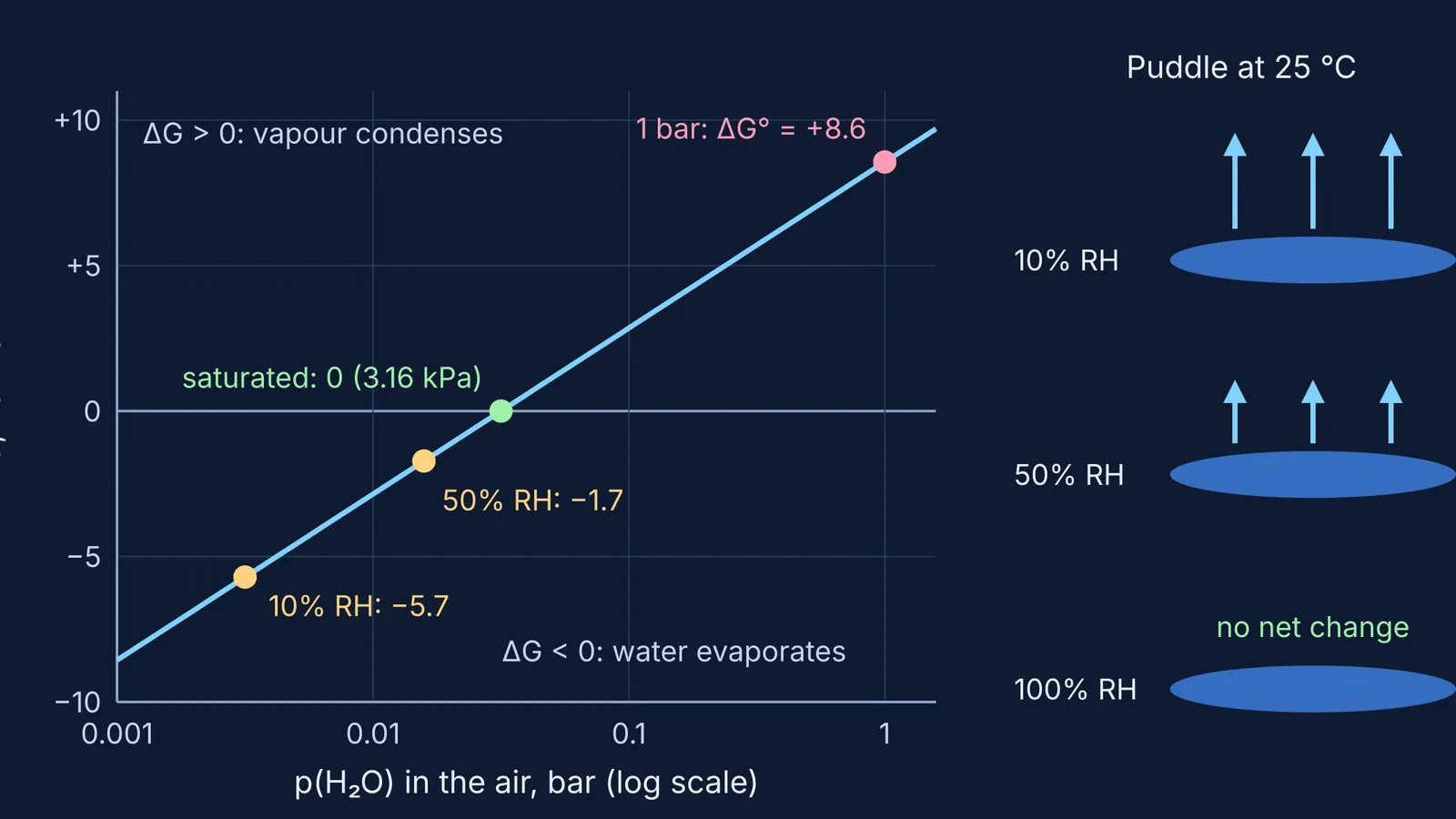
So +8.56 kJ mol⁻¹ answers one narrow question: at 25 °C, does liquid water turn into water vapour at 1 bar? It does not. Vapour at 1 bar and 25 °C would condense. But no puddle is ever surrounded by water vapour at 1 bar. Room air holds water vapour at a partial pressure of a few kPa at most, which is a few hundredths of a bar.
What decides the direction under real conditions is ΔG, not ΔG°:
ΔG = ΔG° + RT ln Q
For H₂O(l) ⇌ H₂O(g), the liquid's activity is 1, so Q = p(H₂O)/p°, where p° = 1 bar. The general difference between the two quantities is explained in the difference between ΔG and ΔG° in thermodynamics. Here we apply it to a phase change.
How does ΔG° predict the vapour pressure of water?
At equilibrium ΔG = 0, so ΔG° = −RT ln K. For this process K is the equilibrium value of p(H₂O)/p°, which is the vapour pressure in bar.
Worked example: find the vapour pressure of water at 25 °C from ΔG°.
Write K. K = p(H₂O, eq)/p°, because the liquid's activity is 1.
Find ln K. ln K = −ΔG°/RT = −8560/(8.314 × 298.15) = −3.453.
Find K. K = e^(−3.453) = 0.0316.
Convert. p(H₂O) = 0.0316 × 1 bar = 0.0316 bar = 3.16 kPa.
Compare with measurement. The measured vapour pressure of water at 25 °C is about 3.17 kPa.
The two agree to within about 0.2%. The ΔfG° values come from thermochemical data, not from a pressure gauge over a beaker of water, yet they predict the measured vapour pressure. That is a strong sign that the ΔG reasoning is right. The method is the same one used for reactions in how to calculate K from ΔG°, and here K is simply a pressure.
Why does a puddle dry at 50% humidity but not at 100%?
Relative humidity (RH) is the ratio p(H₂O)/p(sat), where p(sat) is the vapour pressure, 3.16 kPa at 25 °C. It does not mean the percentage of water in the air.
Since ΔG° = −RT ln K, the equation for ΔG becomes ΔG = RT ln(Q/K). Q/K is just p(H₂O)/p(sat), which is the relative humidity written as a fraction. So:
ΔG = RT ln(RH), with RT = 2.48 kJ mol⁻¹ at 298 K.
10% RH: ΔG = 2.48 × ln 0.10 = −5.7 kJ mol⁻¹. Water evaporates readily.
50% RH: ΔG = 2.48 × ln 0.50 = −1.7 kJ mol⁻¹. Water still evaporates.
90% RH: ΔG = 2.48 × ln 0.90 = −0.26 kJ mol⁻¹. Still evaporates, but the drive is small.
100% RH: ΔG = 0. The air is saturated, and the puddle stays.
Above 100% RH (for example, air cooled at night): ΔG > 0 for evaporation, so vapour condenses. This is dew.
Now picture a sealed jar with some water in it at 25 °C. Water evaporates into the space above it, so p(H₂O) rises and ΔG climbs towards zero. When p reaches 3.16 kPa, ΔG = 0 and the net change stops. Molecules still leave the liquid and return to it, but at equal rates. This is the dynamic equilibrium that NCERT describes for vapour pressure.
The sign of ΔG tells you the direction, not the speed. Wind, a larger surface area and warmer water all make a puddle dry faster, but none of them changes whether it dries.
Does a positive ΔG° mean a process cannot happen?
No. A positive ΔG° means K < 1, and K = 0.0316 is small but not zero. At equilibrium you get a little product, here a small partial pressure of vapour. The rule to remember: ΔG° tells you the size of K, while ΔG tells you which way a particular mixture will move.
You can also ask when ΔG° itself becomes zero. Using ΔH° and ΔS° from above, T = ΔH°/ΔS° = 44 010/118.9 ≈ 370 K. At that temperature the vapour pressure would equal 1 bar, which is the boiling point. The measured boiling point of water at 1 bar is about 372.8 K (99.6 °C). The estimate is a little low because ΔH and ΔS change slightly with temperature, and the calculation treats them as constant. Temperature control of spontaneity is covered in why water freezes below 0 °C. This post shows the other variable: at a fixed temperature, partial pressure decides the direction.
If you want to practise more problems that switch between ΔG°, K and ΔG, the Fermi Problem Library has a step-by-step solver that explains the reasoning at each stage.
How do you answer this in a JEE or board exam?
Calculate ΔG° from ΔfG° values and keep its sign.
Say that ΔG° refers to vapour at 1 bar.
Find K = e^(−ΔG°/RT) and identify it as the vapour pressure in bar.
Compare the actual partial pressure with K, or calculate ΔG = RT ln(Q/K).
Conclude: Q < K means evaporation, Q = K means equilibrium and Q > K means condensation.
Quick checklist
ΔG° for H₂O(l) → H₂O(g) at 298 K is about +8.56 kJ mol⁻¹.
It refers to water vapour at 1 bar, which real air never contains at 25 °C.
K = p(H₂O)/p° = 0.0316, so the vapour pressure is 3.16 kPa, close to the measured 3.17 kPa.
ΔG = RT ln(RH): negative below 100% RH, zero at saturation, positive above it.
A positive ΔG° means K < 1, not "impossible".
ΔG° = 0 near 370 K, close to the boiling point at 1 bar.