

On this page
It looks like a contradiction. Liquid water molecules move about freely; in ice they are locked into a lattice. So freezing lowers the entropy of the water, and the second law says entropy should rise. Yet on a cold night a puddle freezes on its own.
The catch is the word "universe": the second law counts the water plus everything around it. Below, we put numbers on it at three temperatures.
What does the second law actually say about freezing?
The second law says that every spontaneous change increases the entropy of the universe, written ΔS(univ) = ΔS(sys) + ΔS(surr) > 0 (LibreTexts, Criteria for Spontaneous Change/19%3A_Spontaneous_Change%3A_Entropy_and_Gibbs_Energy/19.4%3A_Criteria_for_Spontaneous_Change%3A_The_Second_Law_of_Thermodynamics)). The same page gives the entropy change of large surroundings as the heat they receive divided by their temperature, ΔS(surr) = q(surr)/T.
Freezing is exothermic: the enthalpy of fusion of ice is 6.01 kJ/mol at 0 °C, so freezing has ΔH = −6.01 kJ/mol (OpenStax Chemistry 2e, Phase Transitions). Every mole of water that freezes hands 6,010 J of heat to the air, the glass or the freezer walls around it.
So the water loses entropy while the surroundings gain it. Which one wins depends on the temperature, because the same 6,010 J counts for more when it lands in cold surroundings than in warm ones. If you want the reasoning behind q/T in more detail, our post on why the entropy change of the surroundings is −ΔH/T builds it from scratch.
How do you calculate ΔG for freezing at −10, 0 and +10 °C?
Start with the water's entropy change. At the melting point, melting is reversible, so ΔS(fus) = ΔH(fus)/T = 6,010 J/mol ÷ 273.15 K = 22.0 J/(K·mol), using the 6.01 kJ/mol value from OpenStax. For freezing, flip both signs: ΔH = −6,010 J/mol and ΔS(sys) = −22.0 J/(K·mol).
We treat ΔH and ΔS as constant across this range, the usual textbook approximation.
Now use ΔG = ΔH − TΔS, the Gibbs relation in OpenStax Chemistry 2e, Free Energy. Alongside it, compute ΔS(surr) = +6,010/T.
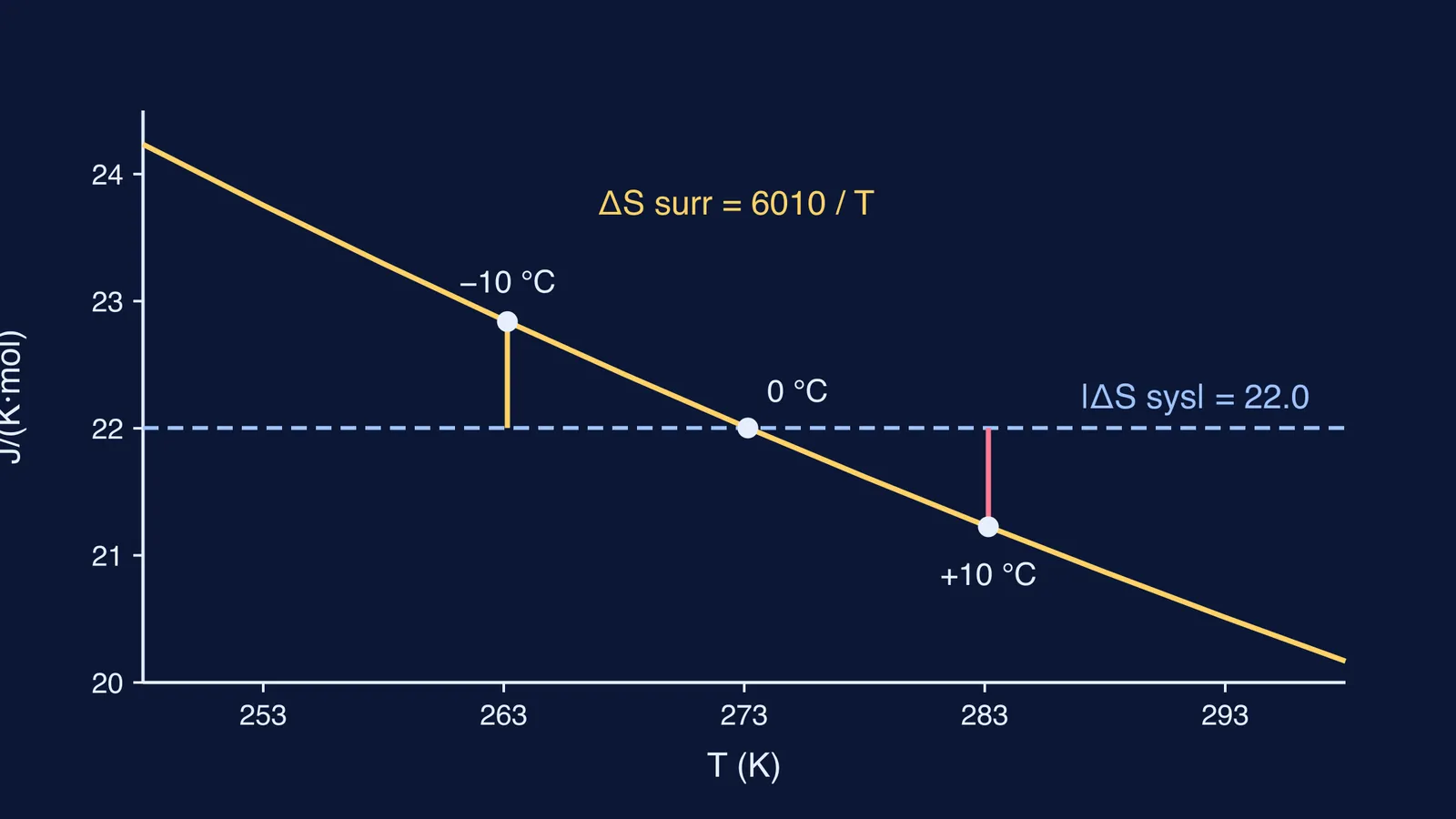
At −10 °C (263.15 K): ΔS(surr) = 6,010 ÷ 263.15 = +22.84 J/(K·mol). ΔS(univ) = 22.84 − 22.00 = +0.84 J/(K·mol). ΔG = −6,010 + 263.15 × 22.00 ≈ −221 J/mol, about −0.22 kJ/mol. Freezing is spontaneous.
At 0 °C (273.15 K): ΔS(surr) = +22.00 J/(K·mol), which exactly cancels the water's loss. ΔS(univ) = 0 and ΔG = 0. Ice and water sit in equilibrium.
At +10 °C (283.15 K): ΔS(surr) = 6,010 ÷ 283.15 = +21.23 J/(K·mol). ΔS(univ) = 21.23 − 22.00 = −0.77 J/(K·mol). ΔG = −6,010 + 283.15 × 22.00 ≈ +219 J/mol, about +0.22 kJ/mol. Freezing is not spontaneous; the reverse, melting, is.
The LibreTexts worked example/19%3A_Spontaneous_Change%3A_Entropy_and_Gibbs_Energy/19.4%3A_Criteria_for_Spontaneous_Change%3A_The_Second_Law_of_Thermodynamics) runs the same check for melting and reaches the mirror result: melting is non-spontaneous at −10 °C and spontaneous at +10 °C.
Why does the entropy of the surroundings settle the sign?
In the three lines above, ΔH (−6.01 kJ/mol, from OpenStax) and the water's −22.0 J/(K·mol) never move. The only term that changes is 6,010/T, the entropy the surroundings gain.
Below 0 °C, T is smaller, so 6,010/T is bigger than 22.0 and the surroundings more than pay for the water's loss. Above 0 °C, T is bigger, 6,010/T falls below 22.0, and the payment comes up short. The crossover is where 6,010/T = 22.0, which is T = ΔH/ΔS = 273.15 K. That is why the melting point sits where it does.
This is the "ΔH negative, ΔS negative" case, which OpenStax describes as spontaneous at low temperature and non-spontaneous at high temperature. Our post on graphing Gibbs energy against temperature for all four ΔH and ΔS cases puts this case next to the other three.
How can you check yourself on problems like this?
Use this four-line routine for any phase change or reaction question that asks "spontaneous or not?":
Write ΔH and ΔS(sys) with signs for the direction asked (freezing, not melting).
Convert ΔH to joules so the units match ΔS.
Compute ΔS(surr) = −ΔH/T and add it to ΔS(sys).
Compute ΔG = ΔH − TΔS and confirm it has the opposite sign to ΔS(univ).
If the signs disagree, look for kJ mixed with J. The deeper idea, that spontaneity is judged by the universe and not the system alone, is laid out in entropy of the universe, the second law and spontaneity.
When you want more practice, the Fermi Problem Library has worked problems with a step-by-step solver that explains the reasoning rather than printing an answer, so you can see where a sign went wrong. If the idea of entropy itself still feels shaky, the Fermi Concept Library gives each concept in chemistry its own lesson and its place in the map.
Try it now: redo the calculation at −20 °C and see how much more negative ΔG becomes.


