On this page
You tie a helium balloon to a chair at a birthday party. By morning it hangs at knee height, smaller and wrinkled, though nobody popped it. Two pieces of Class 11 science explain why: helium slips out through the rubber, and the night cools the gas that is left.
Why does a helium balloon go down overnight?
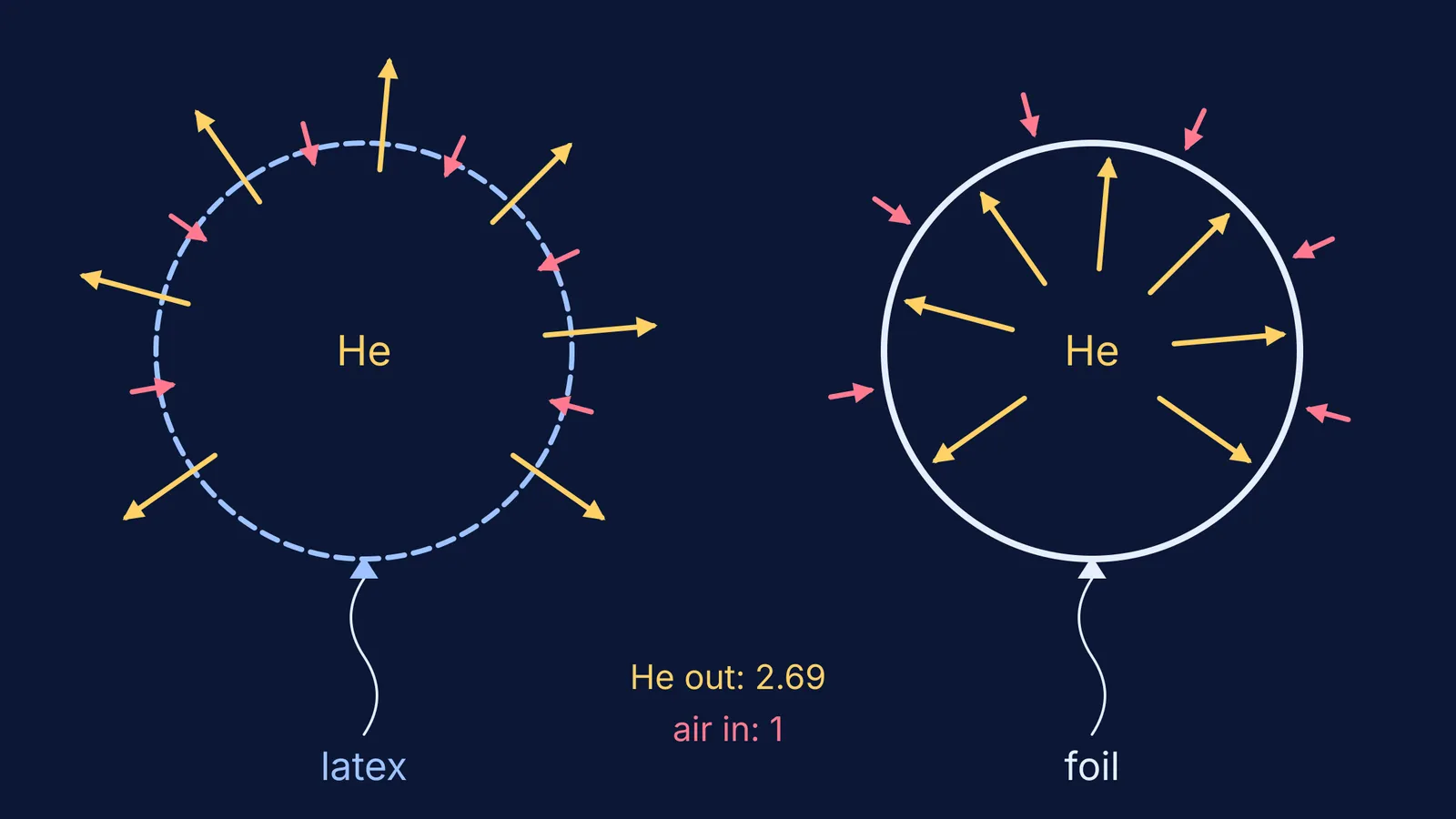
The main reason is a slow leak through the balloon's skin, not through the knot. Latex is slightly porous, and helium atoms are small enough to work their way through it. Balloon suppliers put the float time of an untreated 11-inch latex balloon at roughly 8 to 12 hours or 12 to 24 hours, depending on size, helium quality and temperature.
A balloon floats because it pushes aside more weight of air than it weighs. As helium leaves, the balloon shrinks and pushes aside less air, while the air seeping in makes the gas inside heavier. Both cut the lift until the string and rubber win.
Lars Egil Helseth described this as a simple experiment in The descending helium balloon (Physics Education, 2014): he estimated how fast helium leaks out of a rubber balloon by measuring how fast it descends.
What is Graham's law, and why does helium escape faster than air gets in?
Graham's law says the rate of effusion of a gas is inversely proportional to the square root of the mass of its particles (OpenStax Chemistry 2e/09%3A_Gases/9.05%3A_Effusion_and_Diffusion_of_Gases)). Lighter particles move faster at the same temperature, so they find and pass through tiny gaps more often. The same chapter notes that a helium balloon deflates faster than an argon one.
Here is the worked example for helium against air:
Helium's standard atomic weight is 4.0026, and helium exists as single atoms.
The average molar mass of dry air is 28.96 g/mol, mostly nitrogen (28) and oxygen (32).
Rate of helium / rate of air = square root of (28.96 / 4.00) = square root of 7.24, which is about 2.69.
So, under the same conditions, helium should escape roughly 2.7 times faster than air, and the balloon loses gas overall. Treat that as a rough guide: the law is most accurate for one gas escaping through a hole, and gas passing through rubber also depends on the material. For practice, our Graham's law numericals on rates and molar mass work through the exam-style versions.
Why does a cold night make the balloon smaller?
Charles's law says that at constant pressure, the volume of a gas is proportional to its temperature in kelvin (OpenStax Chemistry 2e/09%3A_Gases/9.02%3A_Relating_Pressure_Volume_Amount_and_Temperature_-_The_Ideal_Gas_Law)). Say the room was 30 °C (303.15 K) during the party and cools to 20 °C (293.15 K) overnight. The new volume is 293.15 / 303.15 = 0.967 of the old one, about 3.3% smaller. Since volume depends on the cube of the radius, the balloon's width shrinks by only about 1.1%.
So the leak, not the cold, does most of the sinking. OpenStax notes that a balloon put in a refrigerator shrinks as its gas cools; warm it again and it grows back. Cooling is reversible, leaking is not.
Why does a foil balloon last longer than a latex one?
Foil balloons are made of a metallised film with a far tighter structure than latex, so helium leaves much more slowly (Bonza Balloons). The same guide says an 18-inch foil balloon floats for several days, often more than a week indoors.
Cold affects foil differently. A foil balloon cannot stretch, so its volume stays nearly fixed. When gas cools at fixed volume, its pressure falls (Amontons's law, in the OpenStax chapter linked above). The foil goes slack and wrinkly, then firms up when the room warms.
A two-balloon test you can run tonight
This turns the explanation into data:
Buy one latex and one foil helium balloon on the same evening.
Tie both to the same weight and mark the height of each on a wall with a sticky note.
Measure the latex balloon's circumference at its widest point with a tailor's tape. Volume is roughly C cubed divided by 6 times pi squared.
Note the room temperature at night and in the morning.
Next morning, measure again and work out how much of the shrinking Charles's law explains. The rest is leakage.
Bonus: put the latex balloon in the fridge for 10 minutes, then take it out. It should shrink and recover. Overnight loss does not recover.
If you find it hard to picture atoms bouncing through gaps, the Fermi Simulation Lab has interactive simulations for ideas that are easier to see than to read, and you can also try this Graham's law simulation of heavy vs light gas diffusion. When a Graham's law numerical goes wrong, the Fermi Problem Library has a step-by-step solver that explains the reasoning rather than printing an answer.
Next time a party balloon droops by breakfast, measure it before you throw it away.