On this page
Freeze a full glass bottle of water overnight and you may find a cracked bottle in the morning. The cause is one unusual property of water, and three steps of Class 11 physics show how strong the effect is.
Why does water expand when it freezes?
Most liquids shrink as they turn solid. Water does the opposite: according to IAPWS, the international body that standardises the properties of water, water expands by approximately 9% when it freezes. Its molecules lock into an open crystal structure, which makes ice less dense than water and is why ice floats.
The Engineering ToolBox ice table gives 999.8 kg/m³ for water at 0.01 °C and 916.2 kg/m³ for ice at 0 °C. Since 999.8 ÷ 916.2 = 1.091, a given mass of water takes up 9.1% more room as ice. Why it freezes at all below 0 °C is worked through in why water freezes below 0 °C.
How much pressure builds up in a full glass bottle?
Take a 1-litre glass bottle filled to the brim with 1,000 mL of water, capped, in a freezer at −18 °C, the temperature the US FDA recommends for freezers.
Find the extra volume. Using the ice and water densities, 1,000 mL of water becomes about 1,091 mL of ice. Roughly 91 mL has nowhere to go.
Find the cost of squeezing water. Water's bulk modulus K is about 2.2 GPa (bulk modulus table), and for small changes the pressure rise is p ≈ K × ΔV/V. Squeezing the liquid by just 1% needs 2,200 MPa × 0.01 = 22 MPa.
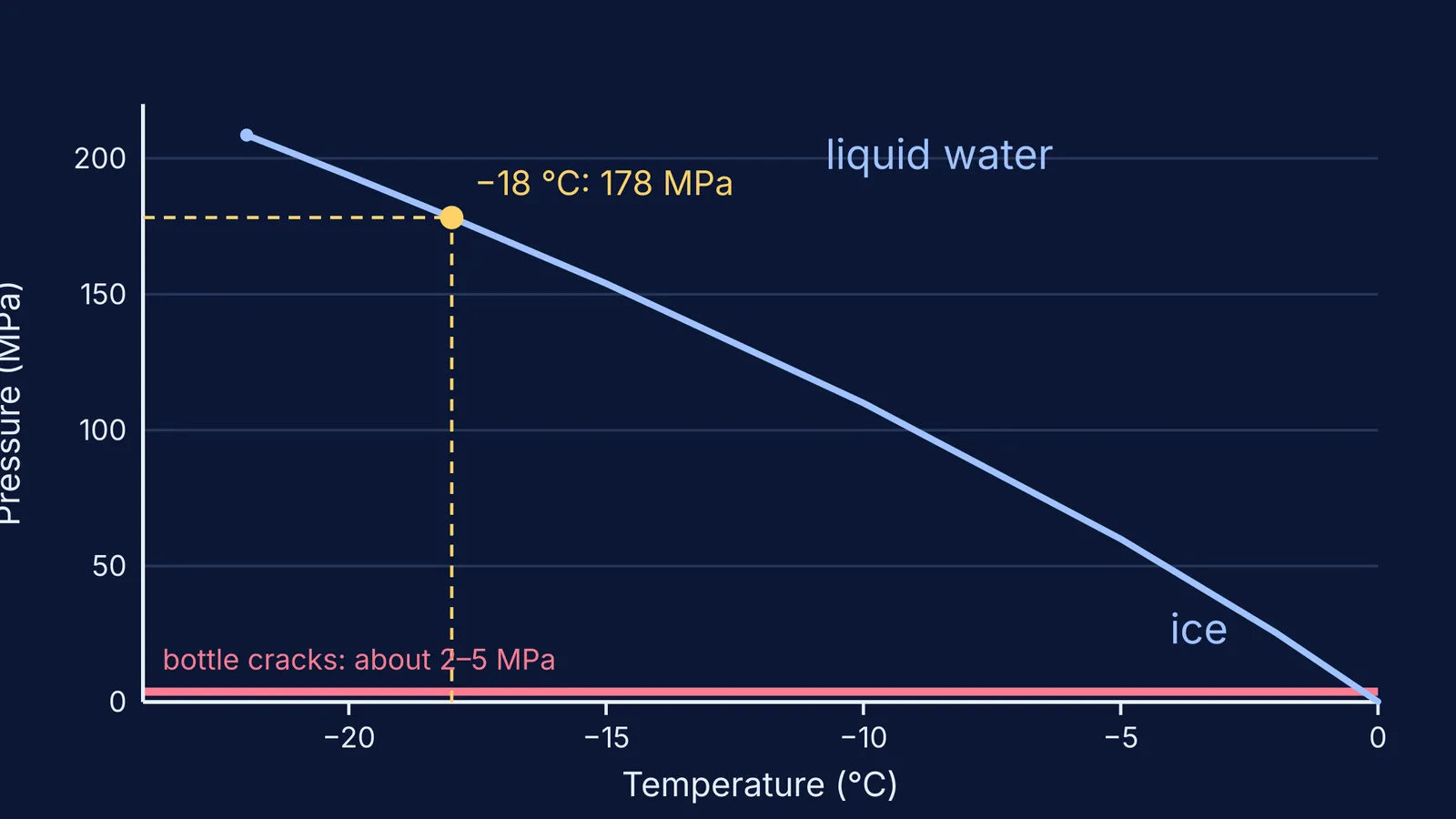
Find the ceiling. If the bottle never gave way, freezing would stop once the pressure could keep the rest of the water liquid. The IAPWS melting-pressure equation for ice puts that at about 110 MPa at −10 °C and about 178 MPa at −18 °C (our calculation from its equation 1). That curve is part of the water phase diagram.
Why does the glass crack long before that?
Pressure inside a cylinder stretches its wall around the circumference. For a thin wall, the hoop stress is σ = p d ÷ (2t), where d is the inside diameter and t the wall thickness, valid when t is under a twentieth of d (Engineering ToolBox).
Say the bottle is 70 mm across inside with a 3 mm wall (illustrative figures). Then σ = p × 70 ÷ 6 ≈ 11.7p: the glass is stretched almost twelve times harder than the water pushes.
Glass is weak when stretched: its practical tensile strength is about 27 to 62 MPa, because its surface is covered in microscopic cracks (RoyMech glass data). Divide by 11.7 and this bottle can fail at an inside pressure of roughly 2.3 to 5.3 MPa.
Now go back to step 2. A pressure of 5.3 MPa means squeezing the water by only 5.3 ÷ 2,200 ≈ 0.24%, about 2.4 mL in our litre. The ice wants 91 mL, so the glass gives way before 3% of the expansion has happened. It is a rough estimate, but the gap is huge.
How much headspace should you leave in a bottle before freezing?
The ice must fit inside the bottle, so water may fill at most 916.2 ÷ 999.8 ≈ 91.6% of it, using the ice and water densities. Leave at least 8.4% empty, not 9%: the 9% is measured against the water, the gap against the bottle.
1-litre bottle: at most about 916 mL of water, at least 84 mL empty.
750 mL bottle: at most about 687 mL of water, at least 63 mL empty.
500 mL bottle: at most about 458 mL of water, at least 42 mL empty.
Round the gap up to a tenth of the bottle for a margin, and measure it by volume, not height: in a narrow neck, 84 mL of space can reach below the shoulder.
The National Center for Home Food Preservation headspace table gives, for juices, ½ inch in a wide-mouth pint and 1 inch in a wide-mouth quart, but 1½ inches in narrow-mouth pints and quarts. Its advice on freezer containers says regular glass jars break easily at freezer temperatures and recommends wide-mouth jars made for freezing and canning.
What should you check before freezing a drink in glass?
Use a container sold as freezer-safe rather than an ordinary glass bottle.
Mark the fill line once with a measuring jug: no more than 90% of the bottle's volume, under the 91.6% limit from the ice and water densities.
Keep narrow-necked glass bottles out of the freezer.
If a bottle has cracked, wrap it and throw it away.
The same three steps (volume change, pressure from the bulk modulus, what the container can take) also answer textbook questions on burst water pipes; the opposite case, solids that grow when heated, explains why railway tracks have gaps. To practise numericals like these, the Fermi Problem Library has worked problems with a step-by-step solver that explains the reasoning rather than printing an answer. If bulk modulus is new to you, the Fermi Concept Library gives each physics concept its own lesson.