On this page
It is 9 pm on a hot evening, the regulator is on full, and the ceiling fan is turning lazily. At 3 pm the same fan, on the same setting, felt like a breeze. Nothing is wrong with the fan. The voltage reaching it has dropped, and the motor inside is built so that its push depends strongly on voltage.
Why does a ceiling fan slow down when the voltage drops?
A standard ceiling fan uses an induction motor: the stator coils make a rotating magnetic field, and that field drags the rotor round (we explain the starting trick in why ceiling fans need a capacitor to start spinning).
The torque developed by an induction motor is directly proportional to the square of the supply voltage, as this explainer on stator voltage control states. The explainer covers three-phase motors, but the single-phase motor in a fan works on the same principle. Both the stator's field and the current it induces in the rotor grow with voltage, and torque comes from the two acting together.
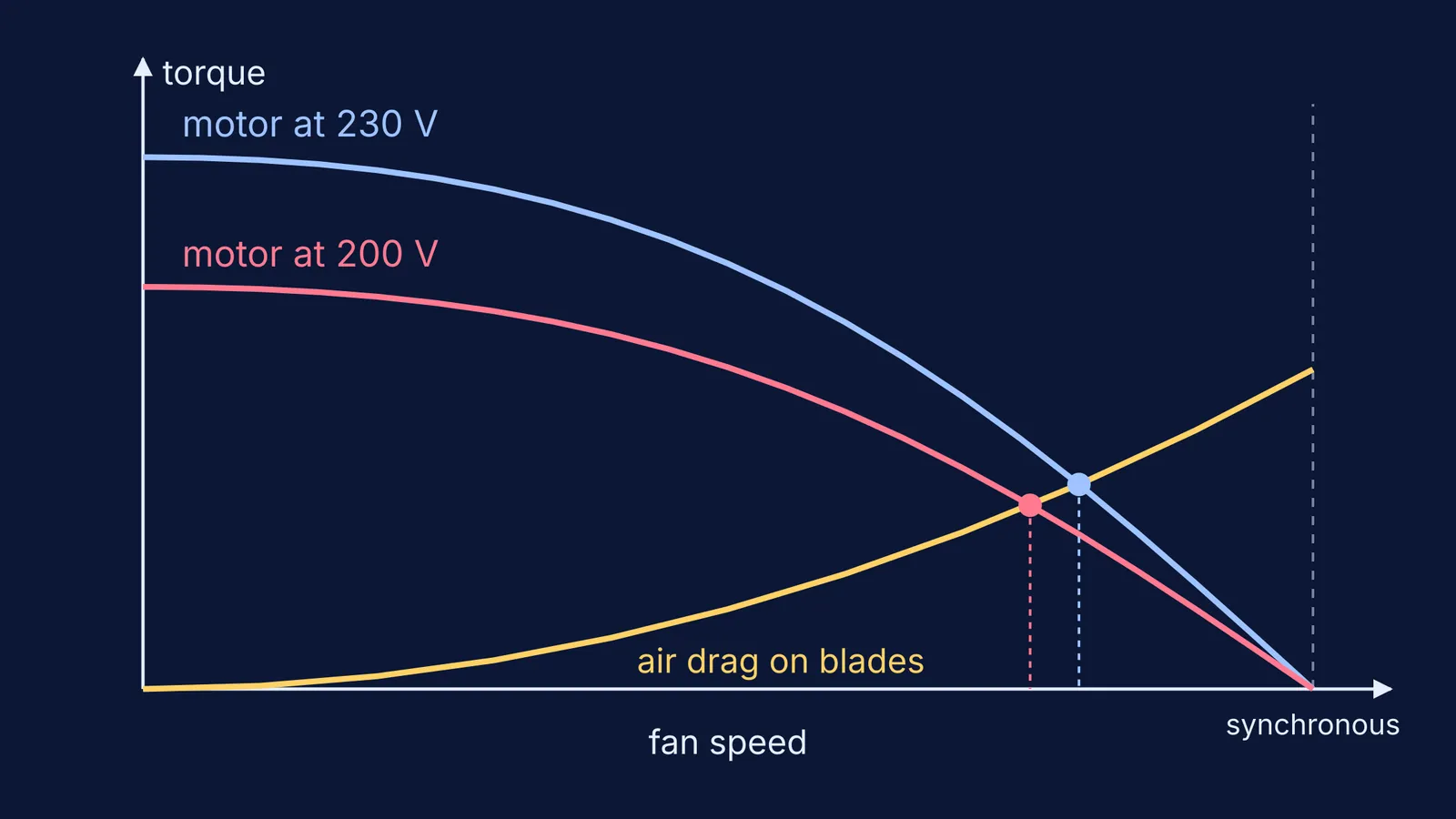
The blades push back. A fan is a load whose torque varies as the square of its speed, the same explainer notes: spin it faster and the air resists harder. The fan settles at the one speed where the motor's push equals the air's drag. Weaken the motor and that balance point moves to a lower speed.
How much torque does a fan lose at 200 V?
Because torque goes as voltage squared, you can work out the loss at any given speed with one division and one square:
At 210 V: (210/230)² = 0.83, so about 17% less torque
At 200 V: (200/230)² = 0.76, so about 24% less torque
At 190 V: (190/230)² = 0.68, so about 32% less torque
The speed falls by less than the torque, because the drag eases as the fan slows. In the simple model behind our diagram, a fan running at 80% of its synchronous speed at 230 V settles near 76% at 200 V and near 70% at 170 V. Real fans differ, but the direction is the same.
If these curves are hard to picture, the Fermi Simulation Lab has interactive simulations for ideas that are easier to see than to read.
Why is the voltage lowest in the evening?
Your home sits at the end of a chain of wires and a local transformer, and all of them have some resistance. The voltage lost along the way is current times resistance, the same V = IR you can see in our worked example of voltage drop in a long extension wire. When the whole lane switches on lights, fans, TVs and ACs, the current rises, the drop grows, and less voltage is left at your socket.
Household demand follows a daily pattern. In smart-meter data from homes in Pune, Prayas (Energy Group) found that outside summer the evening peak usually starts building around 6 pm and occurs at around 9 pm; in summer, cooling loads build from about 1 pm and the peak shifts towards midnight (Prayas, electricity load patterns).
Poor voltage is common. In a 2019 Prayas survey of 3,000 semi-urban and rural households, about 50-60% of households in Uttar Pradesh and about 24-26% in Maharashtra reported voltage fluctuations (Prayas, 2019).
Is running a fan on low voltage harmful?
A slow fan is mostly a comfort problem, because a fan needs little torque at low speed. The stator voltage control explainer notes that fan and pump loads can run on lower voltage without excessive motor current. Loads that don't ease off as they slow are a different matter. Prayas warns that induction motors in refrigerators and air-conditioners may overheat and fail if used at lower voltages (Prayas, quality of supply). That is why fridges and ACs often need a voltage stabiliser.
How can you tell if your home has low voltage?
Prayas notes that the Maharashtra regulator prescribes a reference of 230 V with 10% permissible variation (Prayas, quality of supply), which works out to roughly 207 V to 253 V. Here is a one-week check you can run at home without opening anything:
Pick one fan and one regulator setting. Watch it in mid-afternoon and again at 9 pm. If the same setting is clearly slower at night, voltage is the likely cause.
Watch an old filament bulb at the same times. Dimming in the evening points the same way.
If a stabiliser, inverter or meter display shows input voltage, write down the reading, date and time morning, afternoon and night for seven days.
If evening readings sit well below about 207 V on most days, share the log with your electricity distribution company's complaint line. For comparison, Prayas's plug-in supply monitors record voltage every minute (Prayas, ESMI).
Never open a switchboard or put meter probes into a socket yourself; testing mains wiring is a job for a licensed electrician.
Fermi's AI tutor can work through a problem like this alongside you, drawing the figure and checking your understanding as it goes.