On this page
You cannot put a thermometer into a ladle of molten steel, so steel plants read its temperature from the light it gives off. The simple way, comparing its brightness with a black body, reads low, because hot metal is not a black body. A two-colour pyrometer gets around this by measuring brightness at two nearby wavelengths and taking the ratio. This post works through why the ratio cancels the unknown emissivity, how to turn a ratio into a temperature, and where the method still goes wrong.
What is a two-colour pyrometer?
A pyrometer is a thermometer that works from thermal radiation, without touching the object. A one-colour pyrometer measures the brightness in one narrow band, say near 650 nm, and asks: how hot would a black body have to be to look this bright? A two-colour (or ratio) pyrometer measures two bands, say 550 nm and 650 nm, and uses the ratio of the two brightnesses instead of either one alone.
A forehead thermometer is a one-band infrared reader working near room temperature; its physics is in how a forehead thermometer reads temperature without touching. Furnaces need a different approach.
Why does a one-colour pyrometer read low on hot metal?
A real surface radiates less than a black body at the same temperature. The fraction is its emissivity ε, between 0 and 1. For hot glowing objects, Wien's approximation to Planck's law gives the spectral brightness as
I(λ, T) ∝ ε λ⁻⁵ e^(−c₂/λT), with c₂ = 1.4388 × 10⁻² m K.
A one-colour instrument set for a black body sees a dimmer signal than it expects and reports a lower temperature, the "apparent" temperature Tₐ. Setting ε e^(−c₂/λT) = e^(−c₂/λTₐ) gives
1/Tₐ = 1/T − (λ ln ε)/c₂
Take a surface at a true 1,500 K with ε = 0.4, read at 650 nm.
λ ln ε / c₂ = 650 × 10⁻⁹ × ln 0.4 ÷ 0.014388 = −4.139 × 10⁻⁵ K⁻¹.
1/Tₐ = 1/1,500 + 4.139 × 10⁻⁵ = 7.081 × 10⁻⁴ K⁻¹.
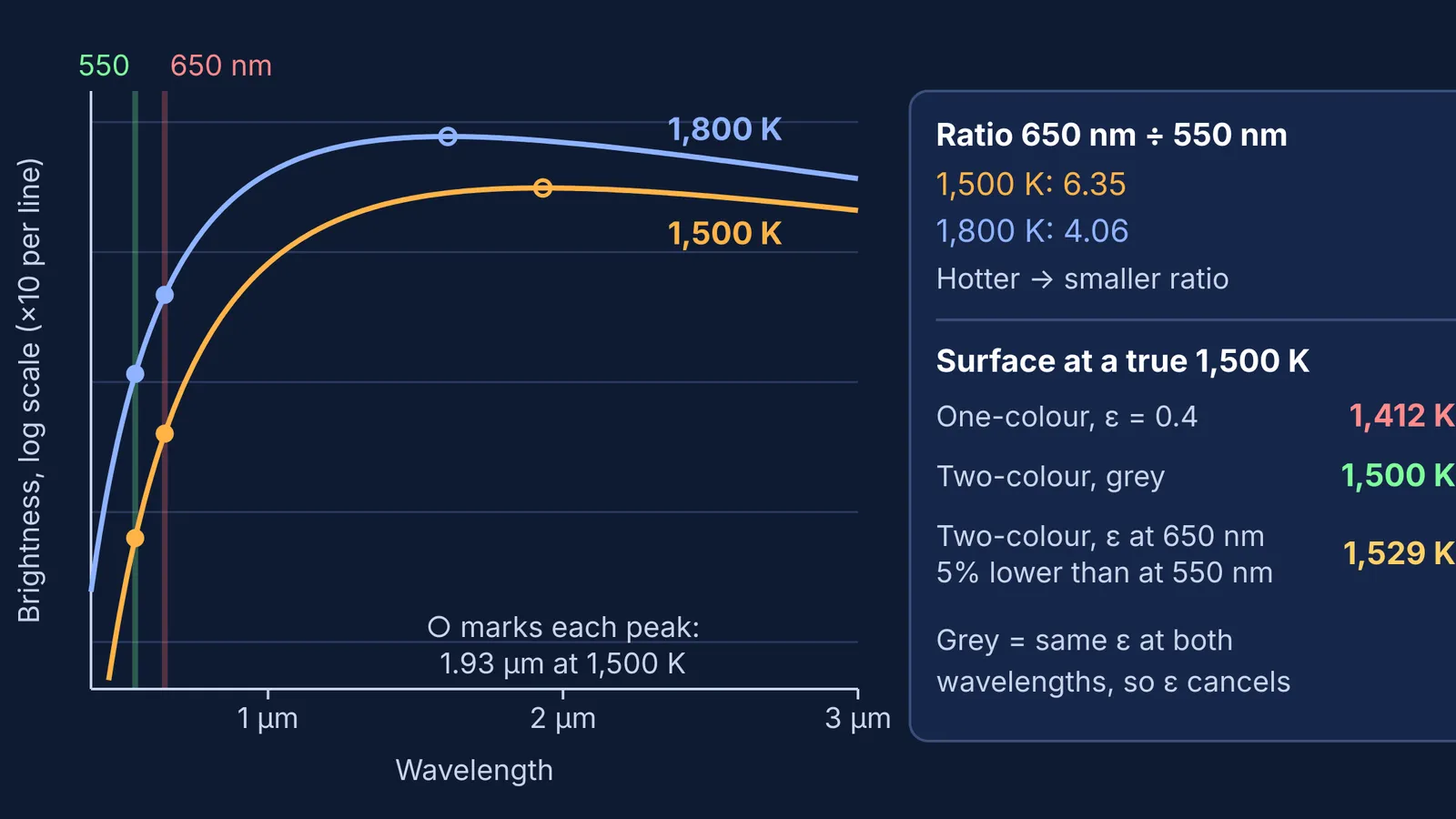
Tₐ = 1,412 K, which is 88 K low.
With ε = 0.8 the error is 22 K. Since ε for hot metal changes with the surface, oxide and temperature, you rarely know it well enough to correct the reading.
How does the ratio cancel the emissivity?
Divide the brightness at 650 nm by the brightness at 550 nm. If the surface has the same emissivity at both wavelengths, ε appears on top and bottom and cancels:
R = I(650)/I(550) = (550/650)⁵ × e^[(c₂/T)(1/λ₅₅₀ − 1/λ₆₅₀)]
Only T is left. A surface whose emissivity is the same at both wavelengths is called grey. Grey does not mean dark or low emissivity; it means the emissivity does not change between the two colours.
The same cancellation works for anything that dims both colours equally: smoke, dust, steam or a dirty window. Halve the light reaching the detector and a one-colour pyrometer at 650 nm reading a black body at 1,500 K drops to 1,433 K. The ratio does not change at all.
Worked example: turning a ratio into a temperature
Rearrange the ratio formula for T:
T = c₂(1/λ₅₅₀ − 1/λ₆₅₀) ÷ ln[R × (650/550)⁵]
Suppose the pyrometer measures R = 6.35.
The constant on top. c₂(1/550 nm − 1/650 nm) = 0.014388 × (1.8182 − 1.5385) × 10⁶ = 4,025 K.
The wavelength factor. (650/550)⁵ = 2.305.
The logarithm. ln(6.35 × 2.305) = ln 14.64 = 2.684.
The temperature. T = 4,025 ÷ 2.684 ≈ 1,500 K.
Check the units. c₂ is in m K and 1/λ in m⁻¹, so the top is in K, and the logarithm has no units. T comes out in kelvin.
Run the formula the other way and you get the ratio at other temperatures: 12.41 at 1,200 K, 6.35 at 1,500 K, 4.06 at 1,800 K and 3.24 at 2,000 K. Taken as long wavelength over short wavelength, the ratio falls as the object gets hotter, because a hotter body shifts its light towards shorter wavelengths. The surface looks less red.
The peak itself is covered in Wien's displacement law and who discovered it, and Stefan's law problems for furnaces are in black-body radiation: Stefan's law and Wien's law problems. If the Planck curve itself is the shaky part, the Concept Library covers every concept in physics, including black-body radiation.
When does a two-colour pyrometer give the wrong answer?
The cancellation needs the emissivity to be the same at both wavelengths. Real metals are not perfectly grey.
Suppose the emissivity at 650 nm is 5% lower than at 550 nm, on a surface at a true 1,500 K. The measured ratio is 0.95 × 6.346 = 6.029. Putting that into the formula gives 1,529 K, which is 29 K high. The surface looks bluer than a grey body, so the instrument thinks it is hotter.
The method also needs a precise detector. At 1,500 K the ratio changes by only about 0.18% per kelvin, so a 1% error in the ratio moves the reading by more than 5 K.
There is a trade-off in choosing the wavelengths. Closer channels make the "same emissivity" assumption more reasonable, but they make the ratio less sensitive to temperature, so any emissivity mismatch causes a larger error. With channels at 0.9 µm and 0.95 µm, the same 5% mismatch (lower emissivity at the longer wavelength) reads about 151 K high instead of 29 K. A technical note from the pyrometer maker Advanced Energy, Understanding two-color (ratio) pyrometer accuracy, makes the same point: a ratio instrument is emissivity independent only if the ratio of emissivities stays constant, its sensitivity to that ratio can be as large as 10 times a single-colour pyrometer's, and it is most useful when the view of the target may be partly blocked. Instruments let the user set this emissivity ratio, which the note calls the "slope".
One last check on the approximation. Planck's law has e^(c₂/λT) − 1 where Wien has e^(c₂/λT). At 2,000 K and 650 nm the difference is under 0.002%, so Wien's form is safe here.
Quick checklist
One-colour: 1/Tₐ = 1/T − (λ ln ε)/c₂; ε = 0.4 at 1,500 K and 650 nm reads 88 K low.
Two-colour: the ratio cancels ε only if the surface is grey (same ε at both wavelengths).
Smoke, dust or a dirty window that dims both colours equally does not change the ratio.
T = c₂(1/λ_short − 1/λ_long) ÷ ln[R × (λ_long/λ_short)⁵], with R = long over short.
R falls as T rises: 6.35 at 1,500 K, 4.06 at 1,800 K for 650 nm over 550 nm.
A 5% emissivity mismatch gives 29 K high at 550 and 650 nm, and far more with closer channels.
This uses Wien's approximation, not the displacement law.