

On this page
Have you ever noticed that a piece of metal heated in a forge first glows a dull red, then bright orange, and finally white? This predictable shift in colour was a major puzzle in 19th-century physics. The solution was discovered by German physicist Wilhelm Wien in 1893. His work provided the link between temperature and the colours emitted by hot objects, later known as Wien's displacement law.
What is Wien's displacement law?
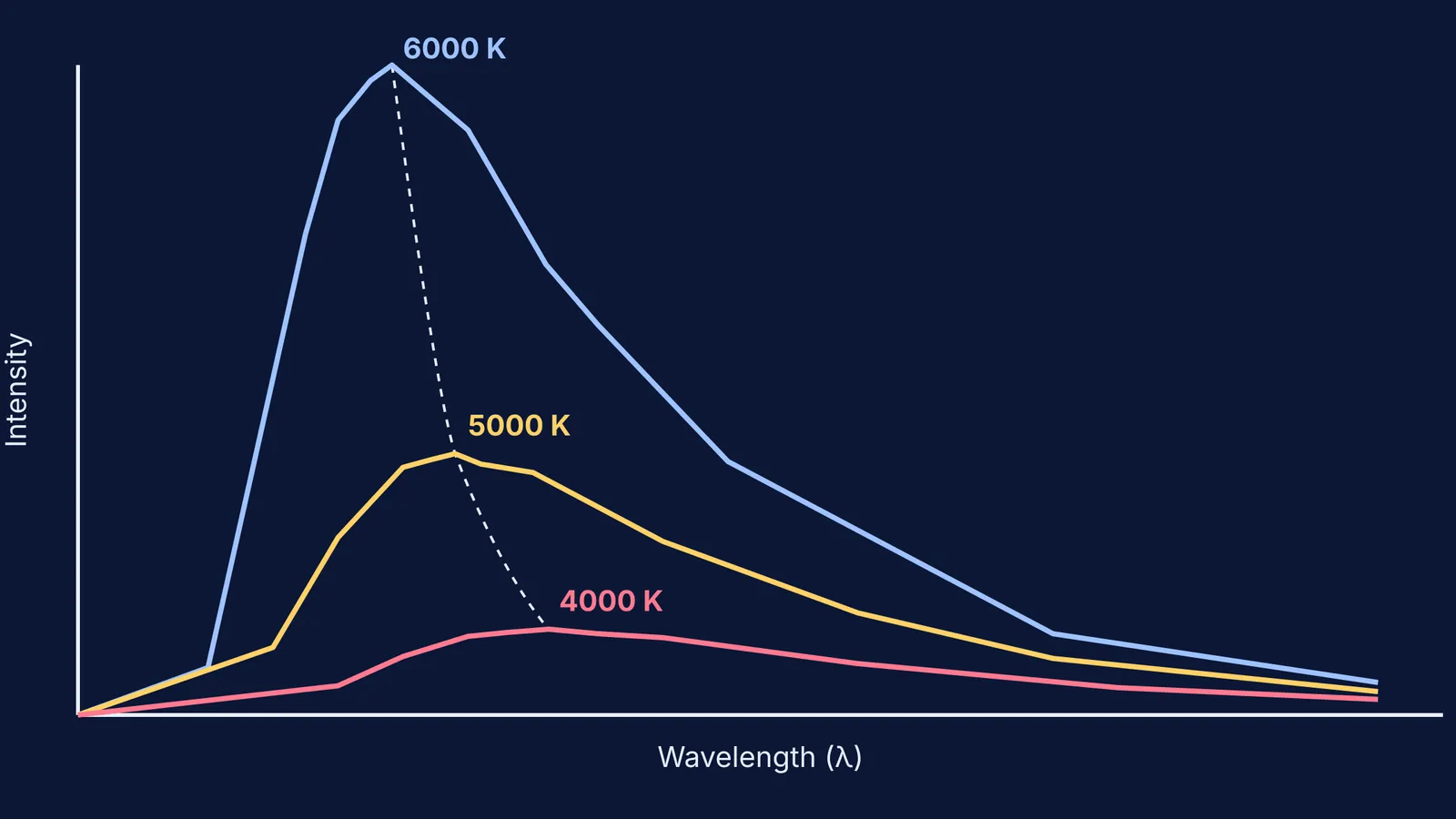
Wien's displacement law states that the peak wavelength of radiation emitted by a black body is inversely proportional to its absolute temperature. A black body is a theoretical object that perfectly absorbs and emits all frequencies of light. While perfect black bodies do not exist, many objects, such as stars and the filaments of incandescent light bulbs, are excellent approximations.
The constant, known as Wien's displacement constant, is approximately 2.898 × 10⁻³ m·K. The word "displacement" refers to how the peak of the emission spectrum shifts—or is displaced—toward shorter wavelengths as the temperature rises. Because blue light has a shorter wavelength than red light, hotter objects appear more blue, while cooler objects appear red.
For example, everyday objects like the human body also emit thermal radiation. Because our body temperature is much lower than that of a star or a forge, our peak emission occurs at a much longer wavelength. This peak lies deep in the infrared part of the electromagnetic spectrum. This is why we cannot see each other glowing in a dark room, but thermal imaging cameras can detect our body heat by picking up those infrared wavelengths.
How did Wilhelm Wien discover it?
In 1893, Wien published his paper, *Eine neue Beziehung zwischen der Strahlung schwarzer Körper und dem zweiten Hauptsatz der Wärmetheorie* (A new relationship between the radiation of black bodies and the second law of thermodynamics).
He used a thought experiment based on the laws of thermodynamics. Wien imagined a hollow cavity filled with electromagnetic radiation, and considered what would happen if the cavity expanded extremely slowly in an adiabatic expansion. By applying the Doppler effect to the light bouncing off the moving walls, Wien proved that the spectrum's shape stays the same, but the peak shifts in direct proportion to the temperature change.
This discovery earned Wien the Nobel Prize in Physics in 1911 for his work on the laws governing the radiation of heat.
If changing equations into curves is hard to picture, the Fermi Simulation Lab has interactive simulations for the ideas that are easier to see than to read. You can turn the heat up on a virtual star and watch its peak colour shift across the spectrum in real time.
How do you use Wien's law to find a star's temperature?
Astronomers use Wien's displacement law as a cosmic thermometer. Because the law works for any ideal emitter, you can find a star's surface temperature just by looking at its light.
Here is a worked example for finding the surface temperature of the Sun:
Measure the peak: The Sun's radiation peaks in the green-blue part of the visible spectrum, at a wavelength of roughly 500 nm (500 × 10⁻⁹ m). Interestingly, although the peak is green-blue, the mixture of all the visible wavelengths combines to appear white to the human eye.
Rearrange the formula: T = b / λ.
Calculate: T = (2.898 × 10⁻³) / (500 × 10⁻⁹).
Result: The division gives roughly 5796 K.
When a physics problem asks you to calculate the temperature of a star, wrong methods are common. The Fermi Problem Library has worked problems with a step-by-step solver that explains the reasoning rather than printing an answer.
This simple division is all it takes for scientists to measure the temperature of distant galaxies without ever leaving Earth.
Read next:


