On this page
Treat each option as its own true-or-false statement and tick only what you have proved. Here are eight original trigonometry questions.
How does partial marking work in JEE Advanced multiple-correct questions?
In the official JEE Advanced 2025 Paper 1 mathematics answer key, Section 2 marks questions with one or more correct options like this:
+4 if you choose all the correct options and nothing else.
+3 if all four options are correct and you choose exactly three.
+2 if three or more options are correct and you choose two, both correct.
+1 if two or more options are correct and you choose one correct option.
0 if you leave it blank; −2 in all other cases.
The scheme can change yearly; reread it on exam day.
Eight trigonometry questions, option by option
Q1. sin θ + cos θ = 1/5 with 0 < θ < π. Which are true?
(A) sin θ cos θ = −12/25. True: square the given equation.
(B) θ lies in (3π/4, π). False: sin θ = 4/5 and cos θ = −3/5, so tan θ < −1 puts θ in (π/2, 3π/4).
(C) tan θ = −4/3. True.
(D) cos 2θ = 7/25. False: it is −7/25.
Answer: A, C. D swaps cos²θ and sin²θ.
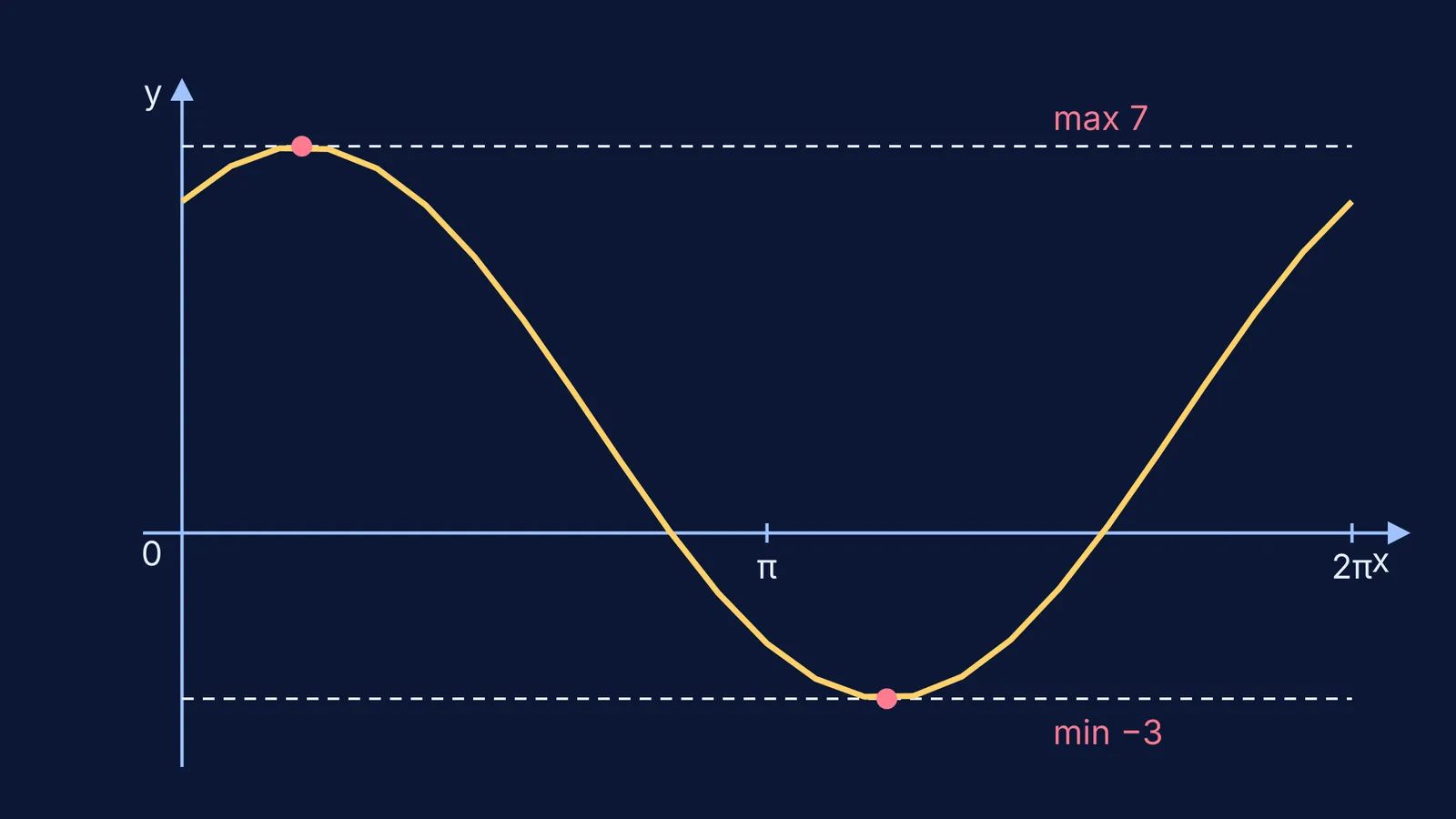
Q2. f(x) = 3 sin x + 4 cos x + 2. Which are true?
(A) The greatest value of f is 7. True: 3 sin x + 4 cos x lies in [−5, 5].
(B) The least value of f is −3. True.
(C) f(x) = 0 has a real solution. True: 0 lies in [−3, 7].
(D) f reaches 7 where tan x = 3/4. True: there sin x = 3/5, cos x = 4/5.
Answer: all four. Dropping D earns +3, not +4.
Q3. 2cos²x + 3 sin x = 0. Which are true?
(A) It has exactly two solutions in [0, 2π]. True: (2 sin x + 1)(sin x − 2) = 0 gives sin x = −1/2: 7π/6 and 11π/6.
(B) The general solution is x = nπ + (−1)ⁿ(π/6). False: that solves sin x = 1/2; use nπ − (−1)ⁿ(π/6).
(C) The solutions in [0, 2π] add to 3π. True.
(D) Every solution satisfies cos 2x = 1/2. True: 1 − 2 sin²x = 1/2.
Answer: A, C, D.
Q4. Which are true?
(A) sin 20° sin 40° sin 80° = 3/8. False: it is (sin 60°)/4 = √3/8.
(B) cos 20° cos 40° cos 80° = 1/8. True.
(C) cos 36° − cos 72° = 1/4. False: it is 1/2.
(D) tan 20° tan 40° tan 80° = √3. True: divide the product in A by the one in B.
Answer: B, D.
Q5. Triangle ABC has a = 7, b = 5, c = 3. Which are true?
(A) A = 2π/3. True: cos A = (25 + 9 − 49)/30 = −1/2.
(B) Its area is 15√3/4. True: ½bc sin A.
(C) sin B : sin C = 3 : 5. False: it is b : c = 5 : 3.
(D) The circumradius is 7√3/3. True: a/(2 sin A).
Answer: A, B, D.
Q6. Which are identities wherever both sides are defined?
(A) (1 − cos 2x)/sin 2x = cot x. False: it equals tan x.
(B) sin⁴x − cos⁴x = cos 2x. False: it equals −cos 2x.
(C) sin 3x/sin x − cos 3x/cos x = 2. True: combine to sin 2x/(sin x cos x).
(D) sin⁴x + cos⁴x = 1 − ½sin²2x. True.
Answer: C, D.
Q7. tan x + tan 2x + tan x tan 2x = 1. Which are true?
(A) x = 3π/4 is a solution. False: tan 2x is undefined there.
(B) Every solution satisfies tan 3x = 1. True: rearrange into the tan(A + B) formula.
(C) It has exactly four solutions in [0, 2π]. True: π/12, 5π/12, 13π/12, 17π/12; 3π/4 and 7π/4 drop out.
(D) The solutions in [0, π] add to π/2. True.
Answer: B, C, D.
Q8. f(x) = cos²x + cos²(x + π/3) − cos x cos(x + π/3). Which are true?
(A) The smallest positive period of f is π. False: f is constant.
(B) The greatest value of f is 1. False.
(C) f(x) = 3/4 for every real x. True: f(0) = 3/4 and product-to-sum shows f never changes.
(D) f is increasing on (0, π/4). False.
Answer: C only.
What should you do with options you cannot settle?
Mark each option T, F or ? first.
Tick every T. Never tick a ?.
With no sure T, leave it blank; a guess risks −2.
For worked solutions, see the trigonometry JEE Advanced practice questions and the JEE Advanced numerical answer questions on trigonometry. If one option type keeps fooling you, the Fermi Problem Library has a step-by-step solver that explains the reasoning. For wider JEE Main and Advanced preparation, try Fermi Test Prep.