On this page
Eight original questions, easy to hard, each with the value to type and the usual lost mark. All fit the trigonometry in the JEE (Advanced) 2026 syllabus: functions, periods and graphs, multiple-angle formulae and general solutions.
How do numerical-answer questions work in JEE Advanced?
In the JEE (Advanced) 2025 Paper 1 mathematics answer key, Section 3 had six numerical-value questions, entered on an on-screen numeric keypad and truncated or rounded to two decimal places. A correct value earned +4 and anything else 0. For two of the six, the key accepted a range (1.15 to 1.25 and 2.35 to 2.45). Patterns change, so read the instructions on the day. Every answer below is the same whether you truncate or round.
Easy for Advanced: products and counting roots
Q1. Find tan 20° tan 40° tan 80°.
Use tan θ tan(60° − θ) tan(60° + θ) = tan 3θ with θ = 20°: the product is tan 60° = √3 = 1.7320… Enter 1.73. Check: 0.3640 × 0.8391 × 5.6713 ≈ 1.732. Lost mark: carrying the 1/4 from the sine version of the identity and entering 0.43.
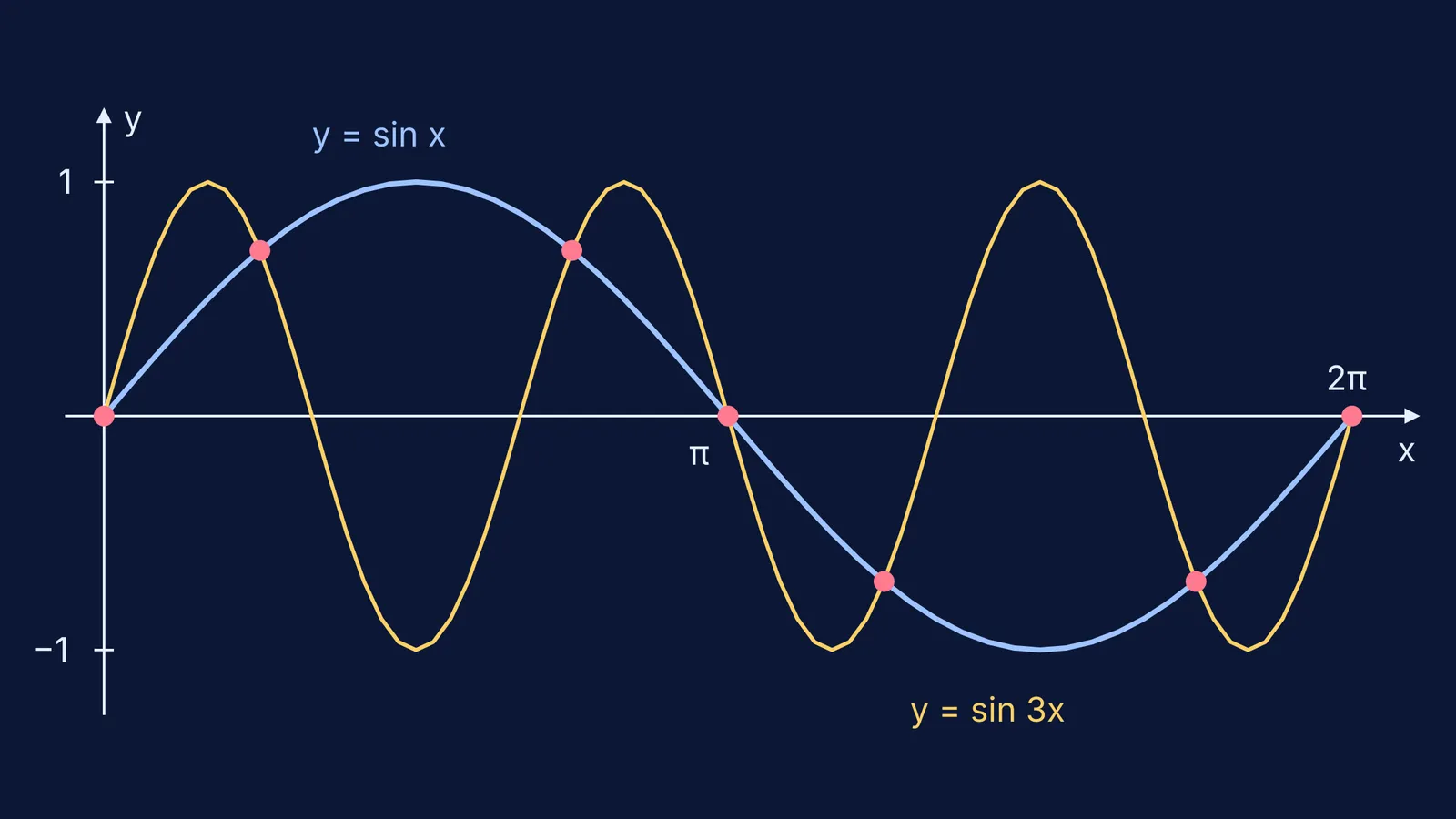
Q2. How many x in [0, 2π] satisfy sin 3x = sin x?
sin 3x − sin x = 2 cos 2x sin x = 0. sin x = 0 gives 0, π and 2π; cos 2x = 0 gives π/4, 3π/4, 5π/4 and 7π/4. Enter 7. Check: the diagram at the top shows seven crossings. Lost mark: cancelling sin x (4), or dropping the endpoint 2π (6).
Q3. Find the sum of all solutions of 2cos²x + 3 sin x = 0 in [0, 2π].
Replace cos²x by 1 − sin²x: 2sin²x − 3 sin x − 2 = 0, so (2 sin x + 1)(sin x − 2) = 0. sin x = 2 is impossible; sin x = −1/2 gives 7π/6 and 11π/6, which sum to 3π = 9.4247… Enter 9.42. Lost mark: a sign slip giving sin x = 1/2 and a sum of π (3.14).
Medium: period, minimum and maximum
Q4. f(x) = sin⁴x + cos⁴x has minimum value m and fundamental period T (in radians). Find m + T.
sin⁴x + cos⁴x = 1 − 2sin²x cos²x = 1 − (1/2)sin²2x = (3 + cos 4x)/4. So m = 1/2 and T = 2π/4 = π/2, and m + T = 2.0707… Enter 2.07. Lost mark: taking T = π, giving 3.64.
Q5. Find the greatest value of 2 sin x (sin x + cos x).
Expand: 2sin²x + 2 sin x cos x = 1 − cos 2x + sin 2x = 1 + √2 sin(2x − π/4). The greatest value is 1 + √2 = 2.4142… Enter 2.41. Check: at x = 3π/8, 2 × 0.9239 × (0.9239 + 0.3827) ≈ 2.414. Lost mark: maximising each part separately and entering 3.
Hard: two ideas in one question
Q6. Find cos²(π/7) + cos²(2π/7) + cos²(3π/7).
Each cos²θ = (1 + cos 2θ)/2, so the sum is 3/2 + (cos 2π/7 + cos 4π/7 + cos 6π/7)/2. The seventh roots of unity add to 0; pairing conjugates gives 1 + 2(bracket) = 0, so the bracket is −1/2. The sum is 3/2 − 1/4 = 5/4. Enter 1.25. Check: 0.8117 + 0.3887 + 0.0495 ≈ 1.25. Lost mark: assuming the cosine sum is 0 and entering 1.50.
Q7. Find tan(π/32) + 2 tan(π/16) + 4 tan(π/8) + 8 cot(π/4).
From cot θ − tan θ = 2 cot 2θ, tan θ = cot θ − 2 cot 2θ. So tan(π/32) + 2 tan(π/16) = cot(π/32) − 4 cot(π/8); adding 4 tan(π/8) leaves cot(π/32) − 8 cot(π/4), and the last term cancels that. The value is cot(π/32) = 10.1531… Enter 10.15. Check: 0.0985 + 0.3978 + 1.6569 + 8 ≈ 10.153. Lost mark: rounding each tangent to two places first, 0.10 + 0.40 + 1.66 + 8 = 10.16.
Q8. How many x in [0, 6π] satisfy sin⁴x + cos⁷x = 1?
sin⁴x ≤ sin²x and cos⁷x ≤ cos²x, so the left side is at most 1, with equality only when both bounds are tight. That needs sin x ∈ {0, ±1} and cos x ∈ {0, 1}, so x = 2kπ or x = π/2 + kπ. In [0, 6π] there are four of the first kind and six of the second. Enter 10. Check: x = π gives 0 + (−1) = −1. Lost mark: allowing cos x = −1 and counting π, 3π and 5π too, giving 13.
How should you enter a decimal answer?
Write the exact form first (√3, 3π, cot(π/32)); it is your check.
Carry four decimals and cut to two only at the end; Q7 shows why.
Reread the question: radians or degrees, sum or count, closed or open interval.
For option-based questions, try trigonometry JEE Advanced practice questions with solutions; for the easier format, trigonometry JEE Main numerical value questions.
If one step keeps tripping you, the Fermi Problem Library has a step-by-step solver that explains the reasoning rather than printing an answer. For the rest of your JEE Main and Advanced preparation, start at Fermi Test Prep.