On this page
Eight original NEET-UG Physics questions, from sign checks to a full cycle, each with a worked answer and its trap: the most tempting wrong option.
Which Thermodynamics topics do these NEET questions cover?
The NMC syllabus for NEET (UG)-2026 lists Thermodynamics as Physics Unit 8: the zeroth, first and second laws; heat, work and internal energy; isothermal and adiabatic processes; reversible and irreversible processes. Molar specific heats (Unit 9) and the Carnot engine are both in Chapter 11 of NCERT Class 11 Physics Part II (Reprint 2026-27).
We use NCERT's ΔQ = ΔU + ΔW (W done by the gas) and R = 8.3 J mol⁻¹ K⁻¹. New to the chapter? Read our guide on how to prepare Thermodynamics for NEET.
How should you use this practice set?
The NTA information bulletin for NEET (UG)-2026 gives +4 for a correct answer, −1 for a wrong one and 0 for an unanswered question. So:
Allow one minute each for Q1 to Q3 and two for the rest.
Write the signs of Q and W before any number.
Mark every guess and read every trap.
Easy: first law, signs and heat at constant volume
Q1 (easy). A gas is compressed by 1.2 kJ of work done on it and loses 450 J of heat. What is the change in its internal energy?
(A) −1650 J (B) −750 J (C) +750 J (D) +1650 J
Answer: (C). ΔQ = −450 J and ΔW = −1200 J (work done on the gas). ΔU = ΔQ − ΔW = −450 + 1200 = +750 J.
Trap: (D) adds 1200 and 450 and forgets that heat leaving the gas is negative.
Q2 (easy). Two moles of an ideal diatomic gas in a sealed rigid tank are heated from 300 K to 350 K. How much heat is supplied? (Take C_v = 5R/2.)
(A) 0.83 kJ (B) 1.25 kJ (C) 2.08 kJ (D) 2.91 kJ
Answer: (C). The volume is fixed, so no work is done and ΔQ = nC_vΔT = 2 × 2.5 × 8.3 × 50 ≈ 2075 J ≈ 2.08 kJ.
Trap: (D) uses C_p = 7R/2, but a rigid tank means constant volume.
Q3 (easy). An ideal gas expands slowly at constant temperature and absorbs 600 J of heat. Which is correct?
(A) ΔU = 600 J, W = 0 (B) ΔU = 0, W = 600 J (C) ΔU = 300 J, W = 300 J (D) ΔU = 0, W = −600 J
Answer: (B). The internal energy of an ideal gas depends only on temperature, so ΔU = 0 and all 600 J leaves as work done by the gas.
Trap: (A) assumes heat must raise internal energy; isothermally it does not.
Medium: isobaric, adiabatic and Carnot
Q4 (medium). A monatomic ideal gas is heated at a constant pressure of 2.0 × 10⁵ Pa, and its volume grows from 3.0 L to 5.0 L. How much heat does it absorb?
(A) 400 J (B) 600 J (C) 1000 J (D) 1400 J
Answer: (C). W = PΔV = 2.0 × 10⁵ × 2.0 × 10⁻³ = 400 J. For a monatomic gas, ΔU = (3/2)nRΔT = (3/2)PΔV = 600 J. ΔQ = 600 + 400 = 1000 J.
Trap: (B) is only ΔU; the gas also does work.
Q5 (medium). An ideal diatomic gas (γ = 7/5) at 280 K is compressed adiabatically from 24.3 L to 3.2 L. What is its final temperature?
(A) 280 K (B) 630 K (C) about 1080 K (D) about 2130 K
Answer: (B). TV^(γ−1) is constant, so T₂ = 280 × (24.3/3.2)^(0.4). Since 24.3/3.2 = 243/32 = (3/2)⁵, the factor is (3/2)² = 2.25, and T₂ = 280 × 2.25 = 630 K.
Trap: (C) uses the monatomic γ = 5/3, giving a factor of (3/2)^(10/3) ≈ 3.9. Check which gas is named.
Q6 (medium). A reversible engine works between reservoirs at 477 °C and 27 °C and takes in 2.5 kJ of heat from the hot reservoir each cycle. How much work does it do per cycle?
(A) 1.0 kJ (B) 1.5 kJ (C) 2.36 kJ (D) 2.5 kJ
Answer: (B). In kelvin, the temperatures are 750 K and 300 K, so the Carnot efficiency is 1 − 300/750 = 0.6. W = 0.6 × 2.5 = 1.5 kJ.
Trap: (C) puts Celsius into the ratio: 1 − 27/477 ≈ 0.94. (A) is the heat rejected.
Hard: a cycle on a PV diagram
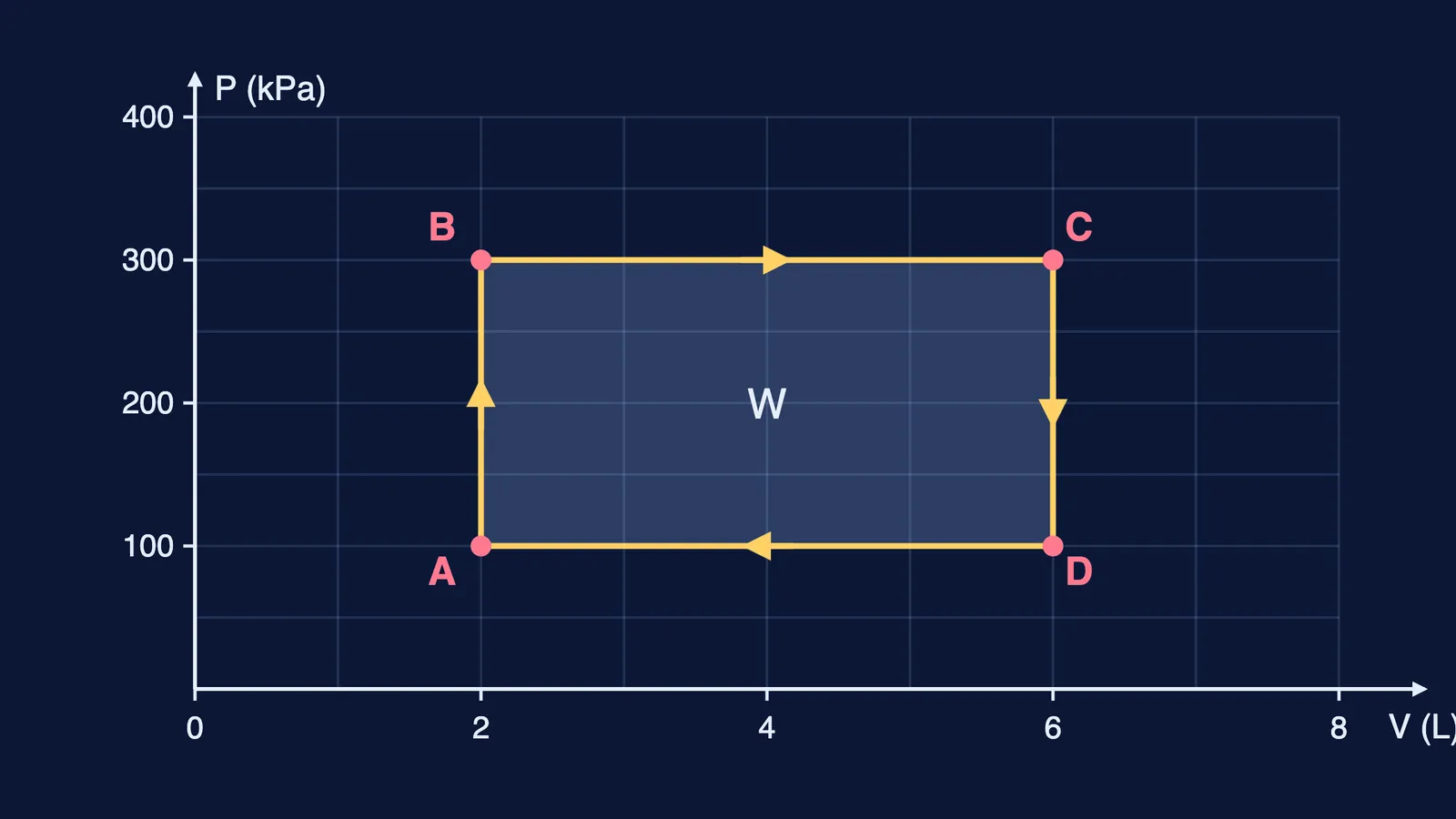
For Q7 and Q8, a monatomic ideal gas runs the clockwise rectangular cycle A (2 L, 100 kPa) → B (2 L, 300 kPa) → C (6 L, 300 kPa) → D (6 L, 100 kPa) → A.
Q7 (hard). What is the net heat absorbed by the gas in one cycle?
(A) 0 J (B) 400 J (C) 800 J (D) 1200 J
Answer: (C). Over a full cycle ΔU = 0, so net ΔQ = net W = enclosed area = 200 kPa × 4 L = 800 J.
Trap: (A) reads ΔU = 0 as "no heat". It means net heat in equals net work out.
Q8 (hard). What is the efficiency of this cycle?
(A) about 22% (B) about 27% (C) about 67% (D) about 89%
Answer: (A). Heat enters only on A → B (constant V: (3/2)VΔP = 600 J) and B → C (constant P: (5/2)PΔV = 3000 J). Efficiency = 800/3600 = 2/9 ≈ 22%.
Trap: (B) divides by the B → C heat alone. (D) is the Carnot limit between C and A (T ∝ PV, a ratio of 9), not this cycle's efficiency.
What should you do after checking your answers?
Sort misses by trap: a sign or bookkeeping slip (Q1, Q3, Q7), the wrong specific heat or γ (Q2, Q4, Q5), or a missing step (Q6, Q8). Redo the group you missed most, then retry the set in three days.
For more engines, try our heat engine and Carnot cycle problems. For where C_v = 3R/2 and 5R/2 come from, see Kinetic Theory of Gases for NEET.
For more questions like these, the Fermi Problem Library has worked problems with a step-by-step solver that explains the reasoning rather than printing an answer.