On this page
Chapter 10 of *Khel Praveen*, NCERT's new Grade 9 Physical Education and Well-being book (First Edition, April 2026), tells the story of the Olympics before the modern era. It sits in Unit 3, Olympism; read it in the NCERT Unit 3 PDF (iehp103).
Where did the ancient Olympic Games begin, and why?
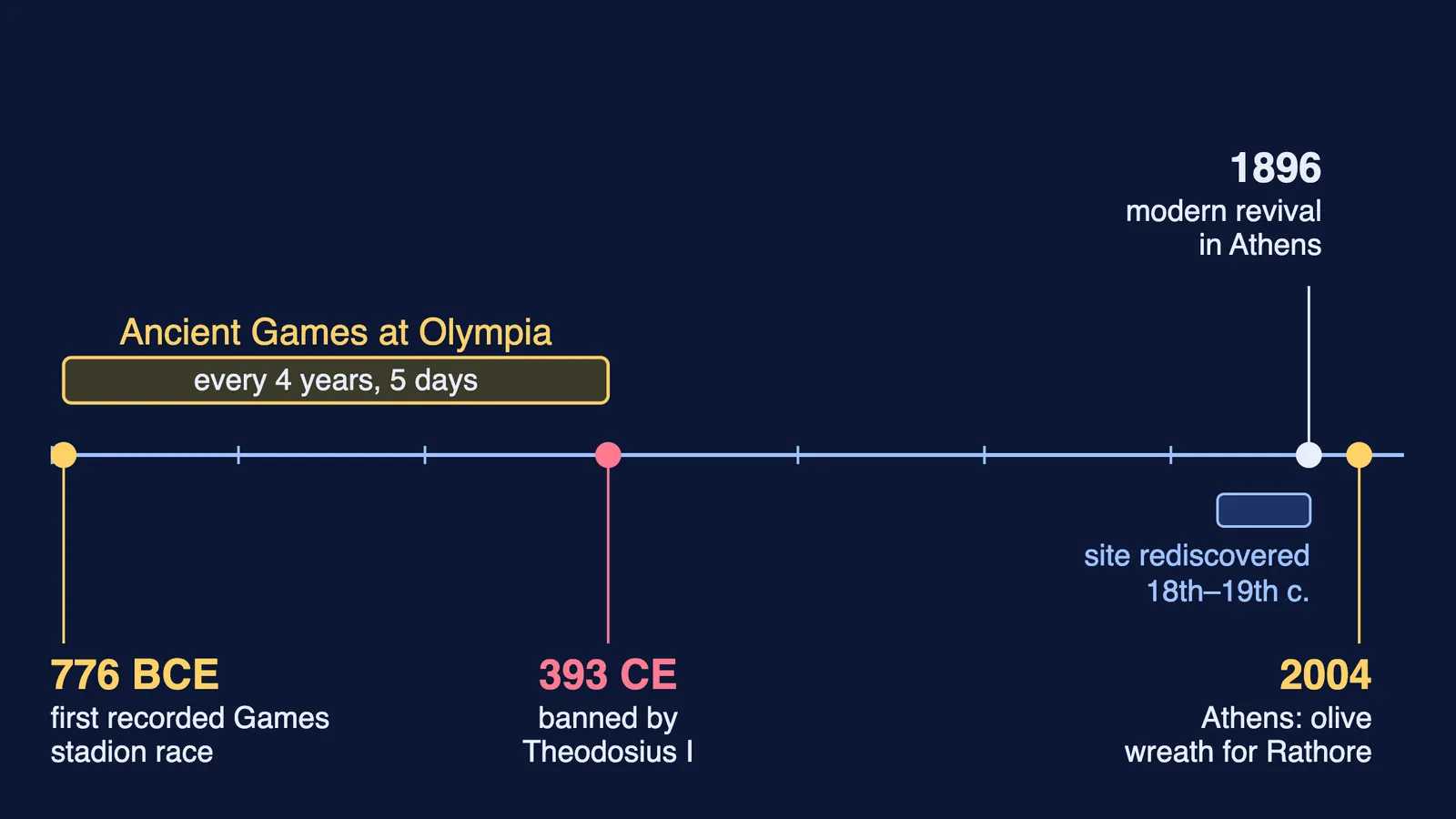
According to the NCERT chapter, the first recorded Games were held in 776 BCE at Olympia, a sacred valley in western Greece rather than a big city.
The Games had a religious purpose: they honoured Zeus, whom the Greeks treated as their chief god. The book names Pausanias and Herodotus as ancient writers who described the Games.
One idea to learn by name is arête, which the book explains as excellence of character. The book treats a win as a gift offered to the gods and a path towards arête.
How were the Games organised, and which events were held?
Organisers: the people of Elis, a small region near Olympia, ran the Games.
Judges: they were called the Hellanodikai, which the book translates as "Judges of the Greeks".
Who could compete: only free-born Greek men, from city-states including Athens, Corinth and Sparta.
The oath: each athlete swore before the statue of Zeus to compete fairly and obey the rules.
Schedule: a five-day festival, every four years.
The earliest recorded event, the book says, was the stadion, a sprint of about 192 metres. Later additions it lists:
Longer running races: the diaulos (two laps) and the dolichos (a long-distance race)
Wrestling and boxing
Pankration, which mixed wrestling with boxing
Pentathlon: running, long jump, discus, javelin and wrestling
Chariot racing, staged in the hippodrome
What did winners get at Olympia?
No money and no medals. The NCERT text says a victor was crowned with the kotinos, a wreath of wild olive leaves cut from a sacred tree beside Zeus's temple. The book links it with purity, hard work and peace.
The bigger reward came at home: poems, statues, and sometimes free meals for life. Pindar praised winners in victory odes (the chapter calls him a poet in one section and a philosopher in another), and the chapter traces today's values of respect, excellence and friendship back to this idea.
The chapter's first section opens with a modern link: at the 2004 Athens Olympics, Indian shooter Rajyavardhan Singh Rathore received an olive wreath after winning silver.
How did the Games shape Greek society, and why did they end?
Greek city-states often fought one another, but the Olympic Truce paused conflicts so that athletes and visitors could reach Olympia in safety. The temple of Zeus held a huge statue by the sculptor Phidias, which the book lists among the Seven Wonders of the Ancient World.
Women did not compete in the main Games. The chapter notes a separate event with races for young women, the Heraean Games, held in honour of the goddess Hera.
The Games ran for more than a thousand years. Under Roman control, the book says, money and politics crept in. In 393 CE, Emperor Theodosius I of Rome banned pagan festivals, and the Olympics ended with them.
Archaeologists rediscovered the site of Olympia in the 18th and 19th centuries. Inspired by ancient Olympia, the French educator Pierre de Coubertin pushed for a revival, and the Modern Olympic Games began in Athens in 1896, the chapter says.
How many marks is this chapter worth in 2026-27?
The CBSE 2026-27 Physical Education and Well-being curriculum sets 100 marks: Theory 20, Practical 80. Theory is 2 marks for each of 8 units (16 marks) plus a 4-mark viva. The book and the curriculum number units differently: the book's Unit 3 (Olympism) matches the curriculum's Unit 6, Olympic Movement, where "Ancient and Modern Olympics" is listed together with Olympism, Olympic values and Olympic symbols, so those topics share the unit's 2 marks; no separate figure exists for this chapter.
Under the CBSE 2026-27 Secondary scheme of studies, Physical Education and Well-being in Class 9 is a school-based internal assessment subject, with no board exam.
Practice questions (our suggestion)
Our own questions; mark labels are our suggestion.
(1 mark) Who were the Hellanodikai?
(1 mark) Which event was the first recorded at Olympia, and roughly how long was it?
(2 marks) Name the separate Games held for young women at Olympia and the goddess they honoured.
(2 marks) What was the Olympic Truce, and why did athletes and visitors travelling to Olympia need it?
(3 marks) Put these in order and add one line on each: the ban by Theodosius I, the revival in Athens, the first recorded Games, the rediscovery of Olympia.
Answer check: Q2 is the stadion, about 192 metres. In Q5 the order is 776 BCE, 393 CE, the 18th–19th centuries, then 1896.
The Class 11 guide to Olympism, Olympic values and symbols carries this story forward, and do Class 9 marks matter explains where school-assessed marks count.
Not sure where to start revising? Fermi's AI tutor works out what you already know and builds a plan for the session.