On this page
Symbols and Metaphors on Stage is Chapter 3 of *Madhurima*, NCERT's new arts textbook for Class 9 (First Edition, April 2026, per the book's prelims). It fills pages 51 to 61 of the chapter PDF and is the second chapter in the book's Theatre section. Its point: everything on stage says something, not only the dialogue.
What is the difference between a symbol and a metaphor on stage?
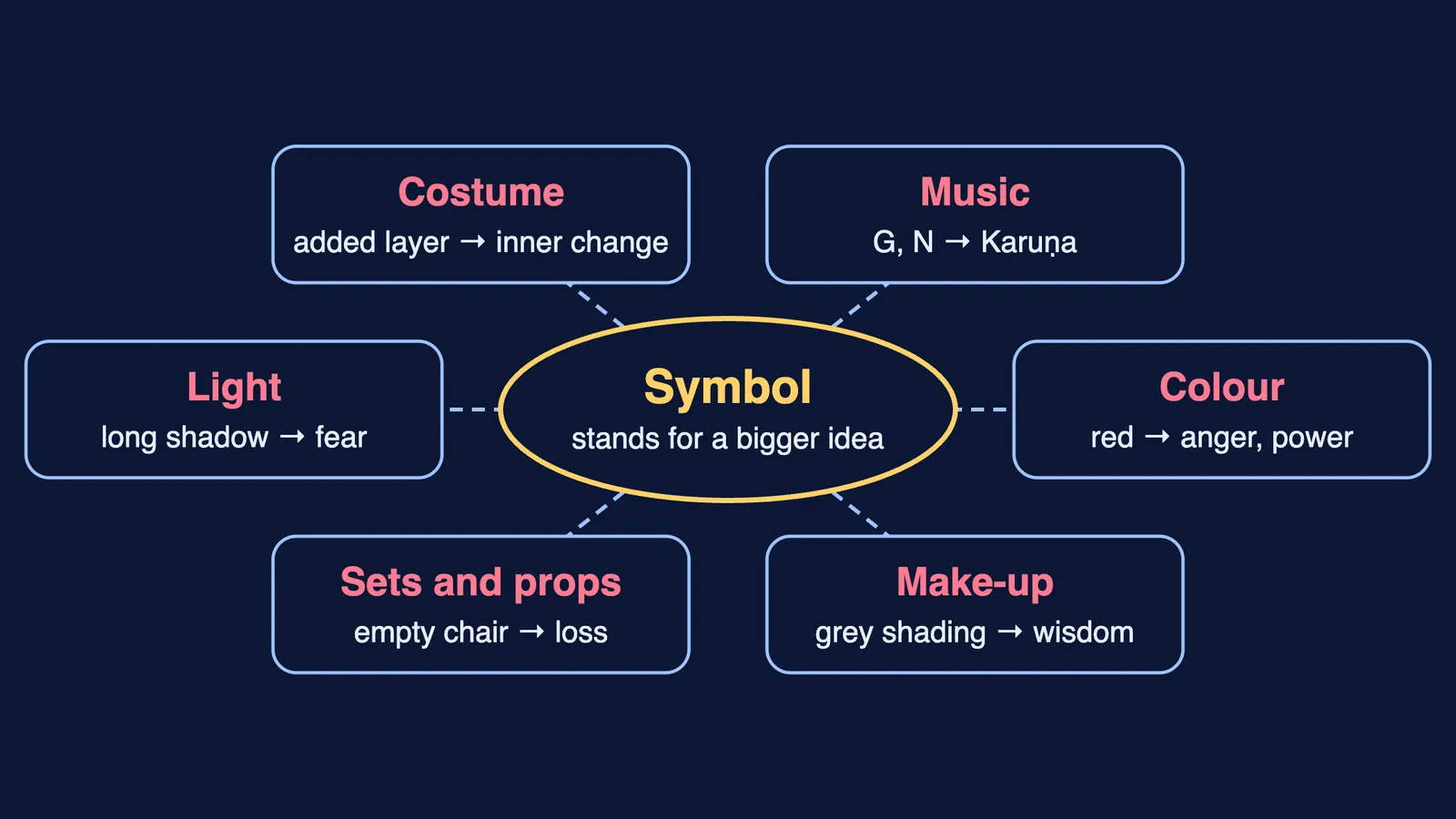
In the chapter, symbolism means an object, action, colour, sound or movement standing for a meaning deeper than what it literally is (Madhurima, Chapter 3). A single lamp can suggest hope; a closed door, fear or opportunity.
A metaphor, as the book puts it, is a device playwrights use to compare two things that look unrelated. A character pacing in circles can stand for confusion or feeling trapped, and a ripped costume for a shattered sense of self.
The book gives five reasons for using them: deeper meaning the audience discovers itself, emotional connection without words, creativity when sets are limited, cultural expression (symbolic costume, colour and gesture in Kathakali and Yakṣhagāna), and images that stay with viewers after the play.
How do colour, music, costume and light carry meaning?
The chapter covers six stage elements (NCERT Madhurima, Chapter 3).
Colour: its chart pairs red with anger, danger, power and passion, blue with calmness, sadness, night and mystery, and white with purity, truth, focus and surrender. Meanings shift with place, period and culture. The Nāṭyaśhāstra also gives each rasa a colour, for example red for Raudra (anger) and grey for Karuṇa (compassion).
Music: a hissing sound at an entry marks danger, a flute marks calm. Drawing on the Nāṭyaśhāstra, the book links the notes M and P with Hāsya and Śhṛiṅgāra, and G and N with Karuṇa, noting that modern composers may differ. (Its table puts Bhayānaka with S, R; its verse translation pairs it with D.)
Costume: rich fabric hints at royalty, plain cotton at humility; an added layer can signal inner change or a shift in the story.
Make-up: grey shading shows wisdom or burden; a face painted two ways shows duality.
Sets and props: a vast empty stage suggests loneliness, clutter suggests chaos, and a raised platform suggests authority. An object that keeps returning becomes a motif; an empty chair can stand for loss.
Light: bright light reads as clarity, dim light as fear or secrecy, and a sudden blackout as shock. Backlight suggests mystery; long shadows, loneliness or inner conflict.
Worked example: one scene built from symbols
Our own scene (not from the book): a grandmother spends her last evening in her village home before moving to the city with her son.
Colour: grey and faded blue for the backdrop and her sari, using the book's links of grey with Karuṇa and blue with sadness.
Music: a slow tune that leans on G and N, the notes the chapter ties to Karuṇa.
Set: the room starts full. Between short blackouts, furniture is removed until the stage is almost bare: growing loneliness.
Prop motif: she keeps touching a brass lota by the door. She leaves it behind; the repeated object now means the home she is losing.
Costume: her son drapes a city cardigan over her sari, an added layer marking the change in her life.
Light: front light at the start; at the end, one backlight throws her long shadow across the floor.
Every choice is defensible from the chapter.
How many marks does Symbols and Metaphors on Stage carry?
Class 9 Art Education is assessed entirely by the school, out of 100: 40 for theory and 60 for practical (CBSE Art Education curriculum 2026-27). In the theory component, Theatre carries 4 marks. That covers the whole Theatre section; the curriculum does not split it by chapter.
The practical score is the average of four 60-mark sections, one per art form. The Theatre section includes 10 marks for applying a concept from the book and 10 for a viva.
Practice questions
Mark labels are our suggestion.
(1 mark) Which rasa does the Nāṭyaśhāstra colour chart in the chapter link with red?
(2 marks) Give one stage example of a symbol and one of a metaphor, and explain how they differ.
(2 marks) A ruler sits on a high platform, a messenger on the floor. What does each level suggest?
(3 marks) Show, using costume and props only, that a family has grown poorer over one year, across three entries.
(4 marks) Plan light and music for a student waiting alone outside an exam hall, using two meanings from the chapter, with reasons.
For metaphors in poetry, see our guide to Fog and The Trees, Class 10. The play The Book That Saved the Earth is a good script to stage with symbols, and our Kaveri Class 9 English guide covers another new book.
Not sure where to begin revising the Theatre chapters? Fermi's AI tutor works out what you already know and builds a plan for the session.