On this page
From 2026-27, Class 9 students in CBSE schools read a new English textbook. NCERT's Kaveri: Textbook of English for Grade 9 is a first edition dated January 2026, and the CBSE 2026-27 Class IX English curriculum names it as the prescribed book. If your science and maths books are also new, our guide to the new Class 9 science and maths books covers those.
What is in Kaveri, the new Class 9 English book?
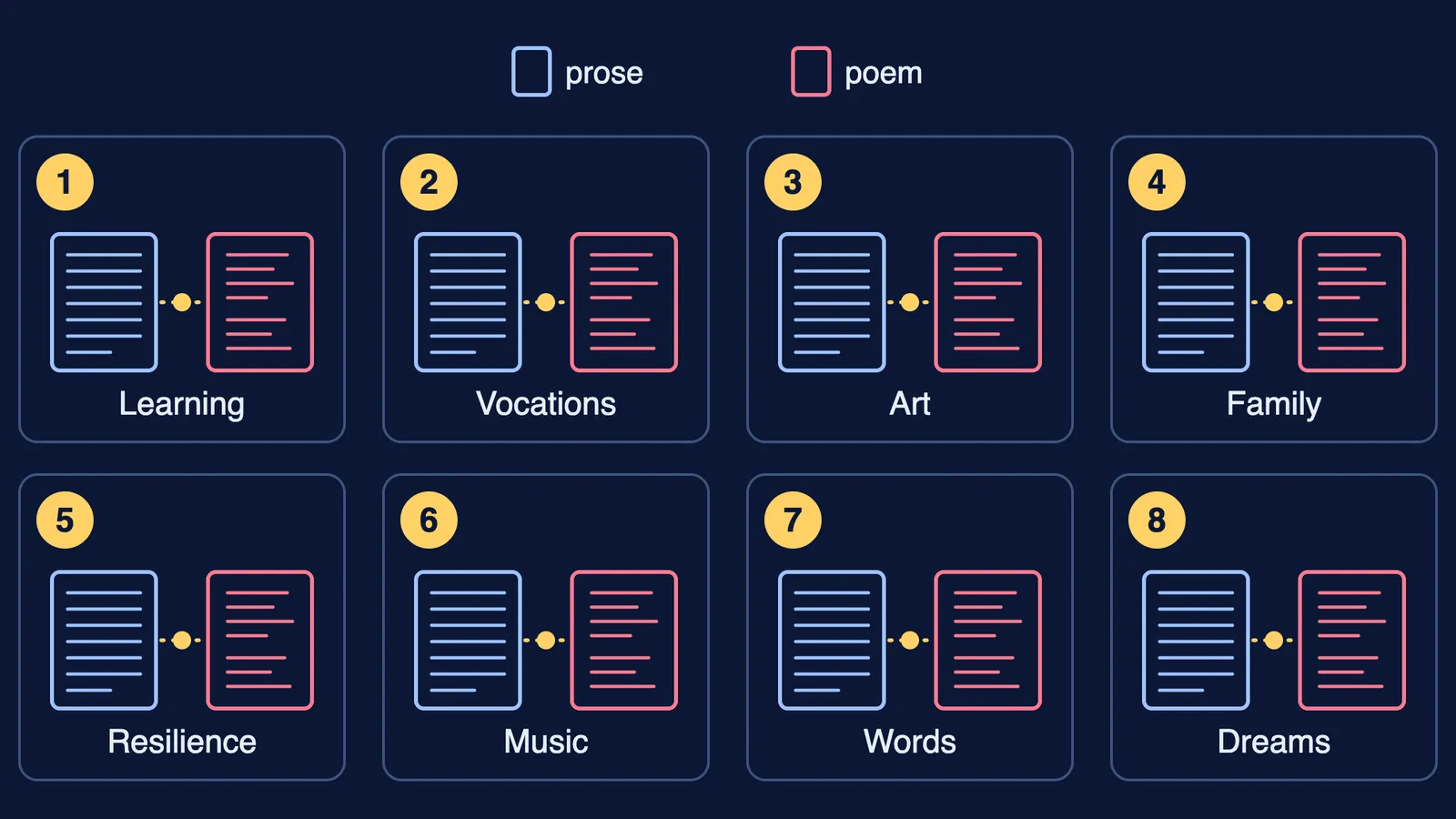
The About the Book section of Kaveri says the book has eight units, and each unit pairs a prose piece with a poem linked by a common theme. Besides stories, the prose includes a documentary article, an expository article, an interview, a letter and a play.
Each unit opens with a warm-up on the theme, then moves through reading, comprehension checks and critical reflection, followed by vocabulary, grammar, speaking, listening, writing and project tasks.
What are the eight units in Kaveri?
Here is each unit as listed on the Kaveri contents page, with the theme in our own words:
How I Taught My Grandmother to Read (story) and Bharat Our Land (poem): learning at any age, and pride in India's knowledge traditions.
The Pot Maker (story) and Gifts of Grace: Honouring Our Vocations (poem): skilled work and the dignity of a craft.
Winds of Change (an expository article on the traditional Indian hand fan, the pankha) and Canvas of Soil (poem): art in everyday objects and gardens.
Vitamin-M (story) and I Cannot Remember My Mother (poem): grandparents, family and memory.
The World of Limitless Possibilities (an interview with Paralympian Deepa Malik) and Nine Gold Medals (poem): resilience and inclusion in sport.
Twin Melodies (play) and A Friend Found in Music (poem): music across generations.
Carrier of Words (a documentary article on a rural postal worker in the desert) and Words (poem): what messages carry.
Follow That Dream (a mother's letter to her teenage daughter) and Believe in Yourself (poem): dreams and self-belief.
Because each pair shares a theme, expect questions that connect the two texts.
How will CBSE mark Class 9 English in 2026-27?
The CBSE Class IX English curriculum for 2026-27 splits R1 English's 100 marks into four parts:
Reading Skills, 20 marks: two unseen passages, one of 400-450 words and a 200-250 word case-based passage with data or a chart.
Writing Skills and Grammar, 30 marks: 10 for grammar (editing, sentence rearrangement, sentence transformation) and 20 for writing, from a short notice up to a 200-250 word essay.
Language through Literature, 30 marks: extract questions from prose or drama and from poetry, five short answers of 40-50 words, and two answers of 120-150 words.
Internal Assessment, 20 marks: pen-and-paper tests, quizzes or presentations, a portfolio and a subject enrichment project, 5 marks each.
One long literature answer tests thinking across texts; the other tests theme, plot or character. Grammar includes tenses, modals, reported speech and clauses; our guide to types of clauses for Class 9 covers the last.
How should you study one Kaveri unit?
Treat each unit as one week and one pair. A six-day plan:
Day 1: Read the prose piece straight through. Write three sentences: who, what happens, what changes.
Day 2: Reread with the in-text questions. Mark two lines you could use as evidence.
Day 3: Read the poem aloud more than once, then silently, as the book suggests; then note its tone and one device.
Day 4: Write one 40-50 word answer on the prose and one on the poem. Count the words.
Day 5: Write one 120-150 word answer that links the pair (example below).
Day 6: Do the grammar and writing task; keep the best piece for your portfolio.
A worked example from Unit 7
Here is a practice question we wrote in the style of the cross-text answer: how do Carrier of Words and Words show that a message matters because of the person behind it?
A strong answer makes four moves:
Claim: both texts value sincerity over the words themselves.
Prose evidence: the postal worker's long desert journeys, and the trust families place in him.
Poem evidence: the speaker's sense that words mean little unless they come from the heart.
Link to life: why a message from someone you trust lands differently.
That shape works for every unit pair.
How can parents help with the new English book?
You do not need to know the poems. Ask your child to retell the week's prose piece in two minutes, then say which idea in the poem matches it. Unseen passages carry 20 marks under the CBSE 2026-27 curriculum, so regular newspaper reading helps; you can also make unseen passage practice with AI and check the key.
Fermi is an AI-powered STEM learning platform, so it does not cover Kaveri. For the rest of the Class 9 timetable, the Fermi Concept Library covers every concept in physics, chemistry, biology, mathematics and computing, each with its own lesson.
Start with Unit 1 this week: one story, one poem, one linking answer.