

On this page
Clauses stop being a definition to memorise in Class 9 and become a skill you are expected to use. The CBSE Class IX English curriculum for 2026-27 says students should "identify and construct clauses, including noun clauses and relative clauses, to create complex and meaningful sentences". The same list asks you to construct sentences using "Conditional Clauses (Type 1)". Below: definitions, a three-question test and a worked example.
What is a clause, and how is it different from a phrase?
A clause is a group of words that has its own subject and verb. A phrase does not have both. "After the bell" is a phrase; "after the bell rang" is a clause, because "the bell" is the subject and "rang" is the verb.
An independent (main) clause "is a group of words that contains a subject and verb and expresses a complete thought", according to the Purdue Online Writing Lab.
A dependent (subordinate) clause "contains a subject and verb but does not express a complete thought", in the same Purdue OWL guide, whose list of common dependent markers includes after, although, as, because, before, if, since, unless, until, when and while.
Shaky on finding the verb and its subject? Revise subject-verb agreement rules with examples and tenses explained simply first.
What are the three types of subordinate clauses?
A subordinate clause does a job a single word could do, and is named after that job.
Noun clause: works as the subject or object. "What she said surprised everyone." Swap in "it": "It surprised everyone." Noun clauses often begin with that, what, whether, if, who or how.
Adjective clause: describes the noun just before it. "The boy who sits near the window topped the test." The CBSE curriculum calls these relative clauses, because they begin with a relative word: who, whom, whose, which, that, where or when.
Adverb clause: tells you when, where, why, how or on what condition. "Because the train was late, we missed the assembly." Adverb clauses can usually move to the other end of the sentence. A Type 1 conditional, "If it rains, the match will be postponed", is an adverb clause of condition joined to a main clause.
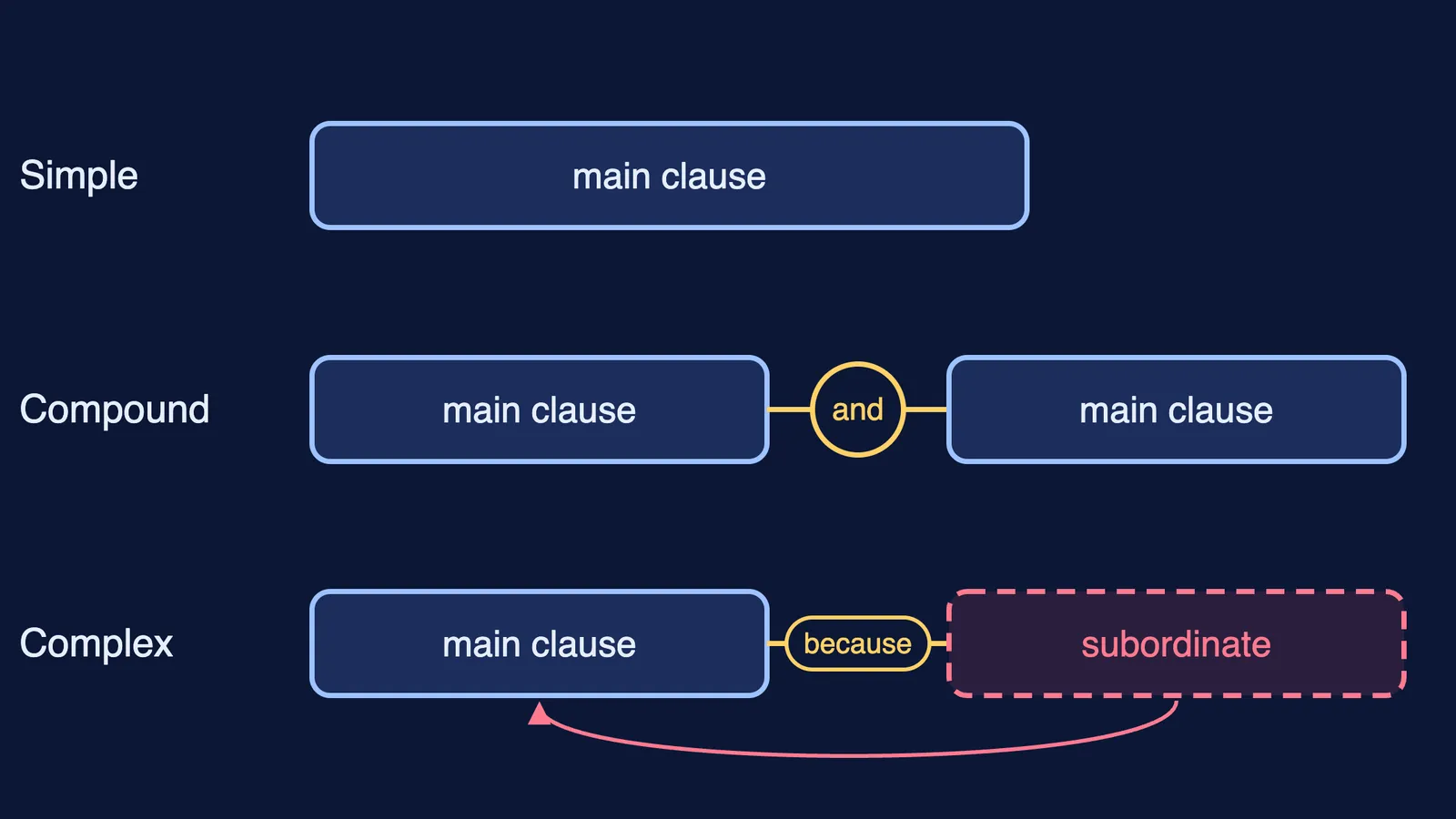
How do you tell simple, compound and complex sentences apart?
Count the clauses, then check whether any of them is subordinate. The definitions below are from Purdue OWL's page on sentence types.
Simple sentence: one independent clause and no dependent clauses. "She was tired."
Compound sentence: multiple independent clauses but no dependent clauses. "She was tired, so she slept early."
Complex sentence: one independent clause and at least one dependent clause. "Because she was tired, she slept early."
Purdue also names a fourth type, the complex-compound sentence, with multiple independent clauses and at least one dependent clause; many school grammar books call it compound-complex.
How do you identify clauses in a sentence? A worked example
Use three questions on any sentence:
Which verbs have their own subject? Each subject-verb pair is one clause.
Can this clause stand alone as a sentence? Yes means main; no means subordinate.
What job does each subordinate clause do? Replaceable by "this" or "it": noun. Describes the noun before it: adjective. Answers when, why or on what condition: adverb.
Try it on: "Ravi said that the experiment failed because the wire that he used was too thin."
Question 1: said (Ravi), failed (the experiment), was (the wire), used (he). Four pairs, so four clauses.
"Ravi said" is the main clause: it is the only one not introduced by a linking word.
"that the experiment failed" is what Ravi said ("Ravi said this"): a noun clause, object of "said".
"because the wire was too thin" answers why it failed: an adverb clause of reason.
"that he used" describes "the wire": an adjective (relative) clause.
One main clause and three subordinate clauses make this a complex sentence.
How should you practise clauses before a test?
Take ten sentences from your English reader or a newspaper. Underline every verb, circle its subject, then label each clause using the three questions.
Rewrite one idea as a simple, a compound and a complex sentence.
Read science for grammar too. "A body at rest stays at rest unless an unbalanced force acts on it" keeps its key condition in an adverb clause. Worked problems in the Fermi Problem Library come with a step-by-step solver that explains the reasoning, so you can see how each condition in the question is used.
Check your own labels when there is no key, using these ways to check answers without an answer key.
Start with five sentences tonight, and label every clause before you check.


