

On this page
Subject-verb agreement comes up again and again in school grammar: in gap-fills, editing tasks and your own written answers. The rule is short. The hard part is spotting the real subject when other words crowd around it.
What is subject-verb agreement?
Subject-verb agreement means the verb matches its subject in number: one subject takes a singular verb, more than one takes a plural verb (Purdue OWL). In the present tense the singular verb usually carries the -s: "Riya walks", "the girls walk".
What are the ten rules of subject-verb agreement?
The examples below come from the Purdue Online Writing Lab and the British Council's LearnEnglish grammar pages, with Indian versions added where it helps.
Two subjects joined by "and" take a plural verb. "She and her friends are at the fair."
Two singular subjects joined by "or" or "nor" take a singular verb. "The book or the pen is in the drawer."
With "or" or "nor" and one plural subject, the verb agrees with the nearer one. "The boy or his friends run every day" but "His friends or the boy runs every day."
Ignore the words between subject and verb. "One of the boxes is open." The subject is "one", not "boxes".
"As well as", "together with", "including" and "accompanied by" do not add to the subject. "The team captain, as well as his players, is anxious."
Each, either, neither, everyone, everybody, someone, nobody and no one take a singular verb. "Each of these hot dogs is juicy." The British Council gives "Neither of the supermarkets was open".
"Both" takes a plural verb. "Both the supermarkets were closed" (British Council).
After "there is" and "there are", the verb agrees with the noun that follows. "There is a question." "There are many questions."
Some nouns look plural but take a singular verb; some always take a plural one. "The news is on at six" and "Mathematics is my favourite subject", but "These scissors are dull". An amount of money counts as one thing, so Purdue writes "Five dollars is a lot of money"; in rupees, "Five hundred rupees is a fair price."
A group noun takes a singular verb when the group acts as one. "The family has a long history." The British Council notes it can take a plural verb when you think of the members as individuals, as in "The audience clapped their hands", and that "the police" is always plural: "The police are offering a reward" (British Council, group nouns). In a school answer, the singular for a group acting together is the safe choice.
Which subject-verb mistakes should you watch for?
Watch for these four traps in editing tasks:
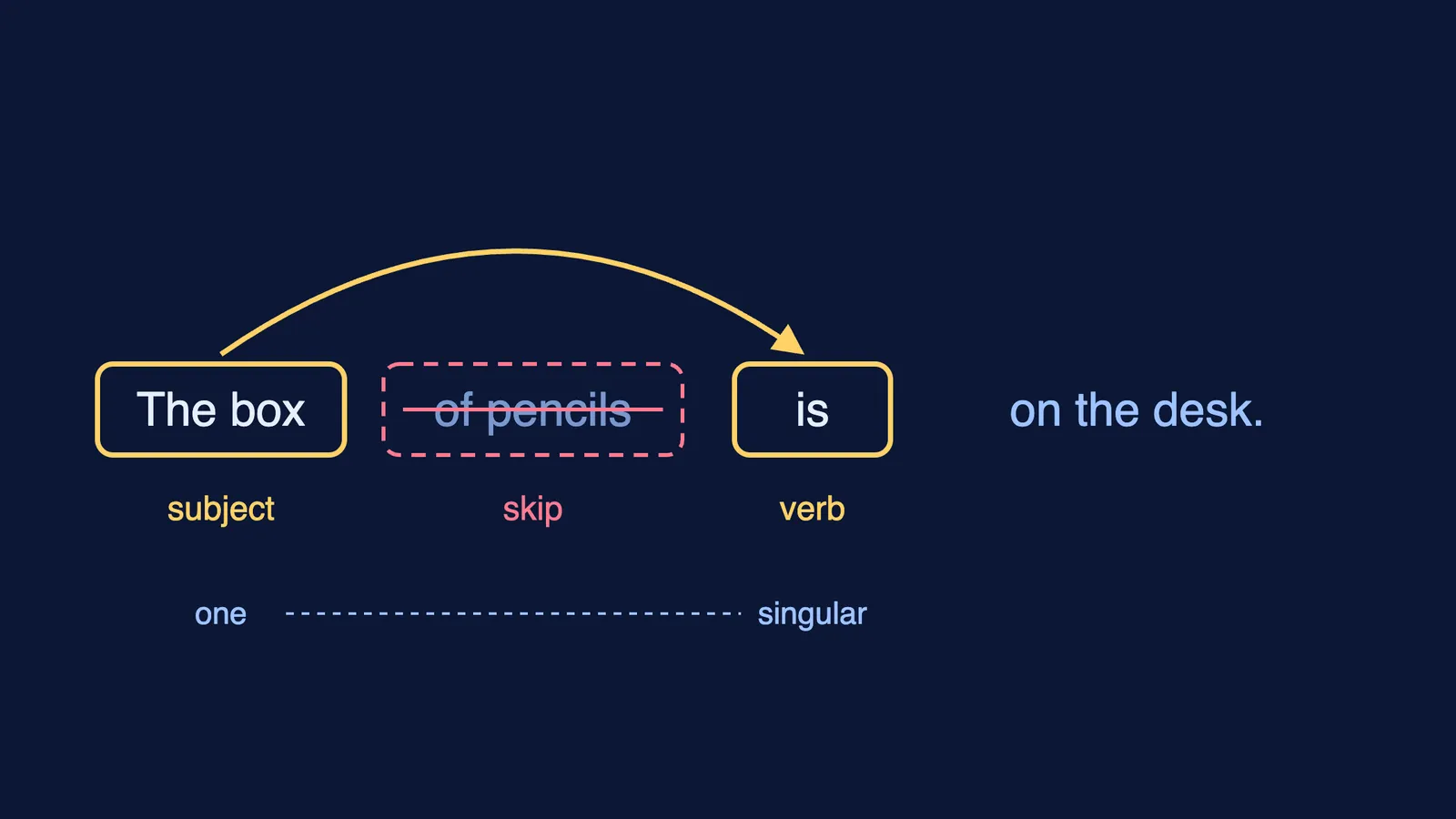
The nearest-noun trap. "The box of pencils are on the desk" is wrong: the subject is "box", so it is "is".
The "one of" trap. "One of my friends live in Pune" should be "lives".
The "as well as" trap. "Rahul, as well as his sisters, are coming" should be "is coming".
The "each" and "neither" trap. "Neither of the answers are correct" should be "is correct".
How do you check a sentence in three steps?
Find the verb. Underline it.
Ask "who or what is doing this?" Strike through any phrase starting with "of", "with", "as well as" or "including".
Say the subject and verb alone. "The box is." "One lives." "Neither is." If the two words sound right together, you have the right verb.
Parents can run this as a five-minute game at dinner: you say a sentence, your child names the subject aloud, then picks the verb. A book you both read gives you real sentences; here is how to read the same book as your teenager and talk about it.
Can you get these ten right?
Cover the answers, choose the verb, then check.
My brother and I (walk / walks) to school.
Either the bus or the auto (is / are) late.
The teacher or the students (has / have) the key.
A bunch of bananas (lies / lie) on the table.
Everyone in the class (was / were) quiet.
There (is / are) three mistakes on this page.
The news (was / were) good.
My spectacles (is / are) broken.
Two hours (is / are) enough for this test.
The principal, together with the teachers, (is / are) in the hall.
Answers: walk, is, have, lies, was, are, was, are, is, is.
Why testing yourself can beat rereading is the subject of our post on a one-week experiment comparing rereading with practice testing. If you are building vocabulary too, try this ten-word weekly routine for learning English words in context.
The same habit, finding what a sentence is really about before answering, helps with maths and science word problems too. For those, the Fermi Problem Library has worked problems with a step-by-step solver that explains the reasoning rather than printing an answer.


