On this page
You learn a new word by seeing it used, using it yourself and trying to remember it later. AI chatbots are quick at the first part: ask for five sentences with *meticulous* and you get them in seconds. But a sentence can sound fluent and still use the word in the wrong sense or with the wrong grammar. So this routine adds a dictionary check before any sentence goes on a flashcard, and then a self-quiz so the word stays.
Why do example sentences help you learn English words?
A definition tells you what a word means. A sentence shows how it behaves: which words go with it, whether it sounds formal, and whether it takes *to*, *of* or *with*. In a study of 121 Japanese students learning English, Stuart Webb tested word knowledge after 1, 3, 7 and 10 encounters in context. Each time the number of encounters went up, students gained in at least one part of knowing the word (Webb, Applied Linguistics, 2007). The same abstract says that knowing a word fully may take more than ten encounters.
AI is useful because it gives you many encounters fast. It only helps if those encounters are correct.
How do you check an AI sentence against a dictionary?
Open a free learner's dictionary such as Cambridge Dictionary and compare each AI sentence on three points:
Meaning: does the sentence use the sense the dictionary gives, not a sense that only sounds right?
Pattern: is it the same part of speech, with the same prepositions and structure as the dictionary's examples?
Tone: if the dictionary marks the word as formal, informal or old-fashioned, does the sentence fit that?
If a sentence fails any check, cross it out. Don't fix it in your head.
What does a dictionary check look like in practice?
Cambridge Dictionary defines *enervating* as "making you feel weak and without energy", with the example "I find this heat very enervating" (Cambridge Dictionary). The word sounds like *energising*, so it is easy to write, or be given, a sentence like "The enervating music got everyone dancing." The grammar is fine; the meaning is backwards. A sentence that passes the check: "After an enervating bus ride in the May heat, we only wanted to sleep." On your card, keep the correct sentence and add a one-line note: *drains energy, does not give it*.
How do you remember new words after a week?
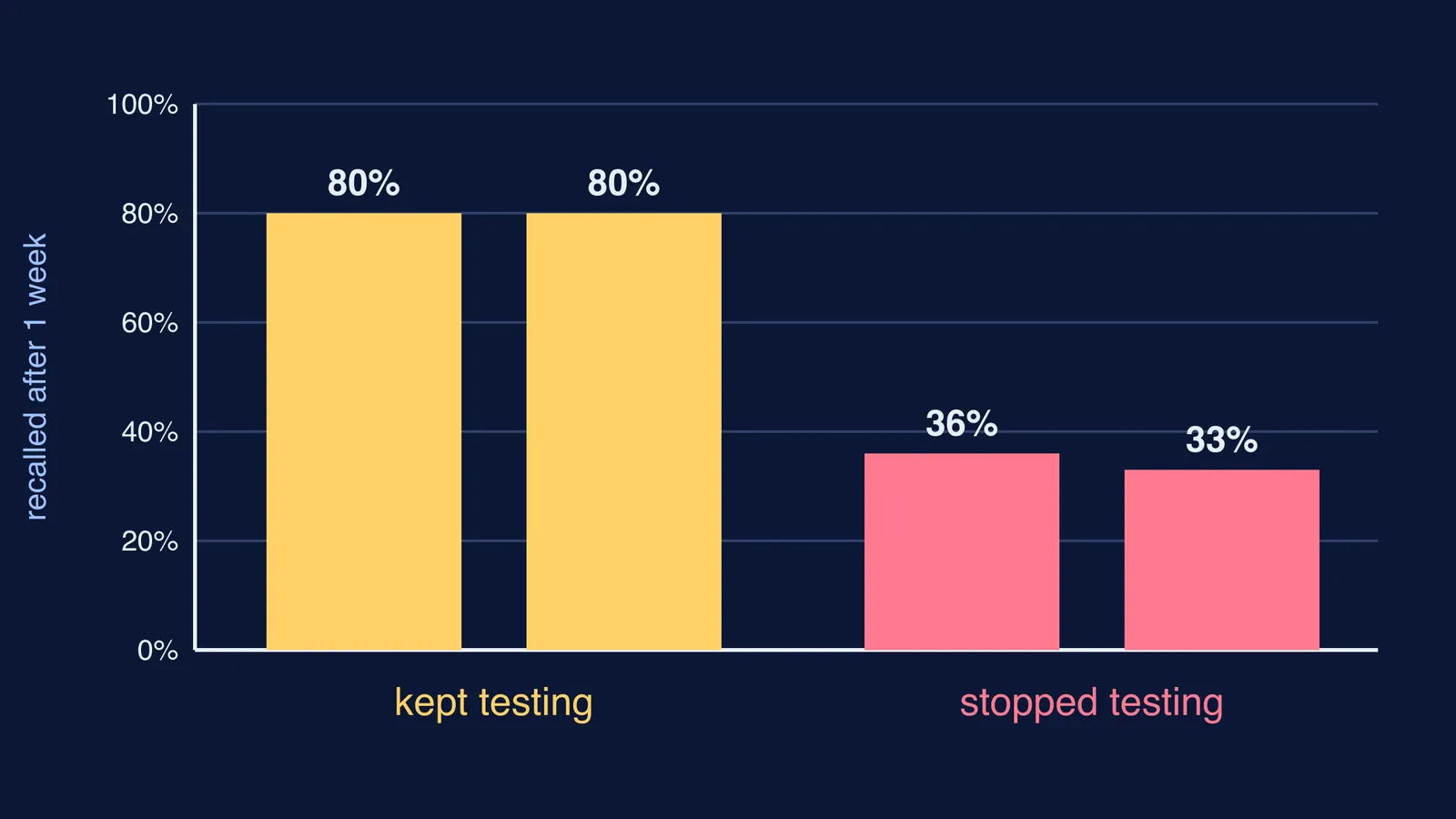
Test yourself. Don't just reread. In Jeffrey Karpicke and Henry Roediger's experiment, college students learned 40 Swahili–English word pairs. Once a student recalled a pair, two groups kept being tested on it, and in two other groups it was dropped from further tests (Science, 2008). A week later, the groups that kept testing recalled about 80% of the pairs. The groups that stopped testing recalled 36% and 33%. On average, every group predicted it would recall about half, so feeling confident is a poor guide.
Spacing matters too. A review by Nicholas Cepeda and colleagues analysed 839 assessments of spaced practice from 317 experiments (Psychological Bulletin, 2006). In that review, the best gap between study sessions got longer the longer you wanted to remember. That is why the plan below brings words back after days and weeks, not just the next morning. See also what Harry Bahrick learned about memory over 50 years.
What does a ten-word week look like?
Monday, 15 minutes: pick ten words from things you are actually reading, such as an English chapter, a newspaper or a science textbook. Ask AI for sentences, check each one in the dictionary, then keep one correct AI sentence and write one of your own.
Tuesday: make cards. On the front, write your own sentence with the word blanked out. On the back, write the word and the dictionary definition.
Thursday: quiz yourself again and sort the cards into "got it" and "missed".
Saturday: write five or six lines using at least five of the words. Ask AI to flag any word that doesn't fit, then check each flag in the dictionary.
Next Monday: quiz last week's missed cards before adding ten new words.
Two weeks and one month later: run through the whole set once.
To sort cards by how well you know them, try a Leitner box for your flashcards. For choosing words that matter in board papers, see how to improve vocabulary for English exams.
Some of your ten words will be science terms like *osmosis*, *torque* or *isotope*. A dictionary gives you the everyday meaning, but the idea behind the word needs a lesson. The Fermi Concept Library covers every concept in physics, chemistry, biology, mathematics and computing, each with its own lesson. Fermi's AI tutor checks your understanding as it teaches.
Start this Monday with ten words from whatever you are reading now.